 Flooring Correct

Are large format tiles harder to install?
Yes, and the reason is mechanical. A large tile has no give, so it bridges dips and humps in the subfloor instead of settling into them the way several smaller tiles would. That shows up as an edge sitting proud of its neighbor, or a hollow spot that cracks later under a chair leg. A flatter subfloor is the fix, and it gets checked at the free in-home measure.
Why size takes away a tile's forgiveness
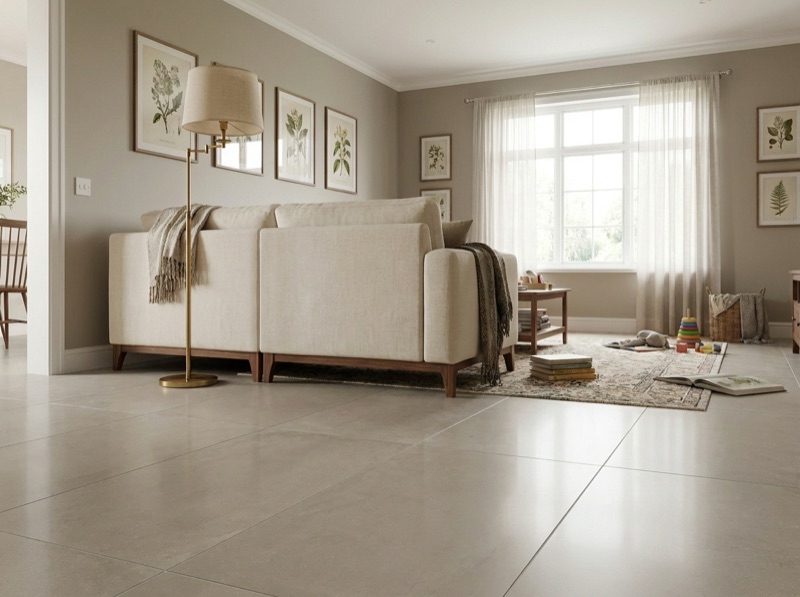
Set several small tiles across an uneven subfloor and each one only has a few inches to span. A slight dip under one tile barely registers, because the tile beside it is bedded at its own level and the grout joint between them absorbs the difference. A large-format tile does not get that grace. Anything with a side of fifteen inches or longer spans much farther per piece, so it behaves less like a stack of blocks settling into an uneven surface and more like a plank of glass laid across two sawhorses. Whatever the subfloor is doing under the middle of that tile, the tile itself has almost no give to absorb it.
Our tile page already sets the exact flatness tolerance and offset limit that large format calls for. This page is about why that tolerance exists in the first place, what it costs you if it gets skipped, and how to catch a problem before the tile ever leaves the truck.
What that means once you have picked a large-format tile
A few things follow directly from the lack of give. Full mortar coverage under the tile stops being optional, since a wider trowel notch and back-buttering the tile itself close the gaps that would otherwise sit hollow under a large slab. The pattern the tile gets set in is constrained as well, and the tile page states the offset limit a long plank is held to. The thread running through all of it is that each rule is protecting the underside of the tile, the one part of the floor nobody ever sees again once the grout goes in. None of this makes large format a bad choice. Porcelain planks and big field tile read as one calm surface with fewer grout lines to clean, which is exactly why they have become the default in a lot of kitchens and baths. It just means the floor gets a harder look before anything is ordered, not after.
The failure mode: an edge that sits proud, or a hollow spot nobody can see
Lippage is the visible version of this failure, an edge that sits slightly higher than its neighbor and catches a sock or a mop every time you cross it. It has its own explanation on its own page, since how it is measured and corrected during installation is a separate topic from why large tile is more prone to it.
The failure that worries us more is the one you cannot see. A large tile spread with an undersized trowel, or set over a low spot the mortar did not fully fill, ends up resting on a partial bed instead of a full one. It looks perfect the day it goes down. Months or years later, a dropped pan, a dining chair rocked back on two legs, or just the wrong footstep lands on the unsupported section and the tile cracks from underneath, with no warning and often no obvious cause. Cracking in general has a longer answer of its own, and a hollow spot under a large tile is one of the more common ways it starts.
Check your own floor before you order
You do not need a laser level to get a useful read on your own subfloor. Lay a long, straight board or a level across the room in a few directions, including corner to corner, in whichever room the large-format tile is going. Press down gently at each end and in the middle. A board that rocks, or a visible gap you can slide a fingertip under, is telling you something worth mentioning before anything is ordered, not something to fix yourself.
What matters most is the age and type of subfloor already there. An older slab that has settled, or a plywood subfloor that has seen some seasons of humidity, is a different starting point than new construction, and so is a room where an existing tile floor is already down. Tell us what the room is now, whether it sits over a slab or plywood, and roughly how old the house is, and the free in-home measure checks the subfloor for flatness on the actual floor rather than from a hand test at home. Call 636-332-0654 with the room in mind and we will start there.
More on large-format tile before you order
Trowel technique, subfloor correction, and whether size alone makes a tile more fragile.
636-332-0654Yes. A wider notch trowel spreads more mortar per pass, and back-buttering, applying a skim coat of mortar to the back of the tile itself before it is set, is common practice with large format. Both exist for the same reason: a big tile has more square inches to keep fully supported, and a gap anywhere under it becomes a weak point later.
Usually, yes. Depending on how far out of level the floor actually is, that can mean grinding down high spots, filling low ones, or a self-leveling underlayment poured across the whole room before any tile work starts. Which one applies to your floor gets decided once the subfloor has been checked at the measure, not guessed from how the floor feels underfoot.
Not because of its size alone. Once a large tile is fully bedded in mortar over a subfloor that is flat and sound, it holds up the same as any other porcelain or ceramic of the same quality. The added risk comes from an unsupported area underneath it, which is a preparation issue rather than something built into a bigger format.
Get your subfloor checked before you order large tile
Tell us the room, whether it sits over a slab or plywood, and roughly how old the house is. The free in-home measure checks the subfloor for flatness on the actual floor before any large-format tile is ordered.
Free estimate
636-332-0654