 Flooring Correct
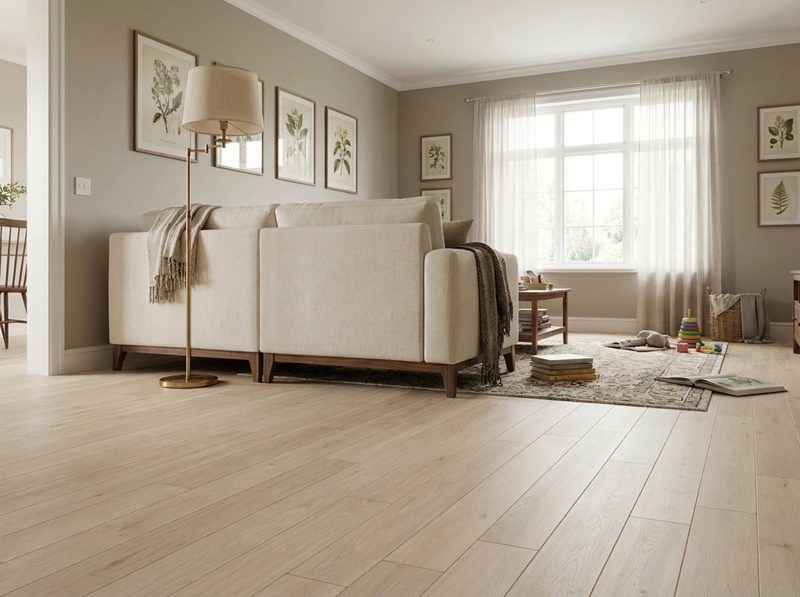
Carpet in squares,
replaceable one
piece at a time.
Modular carpet for basements, offices and classrooms. No wide seams stretched across a room, and one damaged tile comes out without disturbing the rest.
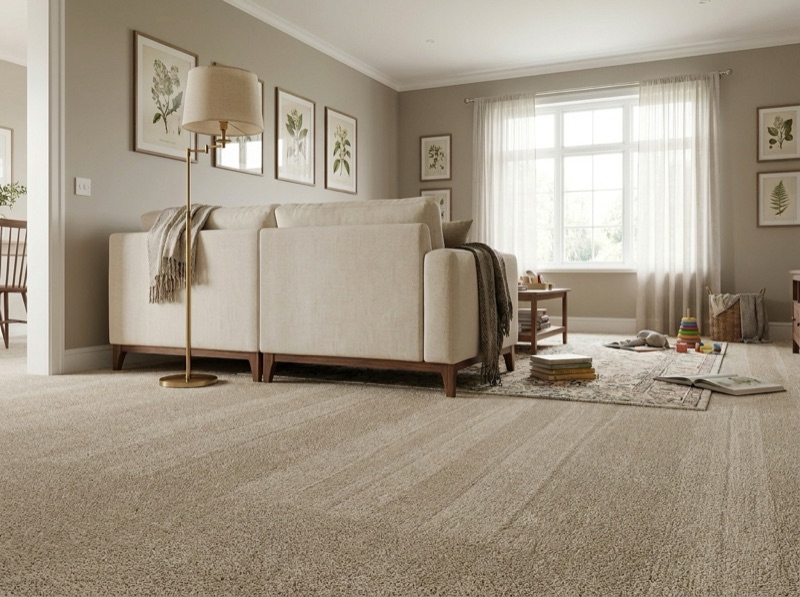
Carpet tile is carpet made in modular squares and planks rather than one wide roll, so a stained or damaged tile can be swapped out without disturbing the rest of the room. Flooring Correct carries it at the Wentzville, MO showroom on Veterans Memorial Pkwy, with free estimates and in-home measure. Call 636-332-0654.
Carpet tile versus broadloom carpet.
Broadloom is the carpet most people picture. It comes off a roll twelve or fifteen feet wide, gets seamed where a room is wider than the roll, then stretched over a separate cushion and hooked to tack strip at the walls. Carpet tile arrives in cartons of squares or planks with the backing already attached. Common formats are a 24 inch square and a 9 by 36 inch plank, though sizes vary by line, and every piece lies flat on the subfloor on its own.
That single difference drives almost everything else people notice about it.
- One piece can be replaced. A tile that gets bleached, burned or permanently stained comes up on its own, which is why buyers usually keep spare cartons from the same run. Broadloom does not come apart that way.
- No stretch, no tack strip, no separate pad. The tiles lie flat, so the room does not have to be shaped around a stretch and there is nothing to re-stretch later.
- The grid is part of the design. Broadloom hides its seams. Carpet tile shows a repeating joint, and the better lines are drawn around that instead of fighting it.
- It fits through doors and down stairs. A carton of tile is a one person carry. A fifteen foot roll of broadloom has to make the turn in a basement stairwell in one piece.
- Odd rooms waste less. Columns, closets, jogs in a wall and built-in cabinets get cut around one tile at a time instead of out of a wide roll.
Where it goes in a house.
Basements are the most common answer, and not only because the stairs are narrow. A finished basement sits on or near a slab, so it is the floor in the house most likely to meet water at some point, and a floor that can be replaced a square at a time is easier to live with than one that cannot. Home offices take it for the rolling chair. Playrooms and craft rooms take it because the odds of one permanent spot are high and the cost of that spot is one tile.
It is still the default in a lot of commercial buildings for the same reasons. Offices, showrooms and schools need a floor that stays quiet under traffic, survives a cleaning routine that will never be gentle, and can be put right in one spot without shutting a room. That side of the work has its own page. If what you actually want is wall to wall softness in bedrooms and on stairs, broadloom is the better tool, and that has a page too.
How it is laid changes how it looks.
Most carpet tile can be set more than one way, and the direction decides the whole floor. Run every piece the same way and it reads closest to broadloom. Quarter turn it, rotating each tile ninety degrees from its neighbor, and the grid becomes the pattern while traffic lanes hide better. Planks can run in straight rows, a brick offset or a herringbone. Settle that in the showroom with samples in front of you, because the same carton produces very different floors.
The names in the carpet tile catalog.
Carpet tile lines carry names rather than numbers, and the catalog runs to a hundred of them. Abstract, Authentic Format Tile, Cabled Plank, Colorburst Plank, Daily Wire, Echo Plank, Gentle Waters, Homepage, Linea, Onward Bound Tile, Restful Trek, Rule Breaker Tile, Streaming and Transforming Spaces Tile give you the flavor of it. If you arrive with a name off a spec sheet, bring it and we will chase it down. If you arrive with nothing but a room and a photo, that is normal, and it is what the showroom is for.
Brands, and what to ask for.
The carpet lines we carry are Mohawk, Pet Premier, Godfrey Hirst, SmartStrand, DreamWeaver and Anything Goes. On the commercial side we also carry Pentz, Engineered Floors, MSI, National Flooring Products, Nextfloor, Tarkett, Armstrong and Bruce. Ask which of them has modular tile in the color, the format and the traffic rating you need, and we will pull what is on the racks.
Measure first, then install.
Carpet tile wants a subfloor that is clean, flat and dry, which is one more reason the measure happens in your house rather than over the phone. Estimates are free. From there the job runs the same eight steps as every floor we install: consultation, product selection, a detailed quote, scheduling, preparation, expert installation, a post-installation inspection and clean-up. Our own crews do the work, all with 15 or more years in the trade and most with 25 or more.
The showroom is at 15570 Veterans Memorial Pkwy in Wentzville, open Monday through Thursday 9:00 to 5:30, Friday 10:00 to 4:00 and Saturday 9:00 to 2:00. We measure and install across St. Charles, Warren, St. Louis and Lincoln counties. Financing runs through Wisetack. Call 636-332-0654.
“We loved the service we received from Audra and Jonah during the process of choosing, ordering and installing our flooring and carpet. They kept us updated on the process every step of the way. ...”
Modular carpet, answered.
Ask the showroom anything. Someone who sells and measures floors every week answers the phone.
636-332-0654Carpet tile is carpet manufactured in modular squares or planks with the backing already attached, rather than in one wide roll. Each piece lies flat on the subfloor, so the floor is made of many small pieces instead of one stretched sheet, and any single piece can be taken up and replaced.
Neither format is automatically cheaper. Both run from entry level to high end, and the material price tracks fiber, density and construction more than the shape it comes in. Broadloom adds the cost of cushion, and carpet tile usually wastes less in a room full of corners. A free estimate on your actual rooms is the only honest number.
That is the main reason people choose it. A damaged or stained tile can be lifted and a matching one set in its place. Buy spare cartons at the same time as the floor, because dye lots change from run to run and an exact match years later is not something anyone can promise.
Usually not. Most carpet tile carries its own backing, which is part of why it lies flat without a stretch. Cushion backed tiles do exist. The manufacturer instruction for the specific line decides what goes under it, and that gets settled before the order is placed.
It is a common basement floor. Cartons come down a narrow stairwell easily, the room does not have to be stretched against walls that may not be square, and one damaged square can be replaced. Carpet tile is not waterproof, so tell us at the measure if the basement has taken on water before and we will talk through the alternatives.
It goes onto a prepared subfloor by the method the manufacturer specifies for that line, most often a pressure sensitive adhesive or tabs that hold the tiles to each other and the floor. The subfloor has to be clean, flat and dry first. Our own crews handle the installation, all with 15 or more years of experience and most with 25 or more.
Yes. Estimates are free, and the measure happens in the actual space so the layout direction, the transitions and the edges get decided there rather than on install day. Flooring Correct offers in-showroom selection help, free estimates, in-home measure and professional installation. Call 636-332-0654.
The carpet tile vocabulary, defined
Every term on the back of a sample, defined plainly. These are the ones that come up most on a carpet tile job. The full library is in the materials encyclopedia.
Carpet tile in your town
Every town below has its own carpet tile page, written around the housing stock that is actually there rather than the same page with the name swapped. The full map is on the service area page.
Start with a free estimate.
Tell us the rooms, the square footage if you have it, and roughly when you want it done. You get a real number and a measure in the space.
Selection help at the showroom, then a measure where the floor is actually going.
636-332-0654