 Flooring Correct
Cut pile carpet
What is cut pile carpet?
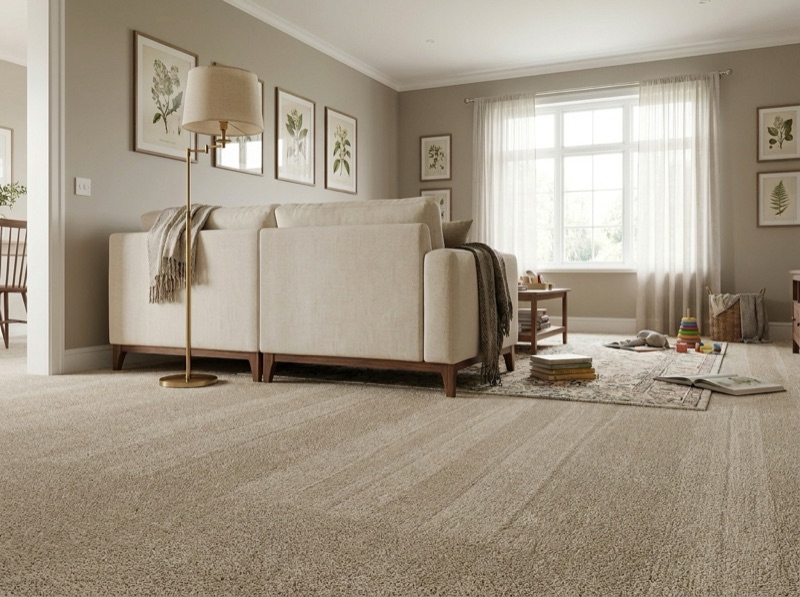
Cut pile is a carpet construction where the tufted loops are sheared open into two upright yarn tips, rather than left as a closed loop. It is a broad category, not one look: plush, Saxony, textured and frieze are all cut pile, and how sharply footprints and vacuum tracks show depends on how tightly the yarn is twisted, not on being cut pile itself.
The word cut pile carries a reputation it did not fully earn. Ask most people what cut pile means and they will describe a formal, deep plush that shows every footprint and every vacuum stripe the moment it is walked on. That description is accurate for exactly one style inside the cut pile family, and it gets attached to the whole category by mistake, which steers plenty of buyers away from a construction that would actually suit them fine.
Why the belief exists
Cut pile earned its footprint reputation honestly, just narrowly. A plush or Saxony cut pile is built with straight, minimally twisted yarn standing upright in a uniform direction. Straight, upright fibers all catch light the same way until something bends them, a foot, a vacuum, a piece of furniture, and then that spot reflects light differently than the untouched pile around it. That is a real, visible effect, and it is the image most people are picturing when they hear cut pile.
What that image leaves out is that plush and Saxony are only the most footprint-prone end of a much wider category. The same cutting process, sheared loops standing open rather than staying closed, also produces constructions built specifically to hide that exact effect.
Correcting it plainly
Cut pile is defined by one thing only: the loop gets sheared open into two tips instead of staying closed. Everything else, how tightly that yarn is twisted before it is cut, how uniform the twist is, and whether it is heat set to hold that twist, is a separate variable layered on top. A tight, well set twist scatters light in more directions, and scattered light does not show a footprint the way uniform, upright fiber does. The name of the category tells you the tip is open. It tells you nothing about whether that open tip is going to show a footprint.
The accurate version, and what follows from it
Inside cut pile, twist is what actually predicts footprint visibility, not the fact of being cut. A low-twist plush or Saxony shows the most, because the yarn stands straightest. A textured cut pile, twisted moderately and set that way, hides tracks noticeably better while keeping a soft, informal feel. A frieze, twisted hardest of all, hides them best of any cut pile, at the cost of the smooth, formal look plush is chosen for in the first place. Our frieze carpet page covers that end of the spectrum, and our Saxony and plush page covers the formal end this misconception is really describing.
Textured cut pile sits in the middle of that range, which is exactly why it is the construction most households end up choosing. It is forgiving enough for a family room and a hallway that sees regular traffic, while still reading softer and more casual than a loop construction. It is not the flashiest option on the sample wall and it is rarely the one anyone specifically asks for by name, which is a large part of why it quietly outsells everything else.
What twist means for wear, not just looks
The same twist that hides footprints also protects the pile itself. A tightly twisted, heat-set tip resists opening up and fraying under repeated traffic, which is what keeps a walkway from looking tired well before the rest of the room does. A loosely twisted plush is more vulnerable to that untwisting over time, on top of already showing every footprint from day one. Bending a sample backward and checking how much backing shows through the yarn is the same density check that applies to any pile, and it is worth doing on a cut pile sample specifically because density and twist together decide how the walkway ages.
Matching the twist to the room
A formal living or dining room that sees company more than daily traffic can afford a softer, lower-twist cut pile, because the tradeoff that matters there is comfort and appearance rather than survival under constant footsteps. A family room, a hallway or a stairway wants the opposite priority. This is exactly the kind of matching that happens at the free in-home measure, where we look at which rooms in your house actually take the traffic and pull twist levels built for each one rather than putting the same carpet in every room because it looked good on one sample.
What else people ask about cut pile
How textured differs from frieze, whether it always shows vacuum lines, and how it compares to loop pile on softness.
636-332-0654No. Both are twisted, but frieze is twisted and heat set harder, producing a curled, kinked tip. Textured cut pile uses a moderate twist that softens the surface without going as far as frieze's rougher, most casual look.
Only the low-twist end of the category, mainly plush and Saxony. A moderately or heavily twisted cut pile scatters light in more directions and shows far fewer vacuum lines, sometimes none that are noticeable in daily light.
Generally yes, especially at the plush and Saxony end, because the open tips flex underfoot rather than staying rigid in a closed loop. Textured and frieze cut piles are less soft than plush but still typically softer than a level loop.
Tell us the room and we will match the twist
A formal dining room and a family hallway do not want the same twist level. Tell us which rooms are in scope and we will pull cut piles built for each one.
Free estimate
636-332-0654