 Flooring Correct
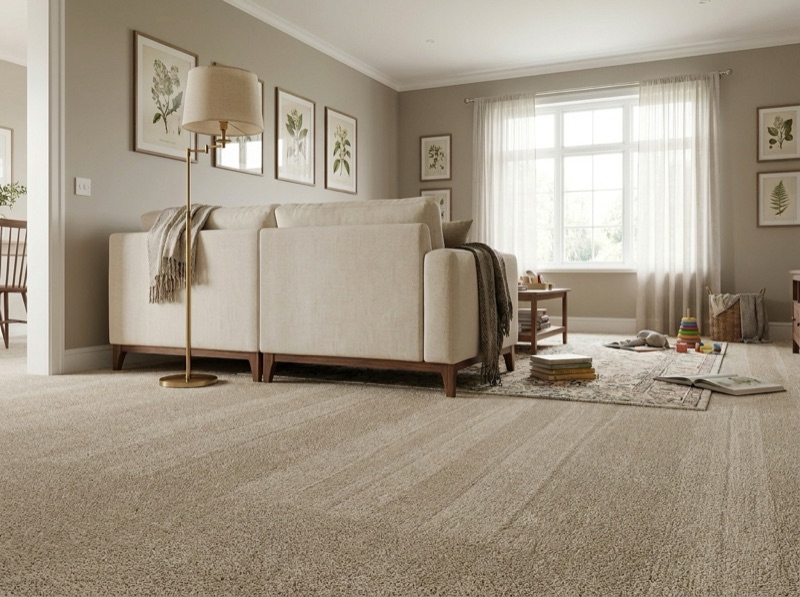
Loop pile carpet
What is loop pile carpet?
Loop pile carpet is tufted so the yarn stays looped rather than being sheared open into upright tips. The closed loop supports itself against the backing, which is what gives loop constructions their reputation for wearing well and hiding traffic patterns. Level loop and multi-level loop, including Berber, are both built this way, at different loop heights and densities.
Loop pile is the construction people reach for when they have already decided durability matters more than softness, and understanding what that decision actually buys, and costs, is worth doing before the sample comes home. The gain is real. So is the give-up. Neither side of that trade is the whole story, and the room decides which side wins.
What you gain
A loop stays closed and supports itself against the backing, unlike a cut pile's open tip, which has to spring back into shape on its own after every footstep. That structural support is why loop constructions have a reputation for holding their shape under heavy, repeated traffic that would flatten a plush cut pile faster. The same closed structure hides traffic lanes better than most cut piles, because there is no open tip to bend and catch light differently along a walked path.
Loop constructions also tend to sit lower and denser than plush or Saxony cut piles, which makes them a common match for rooms where a lot of foot traffic moves through daily. Level loop and multi-level loop, including Berber constructions, both fall inside this family, built at different heights and densities for different jobs.
What you give up
The trade for that durability is comfort. A closed loop does not flex and cushion underfoot the way an open cut pile tip does, so loop constructions read as firmer and less plush, which matters in a room where bare feet spend real time on the floor. It is a genuinely different feel, not a lesser one, but it is worth standing on both before assuming loop is simply the tougher version of the same thing.
There is a second give-up that is easy to miss until it happens: a loop shares backing tension with its neighbors, so a snag can run rather than staying one pulled tuft. Our Berber carpet page walks that mechanism and the two checks that read it on a sample, since Berber is the loop construction most people actually shop for by name.
Where loop wins
Family rooms, home offices with rolling chairs, and any room with heavy, steady foot traffic and no strong need for plush softness are where a loop construction earns its reputation. What goes underneath is part of the same decision rather than an afterthought, and the cushion answer already names a firm, low-give cushion as the usual specification under loop and Berber constructions.
Where cut pile wins instead
Bedrooms, formal living and dining rooms, and any room where bare-foot comfort matters more than resisting heavy point traffic generally do better with a cut pile. A household with an active cat or dog has a real reason to lean cut pile in the rooms that animal actually spends time in. Our cut pile carpet page covers that side of the trade, and the carpet page holds the lines we keep on the floor in both constructions.
Level loop, multi-level loop and what changes between them
Inside the loop family there are two shapes worth telling apart. A level loop is tufted so that every loop finishes at the same height, giving a flat, even surface with nothing standing proud of anything else. That uniformity is the reason level loop is the usual specification wherever chairs, carts and constant foot traffic cross a floor. There is no taller tuft for a caster to fold over and nothing to crush unevenly, so the surface stays what it was.
A multi-level loop runs two or more loop heights in the same carpet, so texture, and often a visible design, comes out of the height difference alone rather than out of a second color. It reads warmer and less institutional than a level loop, and the broken surface hides everyday soil a little better. The tradeoff is that the height difference is the first thing a walked lane erodes, so the texture reads flatter along a path than it does at the edges of the room. Neither shape is a grade. They are two different jobs, and loop height and density tell you far more about either one than the name on the tag does.
The mistake this page is trying to prevent
The common mistake is choosing a pile type off one factor, usually either how it feels underfoot in the showroom or a general sense that loop is the tougher choice, without weighing it against the specific room and the specific household. A loop construction in a formal bedroom trades away comfort the room did not need to give up. A plush cut pile at the bottom of a staircase with a large dog trades away durability the stair cannot afford to lose. Matching the pile to the room, not to a general reputation either construction carries, is the whole decision, and it is worth making room by room rather than once for the whole house.
What else people ask about loop pile
Whether loop always beats cut on durability, what a pulled loop actually means, and how it compares on allergies.
636-332-0654Not automatically. Density and twist matter as much as the loop-versus-cut distinction itself. A dense, tightly built loop generally outlasts a loosely tufted cut pile, and a tightly twisted, heat-set cut pile can outlast a loosely built loop in the same spot.
A small snag is usually manageable, especially if it is caught early and snipped rather than pulled further. A larger run affecting several rows is a different repair question, worth bringing to the showroom to look at directly.
Loop and cut pile do not differ meaningfully on that front. Density and how easily a construction releases trapped dust during vacuuming matter more than whether the pile is looped or cut, and either type can work for a household managing allergies if it is vacuumed and deep cleaned on schedule.
Match the pile to the room, not the reputation
Tell us which rooms take the traffic and which ones want comfort, and whether pets are part of the household. We will pull the constructions built for each.
Free estimate
636-332-0654