 Flooring Correct
Berber carpet
What is Berber carpet?
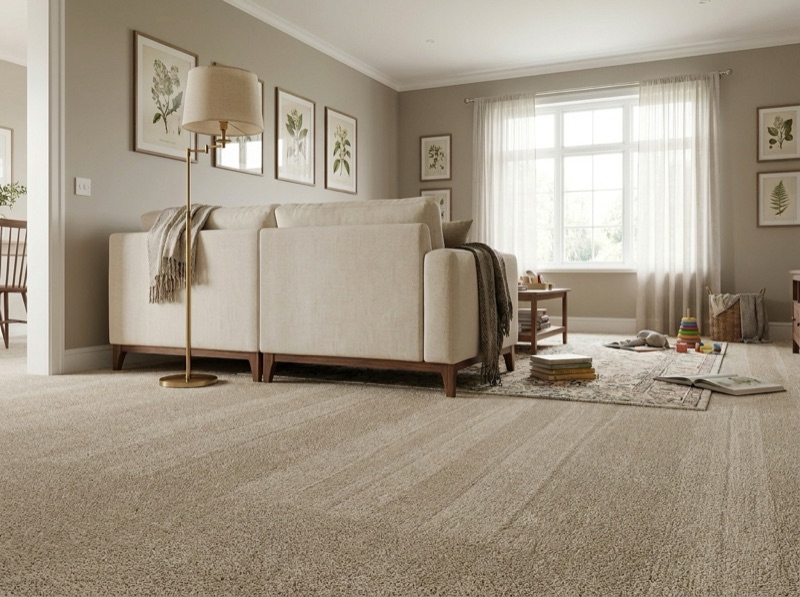
Berber describes a low, dense loop-pile construction, not a fiber and not one exact pile height. The yarn is tufted through the backing and left looped rather than sheared open, often flecked with a second color. That uncut loop, not the flecking or the color, is what makes a carpet Berber rather than a marketing label alone.
Berber gets used loosely enough in showrooms and online listings that most people arrive already unsure whether it means a color, a fiber, or a level of quality. It is none of those. Berber is a construction, a specific way the yarn is put into the backing, and once you see what that construction actually does, the rest of the reputation, good and bad, follows directly from it.
The loop is the whole definition
Every tufted carpet starts the same way: yarn is pulled through a backing material in tight rows, and a needle leaves a loop behind on the face side. What happens next decides everything. In a cut pile, a blade opens every one of those loops into two upright tips. In a Berber, the loop is left alone. The yarn stays looped, low, and dense, and that closed loop is the entire technical definition. Color flecking is a style convention borrowed from the undyed, naturally speckled wool the term originally described, and it rides along on plenty of Berber constructions without being required by the name.
This is also why two carpets can both be sold as Berber and feel noticeably different underfoot. Loop height, loop density, and fiber choice all vary inside the category. What every Berber shares is the closed loop, and that single structural fact is what you are actually buying when you buy the name.
What the closed loop means for the buyer
A closed loop has no free tip to lay over, so it does not develop the shading and traffic-lane look a cut pile gets when its fibers bend and catch light differently under a footpath. That is the whole reason Berber has a reputation for hiding wear: there is structurally less for the eye to catch. The same tight, low structure also resists crushing under furniture legs, because the loop supports itself against the backing rather than depending on an open tip springing back into shape.
The tradeoff comes from the same source. A low, tight loop does not read as plush, and it is not the surface to reach for if bare-foot softness is the goal. Our carpet overview covers pile choices side by side, including where loop and cut pile trade places on comfort.
Where the loop actually fails
A closed loop is also the entire failure mode, and it is worth understanding rather than just hearing as a warning. Because the loops are linked to their neighbors through shared backing tension, a single loop that gets caught and pulled does not always stay a single loop. A cat's claw, a dog's nail catching a sweep past the paw, or a vacuum's rotating beater bar snagging an edge can draw one loop up, and if it pulls free of the backing before the yarn breaks, the row it belongs to can run the way a knit sweater runs from one snag.
A cut pile does not share that specific risk in the same way. Pull one tuft loose and the tufts around it are unaffected, because there is no shared loop connecting them. That difference is the real reason households with active claws are steered toward cut pile carpet for rooms where the animals actually spend their time, while a tighter, lower Berber construction still holds up well in rooms with lighter contact.
Checking it yourself on a sample
- Start with density, which the carpet page shows you how to read on any pile. On a Berber it is doing double duty: a tightly packed loop resists crushing, and it also leaves a claw far less slack to get under in the first place.
- Tug gently on a loop at the sample's cut edge, away from where you will actually walk. A well set loop resists and holds its neighbors; a loose one gives more than it should.
- Run a fingernail across the surface the way a claw would move. If it catches and lifts a loop easily on the sample, expect the same behavior on the floor.
- Compare loop height across the sample. A shorter, tighter loop generally resists snagging better than a taller one, even within the Berber category.
Where a loop construction like Berber makes sense
Loop constructions, Berber included, show up often in basements and other below-grade rooms, usually paired with a fiber built to shrug off moisture rather than for its resilience. Our basement flooring guide covers why a slab changes the recommendation before the pile does. The loop's low profile and traffic-hiding structure also suit family rooms and home offices that see steady, moderate use without the concentrated point-load a claw or a rolling chair caster puts on a single spot.
None of that replaces a look at the actual household. A quiet, adult home and a home with two dogs and a cat are not shopping for the same loop, even if both are shopping under the Berber name. Tell us which one describes your house and we will pull constructions built for it rather than starting from the label alone.
What else people ask about Berber
Whether it always means wool, how it compares to loop pile generally, and what a snag actually means.
636-332-0654Berber is a specific style within the loop pile family, usually a low, dense, level loop, often flecked with a second color. Loop pile is the broader technical category that also includes multi-level loop constructions that never carry the Berber name.
No. The name started with undyed, naturally speckled wool, but it now applies to loop constructions across the fibers we carry, including nylon, triexta and olefin. The construction, the closed loop itself, is what qualifies a carpet as Berber, not any one fiber underneath it.
Not usually a manufacturing defect. It is the structural tradeoff of a loop construction meeting a claw, a beater bar, or a heel. A snip at the loop, rather than pulling, keeps it from running further.
It can, but not automatically, and the answer is more specific than the label. A loop wears well on a step and hides the track down the center, while a pulled loop runs along the nosing where every eye lands, so a dense cut pile is the safer call in a house with claws. Our stair carpet answer settles the rest of what a tread asks for.
Tell us about the room, and the paws in it
A quiet home and a home with dogs and cats are not shopping for the same loop. Describe the room and who lives in it and we will pull constructions built for that house.
Free estimate
636-332-0654