 Flooring Correct
Frieze carpet
What is frieze carpet?
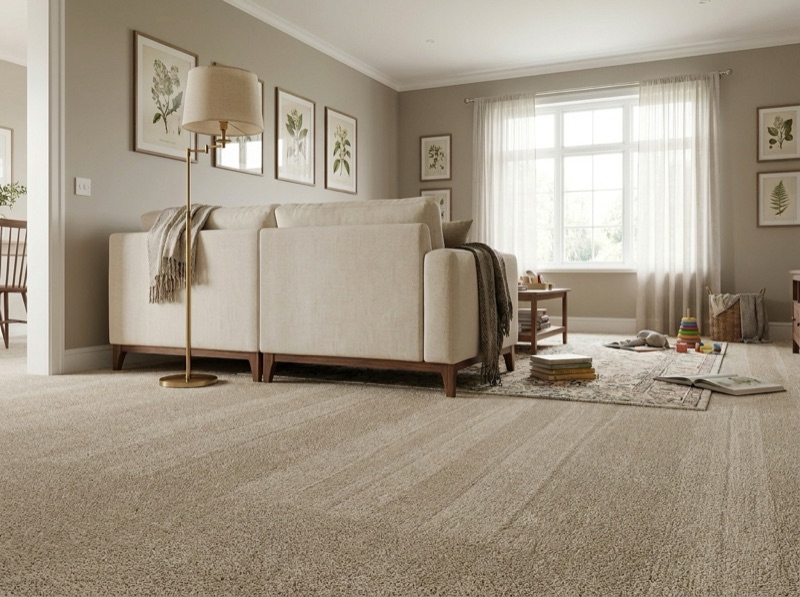
Frieze is a cut pile whose yarn is twisted far harder than a standard cut pile and then heat set, so each tuft holds a kinked, curled shape instead of standing straight. The curl is built into the yarn before it is ever tufted and sheared, which is why frieze describes a process rather than a fiber or a color.
Frieze and a plain, straight cut pile start from exactly the same place: yarn tufted through a backing and sheared open into upright tips. What separates them is decided twice before the carpet exists, once at the spinning frame and once in the heat-setting room. What the finished carpet is good for, and where it is the wrong call, is worked out in our frieze answer. This page walks how it is made.
Step one: the yarn is spun and plied with twist
Carpet yarn is not a single filament. Individual fibers are spun together into a strand with a twist in it, the way rope is made from smaller strands, and then two or more of those strands are usually plied together with a second twist running the other way. Some twist is not optional. A strand with none would be too weak and too limp to tuft cleanly, and its tips would fall open the moment the shear blade reached them.
So the question that separates a smooth plush from a frieze is not whether the yarn is twisted but how far. Twist level is a measured specification in the mill, not a judgement call. A plush sits at the low end of the range. A textured cut pile sits in the middle. A frieze sits at the top, twisted hard enough that the strand stops lying straight and starts to kink and double back on itself. Nothing about the fiber has changed at this point. Only the geometry of the yarn has.
Step two: the twist is heat set
Twisted yarn wants to untwist, the same way a wound rubber band does the moment you let go of it. Heat setting removes that tendency. The yarn is carried through controlled heat and moisture, which resets the fiber's memory around the shape it happens to be holding, so it keeps that shape once it is cut, walked on and vacuumed. Run a lightly twisted yarn through the step and you get the straight, upright pile of a plush or a Saxony. Run a hard-twisted yarn through the same step and the kinked, curled shape is what gets locked in. That locked-in curl is the whole of what the word frieze describes.
The variables here are heat, moisture and how long the yarn is held in it, which is why two carpets carrying a similar twist level on paper are not necessarily the same carpet. A twist that was never fully set is invisible on a swatch card and obvious some years into a floor. That is why the check further down this page reads the setting rather than the twist.
Step three: tufting and shearing
The already-twisted, already-set yarn is then tufted through the backing by a row of needles, exactly as any other carpet is, and the loops are sheared open into tips. Some lines take more than one shear pass to even those tips out. What matters about this stage is what it does not do: it does not create the curl. The curl arrived already locked into the yarn, which is why running a hand over a frieze feels like a texture built into the fiber rather than one cut into the surface afterward.
Backing and finishing follow, and none of it changes the twist either. By the time a frieze reaches a rack, the property it is bought for was settled two steps earlier by a machine nobody shopping for it will ever see.
The fold-and-release check for heat set
One check is worth running on a frieze sample, and it reads the heat setting rather than the twist. Fold the sample back against itself so the pile is pressed hard into its own face, hold it there, then let go and watch. A well set frieze opens back to its curled shape almost at once. One that stays creased, or comes back slowly and only partway, is telling you the twist was not locked in as thoroughly as it should have been.
That is a fair thing to ask about at the rack rather than guess at from a photograph. It is a manufacturing check and nothing more, so it will not tell you how the carpet behaves in a room. That part is already answered in full.
Fiber choice is a separate question from the twist
It is worth being clear about what the heat-set curl does and does not decide. The twist sequence is what makes a frieze a frieze, and it can be run on more than one fiber underneath. A resilient fiber springs back from crushing under a curl that is already breaking up the light on top, which is a real combination worth asking about for a room that never gets a day off, while a softer fiber under the same twist trades some of that recovery for a gentler hand. Twist and fiber are two decisions that happen to be made at the same moment on the sample wall, not one decision wearing two names. Our cut pile carpet page places frieze inside the wider family, Saxony and plush covers the low-twist end of the same range, and which fibers we actually keep on the floor is on the carpet page.
What else people ask about frieze carpet
Whether every cut pile is heat set, how the surface actually feels, and what an uneven-looking frieze is telling you.
636-332-0654Nearly all of them do, because a twist that is not set relaxes open over time whatever its twist level was. The variable is not whether the step happens but how hard the yarn was twisted going into it and how thoroughly the setting took hold. That is why two carpets listing a similar twist can age very differently.
It feels different rather than rough, more textured than a smooth plush and springier under a bare foot. Most people find it comfortable, and the curled fiber has no sharp edges. It is worth standing on a sample rather than judging it by sight, since the look is more informal than the feel is.
A well set frieze should not look noticeably different after vacuuming, since the curl is locked into the fiber rather than styled onto the surface. Unevenness usually points back to a heat set that did not fully take, which is worth raising as a question before you buy a specific line.
Narrow it down between frieze and a smoother cut pile
Tell us the room and how hard it gets used, and we will pull frieze and cut pile samples at different twist levels so you can fold them yourself.
Free estimate
636-332-0654