 Flooring Correct
What is frieze carpet good for?
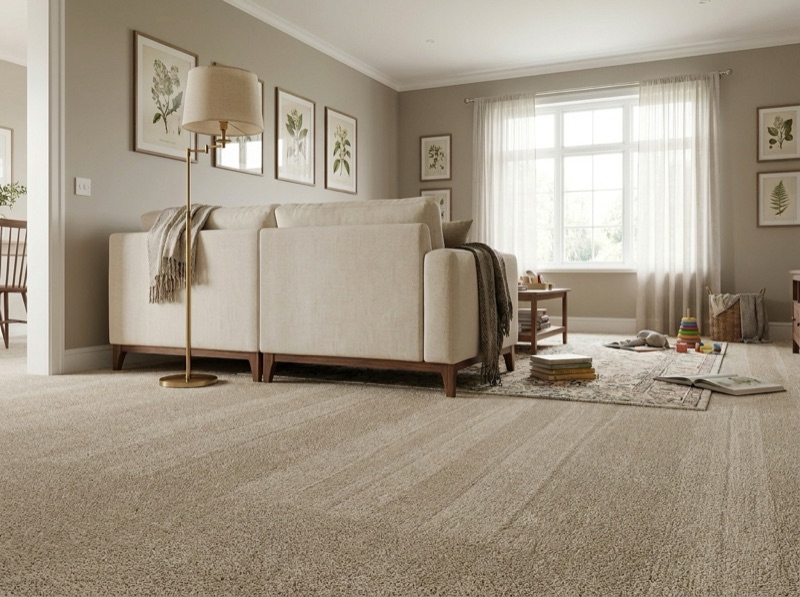
Frieze is a cut pile twisted so hard that the tufts kink and curl and lie in every direction at once. That randomness is the whole point. With no uniform nap to disturb, footprints, vacuum lines and traffic shading barely read on it. It suits family rooms, basements, hallways and busy households. It will never look crisp or formal.
Twist is the thing being described
Frieze is not a fiber and it is not a pattern. It is a description of how hard the yarn was twisted before it was tufted into the backing. Every cut pile carpet has some twist in it. Frieze is what you get when that twist is taken far enough that the tufts stop standing up straight and start to kink and curl back on themselves.
The twist then gets heat set, which locks the yarn into that shape so it holds instead of relaxing open over the years. Yarn that holds its twist keeps its tips closed. Yarn that relaxes open is what starts a walkway looking tired. Where frieze sits among the other cut pile constructions is laid out on our carpet page. What follows is what the twist itself buys and what it costs.
Why a curled pile hides everything
A plush or a Saxony has a nap. The tufts all stand roughly the same way, so the surface reflects light as one continuous sheet, and anything that pushes a patch of it the other way shows up immediately as a lighter or darker mark. That is what a footprint is. It is not dirt and it is not damage. It is fiber lying in a different direction from the fiber around it.
Frieze has no nap to disturb. The tufts already point every way at once, so there is no single reflecting surface for a foot or a vacuum to break up. Footprints, vacuum lines, the shading down a hallway and the darker patch where a chair has sat all stop reading, because the surface never had a consistent direction to lose in the first place. The same randomness is why a seam usually reads less in a frieze than in a plush, where the nap runs across the join and points straight at it.
What a hard twist does under traffic
Hiding footprints is cosmetic. The twist is doing structural work as well. The usual way a cut pile carpet fails is not that the fiber wears through. It is that the tips untwist, fray open and tangle into each other in the lane people walk, and once that has happened no cleaning reverses it. That failure is matting, and it is what ends most carpets rather than actual wear.
A tight, well set twist resists it for longer. That makes twist a better predictor of how a carpet ages than the number most people shop by. Face weight counts how much fiber is present. It says nothing at all about how that fiber is wound, which is why two carpets of identical weight can look nothing alike a few years in.
The rooms it is built for
- Family rooms and finished basements. Rooms that take real life and are not being judged on formality.
- Hallways and the traffic path across a living room. The lane is where shading appears first, and this is the construction that does not show it.
- Households with kids and dogs. It is a cut pile, so there is no loop for a claw to catch, and the surface does not record every trip across it. Fiber and backing matter at least as much here, and those are on carpet for pets.
- Rooms with big windows. Strong side light hits a floor at the one angle that exposes shading and footprints on a plush. A curled pile gives it far less to find.
- Anywhere you would rather not see the vacuum's own tracks. A frieze looks the same before and after.
Where frieze is the wrong call
It will never look formal. A frieze reads casual, textured and slightly tousled no matter what color it is. If the room wants a smooth, tailored, uninterrupted surface, no frieze delivers that, and a better frieze will not get you closer. That is a look a plush or a Saxony owns and this construction gives up on purpose.
The hard twist also stiffens each tuft compared with the loose yarn in a soft plush, so a frieze trades some of that dense, silky hand for resilience. In a bedroom where comfort is the only real requirement and nobody is walking a lane across it, a plush may honestly feel better, and the room can afford it.
Two more honest limits. A long, loose frieze holds crumbs, grit and pet hair down at the base where a quick pass will not reach, and a beater bar set too aggressively can fuzz the curled tips. And rolling loads are still rolling loads: a desk chair on bare casters wants a low, dense surface rather than something with length to dig into. On a stair the decision gets more specific than a construction name, and that is worked out in the stair answer.
Short frieze and long frieze are different floors
Frieze covers a range wide enough that the word on the tag does not tell you what you are getting. At the short end, a dense frieze with a tight curl is one of the most practical carpets sold anywhere. It hides everything, it holds its shape under traffic, and it vacuums without argument.
At the long end the tufts get longer and looser and the look moves toward shag. That is a striking floor and a much more specific decision, softer and deeper underfoot but carrying every cleaning and crushing consequence that comes with length. The construction name will not sort those two apart for you. Pile height and density will.
How to read the twist on a sample
There is a two second check you can run on any cut pile at the rack. Run your hand across the surface against the direction of the pile and watch whether the color changes. If it shifts noticeably light and dark, the carpet has a nap and it will show you every footprint. If it barely changes, the twist is doing its job. Then look at one tuft from the side and see how many turns you can count in it before the tip opens out.
Everything else is easier decided standing on it. Bring the question to the Wentzville showroom and ask to see frieze at both ends of the range, start narrowing by room with the floor finder, and let the free in-home measure settle where the seams fall and how the carpet meets the next room. Call 636-332-0654.
What else people ask about frieze
Frieze against shag, how it does with animals, and the one trap in a carpet that hides everything.
636-332-0654They are relatives rather than twins. Both are cut pile with length and both are twisted, but shag runs longer and looser and reads as a statement in a room. A short, dense frieze is a working carpet built to hide traffic. Once the tufts get long enough to flop rather than curl, you have moved into shag territory and inherited its cleaning habits.
It holds up better than most cut piles, and for two separate reasons. There is no loop for a claw to catch and pull, and the hard twist resists the tip fraying that ages a walkway. What it does not decide is stain behavior or odor, which come down to fiber and to whether the backing has a moisture barrier. Those get chosen together.
It hides the look of soil very well, which is genuinely useful and also a small trap, because a floor that never looks like it needs vacuuming still does. Vacuum a frieze on a schedule rather than on appearance. Mid tone and multi tone colors help further, as the carpet page explains.
Run a hand across the samples
Tell us the rooms and the household. We will pull samples that fit and show you what different twist levels do, then measure in your house before anything is ordered.
Free estimate
636-332-0654