 Flooring Correct
What carpet hides stains best?
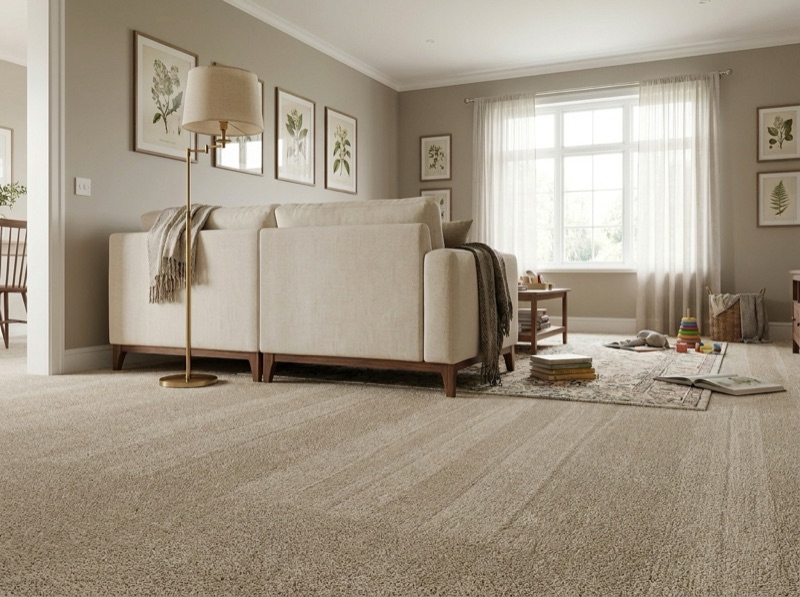
Multi tone carpet hides marks best. A mid depth color with fleck or heather in the yarn, in a textured or patterned pile, breaks up the outline of a spot so the eye stops finding it. Solid light and solid dark both show the most. Hiding a mark and resisting one are separate properties, and the fiber decides the second.
Hiding is an optical problem, not a chemical one
The eye finds a mark the way it finds anything: by contrast against a field it has already accepted as uniform. A flat, even carpet hands it that uniform field, so a spot the size of a coin reads clearly from the doorway. Put variation into the carpet before anything is ever spilled on it and the eye has to work much harder, because it is already busy sorting light from dark in that exact spot. That is the whole mechanism. Every carpet that hides well is running some version of it.
Why solid light and solid dark both lose
A pale solid shows soil, and soil is most of what a carpet collects. A very dark solid is worse than people expect, because it shows everything pale: lint, dust, drywall grit left over from a project, salt off winter boots, and light colored pet hair. It shows footprints and vacuum tracks more than a mid tone does as well. The middle of the range is the only part of the scale that hides in both directions at once, which is why so much carpet is sold there. Our carpet page makes that point in a sentence. Here is what to do with it.
Three places the variation can come from
Fleck, at the yarn level. Heather, tweed and space dyed yarns put two or three tones into the same strand, so the surface is never one color anywhere. This is the most effective camouflage for the small everyday spots, and it works from day one without any pattern being readable from across the room.
Texture, at the construction level. In a textured cut pile the yarn is wound hard enough that the tips stop standing in ranks, so they lean at different angles and catch light unevenly. A frieze pushes that idea further again. The surface is already broken up before anything ever lands on it, which is most of what frieze is for.
Pattern, at the design level. Cut and loop constructions and tone on tone patterns hide areas rather than points, and they do one thing nothing else does: they camouflage a traffic lane and a seam. The catch is that any loop is a claw risk, which matters if there is an animal in the house.
The marks that are not stains
Most of what makes a carpet look dirty is not a stain at all. A traffic lane going gray down the middle of a hall is soil ground into the fiber plus tips that have untwisted and lost their shape, so they no longer throw light back the way the fiber beside them does. Footprints and vacuum marks in a plush are the same effect at a smaller scale. No amount of stain resistance touches any of that. Twist, density and texture do, and so does the height you choose.
Hiding and resisting are two different purchases
Hiding is what the carpet looks like once the mark is in it. Resisting is whether the mark takes hold in the first place, and that is a fiber and finish question rather than a color one. A carpet can be excellent at one and unremarkable at the other, and a sample tag will happily let you assume you bought both.
The honest cost of good camouflage is that it lets soil stay. Grit in a pile is abrasive. It works against the fiber every time somebody crosses the room, so a carpet that hides everything and therefore never gets cleaned wears out from the inside while still looking acceptable from the doorway. Camouflage should buy patience between cleanings rather than replace them, and what actually ends a carpet covers where the alternative leads.
There is also a short list of marks nothing hides, because they change the carpet's color instead of sitting on top of it. Bleach and some household cleaners take color out. Rust and certain dyes put color in. Those become repairs, and a remnant kept from the original install is what makes a repair possible.
Judging a sample honestly
Do not hold a sample up at eye level under a showroom light and decide there. Put it flat on the floor and look down at it from standing height, which is the only angle you will ever actually see your floor from. Then take it home, lay it in the doorway of the room it is for, and look at it under a lamp at night as well as in daylight, because carpet color moves further between those two than any other flooring material does. Our floor finder narrows the field before you come in, the Wentzville showroom has the samples out where you can do all of this by hand, and the free in-home measure takes care of the room. Call 636-332-0654.
More on what shows and what does not
Dark against light, patterns at a seam, and why camouflage is not a reason to clean less often.
636-332-0654Not really, it just hides a different list. A dark carpet swallows dark soil and then shows every pale thing that lands on it, from lint and dust to light pet hair and the salt that comes in on winter boots. A light carpet does the reverse. What actually hides is the mid range with tonal variation running through the yarn, because it has no uniform field for a spot to stand out against.
To a degree, yes. A pattern breaks up the straight line where two pieces of carpet meet, in the same way it breaks up a spot. The trade is that a pattern has to be matched across the seam, which uses more material and makes where the seam falls a more deliberate decision than it would be in a plain carpet. Where that seam falls gets worked out on site at the free in-home measure rather than guessed off a floor plan.
Yes, and it is worth putting on a schedule rather than waiting until the floor looks bad. With a carpet that camouflages well, looking bad arrives long after the wear has started, because the grit doing the damage is invisible in the pile the entire time. Vacuuming lifts the loose part of it and a periodic deep clean takes out what has bonded to the fiber.
See it under your own light
Tell us the room and what goes on in it. We will pull samples in the right range for you to take home, then come out and measure once you have narrowed it down.
Free estimate
636-332-0654