 Flooring Correct
Saxony and plush carpet
What is the difference between Saxony and plush carpet?
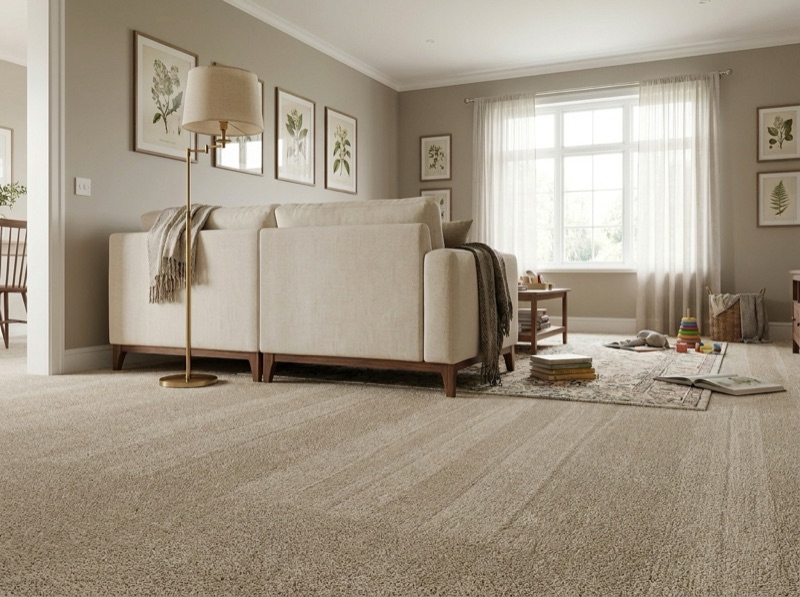
Saxony and plush are both formal cut pile carpets, sheared so every tip stands upright and even, and both show footprints more than a textured carpet does. The difference is the twist. Saxony yarn is twisted firmly and heat-set so tips stay slightly separated, giving a soft, faintly textured look. Plush yarn carries less twist, which levels the surface into a smoother, almost velvet finish.
Saxony and plush get lumped together constantly, and from across a showroom they can look like the same carpet. Walk up to a sample of each and the difference becomes obvious within a few seconds. Here is the sequence worth following, in the order it actually plays out on the showroom floor.
Step one: what they have in common
Both are cut pile constructions, meaning the loops of yarn are sheared open at the top rather than left looped, and both are finished so the sheared tips stand upright in an even, formal surface. The carpet page notes that a plush or Saxony reads formal and shows every footprint, and that trade, elegance for visible traffic marks, applies equally to both. If you have ruled out a textured cut pile because you want that smooth, formal look, you are choosing between these two, not away from them.
Step two: the twist that actually separates them
Saxony yarn is twisted more firmly and heat-set so the twist holds, which keeps individual tips slightly distinct from one another rather than merging into one flat plane. The result is a soft, faintly grained surface, more traditional in feel, the look most people picture when they hear formal carpet. Plush yarn carries a lighter twist, which is exactly what levels the surface into the smoother, denser-looking finish sometimes called velvet plush. Neither twist is better in the abstract. They produce two different surfaces from the same basic idea.
Step three: what the room's light does to each
A Saxony's slight texture catches shadow across its surface, which tends to soften footprints and vacuum lines compared with a flat plush, though it does not hide them entirely. A plush pile, being smoother, catches light more uniformly and shows a sharper, more defined footprint or vacuum stripe, the trade a lot of people are making without realizing it when they pick the sleeker-looking sample. A room with strong side light from a window, the kind that rakes across a floor in the afternoon, will make that difference more visible than a room lit only from above.
Step four: the check that actually decides it
Run your palm flat across both samples, against the direction of the pile rather than with it. On a well-made Saxony, the tips resist and hold their separation. On a plush, the surface yields more evenly and the hand leaves a visible mark that slowly relaxes back. That single motion tells you more about which one you are actually drawn to than staring at either sample from a few feet away, because the visual difference between a good Saxony and a good plush is subtle until your hand is on it.
Step five: pairing the pile with a fiber
Once the pile style is settled, the fiber underneath it decides how the room performs day to day. A formal living or dining room that sees occasional use can carry <a href="/materials/polyester-carpet-fiber/">polyester's deep color and softness</a> without much penalty, since the resilience question matters less where traffic is light. A primary bedroom leans the same direction. A more heavily used formal room, or a household that wants the same look to hold up under more regular activity, is better served by nylon or triexta underneath either pile style. The pile decides the look. The fiber decides how long that look survives.
Step six: the cushion underneath
Settle the cushion at the same time you settle the fiber, because a formal pile is less forgiving of a mismatched one than a textured carpet is, and what a cushion is actually doing under a carpet is worked through in full on its own page.
The honest downside, before you commit
Neither pile hides daily life the way a textured cut pile or a loop construction does. A busy household with kids tracking through constantly or a dog that beds down in the same spot every afternoon will see it faster on a Saxony or plush than on almost anything else in the carpet lineup, regardless of which fiber sits underneath. That is not a reason to avoid either style. It is a reason to be honest about which rooms in the house actually stay formal and which ones do not, before the carpet goes down rather than after.
What else people ask about Saxony and plush
Footprints, durability and whether the look reads as dated on a current line.
636-332-0654Generally yes. Plush has a smoother, more uniform surface, so a footprint or vacuum stripe reads more sharply against it. A Saxony's slight texture catches shadow across its surface in a way that softens the same marks, though it does not eliminate them.
Pile style alone does not decide durability. That comes from the fiber underneath and how dense the twist is set, which is why the fiber pairing matters as much as choosing between the two looks. A well-built plush in nylon can outlast a loosely tufted Saxony in polyester.
The name is traditional, but the construction still shows up across current lines, often updated with newer fibers and finer twist. What reads as dated is usually the color or the room around it, not the pile construction itself.
Narrow the fiber once the pile is chosen
Tell us whether you are leaning Saxony or plush and how the room actually gets used, and we will pull the fiber options that hold that look the longest for your traffic.
Free estimate
636-332-0654