 Flooring Correct
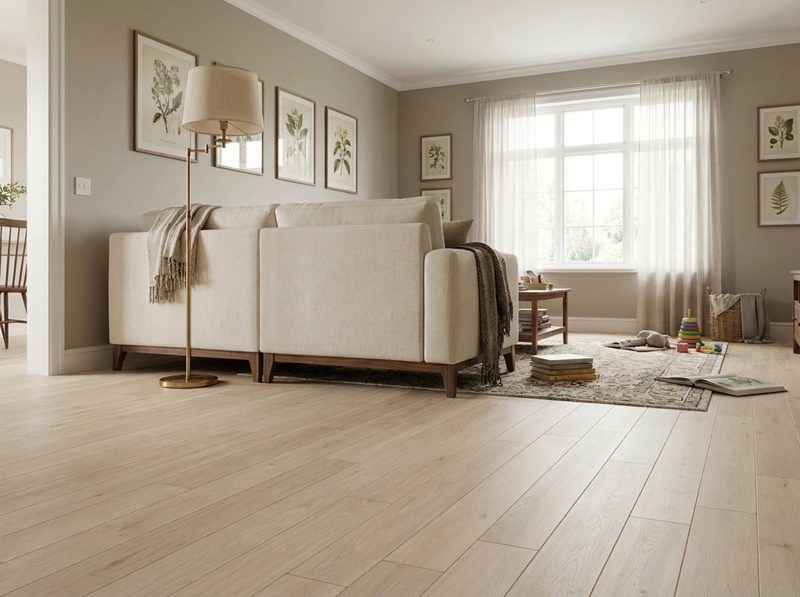
Carpet tile for the lower levels
of a city that never stopped building
Carpet tile earns its place downstairs, and Lake Saint Louis has been adding lower levels for about fifty consecutive years. A basement finished in the 1970s, one finished during the 2000s and one finished last year are three different rooms with three different histories under the surface. The measure is free and it happens at your address, because that history is not visible from here.
What carpet tile is made of and how a modular square behaves is set out on the carpet tile pillar. This page only asks one thing: what happens when you put carpet tile into a Lake Saint Louis house. That is a narrower question than it sounds, because this city does not have one kind of house. Building here has never really stopped, so the room you are thinking about might have been finished by the original owner in the 1970s, refinished twice since, or handed over complete by a builder a couple of years ago. The tile is the same product in all three. The job around it is not.
A lower level here is not one kind of room
Downstairs space in this city has been finished, unfinished and refinished across five decades of changing taste, and it shows up as five different rooms. Some are one open rectangle with a stair landing at one end. Some are chopped into a hobby room, a storage room and a hallway because that is how the original owner used the space. Some were finished by whoever owned the house in the 1990s and have since become the room everybody actually sits in. Carpet tile suits all of them, but it does not lay out the same way in any two.
What we are reading at the measure is the shape of the room and the state of what is on the floor. Where does the pattern start so the cut squares land somewhere sensible. Where does the layout have to change direction around a support post, a mechanical closet or a stair landing. Is the existing covering coming up in one piece or has it been down long enough to have opinions. None of that answers itself from a photo.
Where the squares stop is where a lower level is won or lost
A broadloom floor is held at its edges by tension. It gets stretched, hooked to a strip at the wall and tucked, and that perimeter is doing structural work. A modular floor has none of it. Each square sits where it is set and stays there on its own, so every edge of the room becomes a detail somebody has to decide rather than a consequence of pulling the carpet tight.
In a lower level that is exactly where the character of the room shows up. A hearth, the toe kick of a bar somebody built, the sill of an egress window, the line where finished floor gives way to painted slab. Those edges were improvised by whoever finished the space, they are rarely square to one another, and a stretched carpet absorbs that while a grid of squares reports it. So the perimeter gets planned with a tape in the room, edge by edge, and it is the part of a modular job that no amount of talking on the phone can settle.
The square that lifts out is the whole argument downstairs
Above grade, a floor covering is a floor covering. In a lower level the ability to take up one square and put another one down is the reason people choose this in the first place. A room that doubles as the place the kids do everything, the place the dog sleeps and the place the holiday boxes get opened is a room where one square is going to have a bad day at some point. That trade off against a broadloom carpet is set out properly on carpet tile against broadloom carpet, and the soft version of the same room lives on carpet in Lake Saint Louis.
What we ask before a single square is ordered
The questions that decide a modular floor are not really about the floor. Which way do you come into the room, and what do you see first from the bottom of the stairs. Which quarter of the space carries the traffic, and which quarter has had the same furniture standing on it since the day the room was finished. A stretched carpet answers all of that the same way, because it is one piece and its direction is decided by where the seams have to fall. A floor of squares does not. The answers change where the pattern is set out from, which direction the pieces run, and where a change of tone would read as deliberate rather than accidental. Anything specific to your address, your lower level or your association is something we ask about, and the Lake Saint Louis page sets out how the city is put together.
Dry lay the squares before you buy them
Carpet tile is one of the few things we sell that you can test at full scale before you own it. Take several squares home, set them dry on the lower level floor, turn a few of them a quarter turn to see how the joint reads, and then look at the result under the bulbs that room actually has. Lower level light is rarely daylight, and a square that looked lively on a lit rack can go flat under recessed cans.
Then leave them down for a few days and keep walking past them. A floor you have looked at once is a floor you have not really looked at, and a lower level changes more between a Saturday morning and a Tuesday evening than people expect it to. Squares are light to carry and easy to put back in the bag if the answer turns out to be no. Hours and directions are on the showroom page, and the in home measure covers what happens when we come to you.
The five things a Lake Saint Louis lower level gets checked for
- What is on the floor now and how many layers it turns out to be once we look at a corner instead of the middle
- How the room is squared up, since a long run of modular squares will show a drift that a photograph never does
- Where the layout has to work around a post, a mechanical closet, a stair landing or a wall added after the original finish
- How the tile finishes at the bottom of the stair and at any doorway into unfinished space
- Whether the room has ever taken water, which you will know and we will ask about rather than discover later
Names you will see on our carpet tile rack
Mohawk, SmartStrand, Godfrey Hirst, DreamWeaver, Pet Premier and Anything Goes are all on our floor. What separates them is not something a catalog image can show you. It is how a square holds its face after a season of real use in a real room, and how well the joint keeps disappearing once the floor has been walked on for a year. That is why the tiles go home with you rather than being sold across a counter, and why the recommendation waits until we have seen the space they are going into.
If the room downstairs wants a hard surface instead
Plenty of lower levels in this city end up hard rather than soft, and that is a fair conclusion to reach. The wood answer that is built to cope below grade is covered on engineered hardwood in Lake Saint Louis, and the version most people are picturing when they say they want something that shrugs off a spill is luxury vinyl plank in Lake Saint Louis. We will tell you at the measure if we think the room is arguing for one of those instead. The room page for a basement weighs the same choice from the other direction.
“Amazing, quick, easy experience. My floors look great!! Jonah steered my in the right direction with his expertise on several options I initially wanted to do different, I couldn't be happier with deciding to go with his suggestions!”
Questions from the bottom of the stairs
Straight answers about modular carpet in lower levels that were finished decades apart, in a city that has been adding them the whole time. Call 636-332-0654.
636-332-0654It is one of the main reasons people ask us about it. Lower levels here get used hard and used for several things at once, and being able to lift a single square out and replace it is worth more downstairs than anywhere else in the house. What decides it is the condition of the floor we find at the measure.
Mostly the tear out. A room that old has often been re-floored at least once, so there can be adhesive from an earlier era, a buried patch, or a wall that was added after the original finish. We look at a corner before quoting rather than taking the surface at face value.
Yes, and with carpet tile you should. Take more than one line, because two squares that look alike on the rack often separate the moment they are down on the actual floor next to your own furniture. Then bring them back and swap them for something else if the room says no. That is a short errand from Lake Saint Louis rather than a project.
It can if the room is not square, which is why squaring the space is one of the first things we take at the measure. We set the layout so the drift is controlled and the cut squares land where they are least noticeable rather than in the middle of the sight line.
Tell us. It is the single most useful thing a homeowner can volunteer about a basement, and it changes what we recommend. We would far rather hear it at the measure than work it out afterwards from how the old covering came up.
Both. The estimate and the in home measure are free, and the measure is at your address because a lower level cannot be quoted over the phone. The short run out from Wentzville makes that easy to arrange. Call 636-332-0654.
Get the lower level measured, ten minutes from our door
We come to Lake Saint Louis, take the room square, look at what is already down and check how the floor wants to finish at the stair. Free, at your address, and quick to book from 6.1 road miles away. Call 636-332-0654.
Free estimate
636-332-0654