 Flooring Correct
Carpet Tile vs
Broadloom Carpet:
Seamless or Repairable
Broadloom rolls out into one plush, uninterrupted surface with no seams to see. Carpet tile trades that for a floor you can repair one square at a time. Both are honest carpet. This page says which use case each one actually wins.
Carpet tile and broadloom carpet are the same fiber families sold two different ways, and the honest split between them has less to do with which room you are in than with what that room actually does to a floor. Broadloom wins the rooms that want to feel like one continuous, plush surface. Carpet tile wins the situations where wear concentrates in one spot or where a single ruined square should not mean replacing the whole room. We sell both constructions, so here is where each one actually wins. Call 636-332-0654.
What each side is actually offering
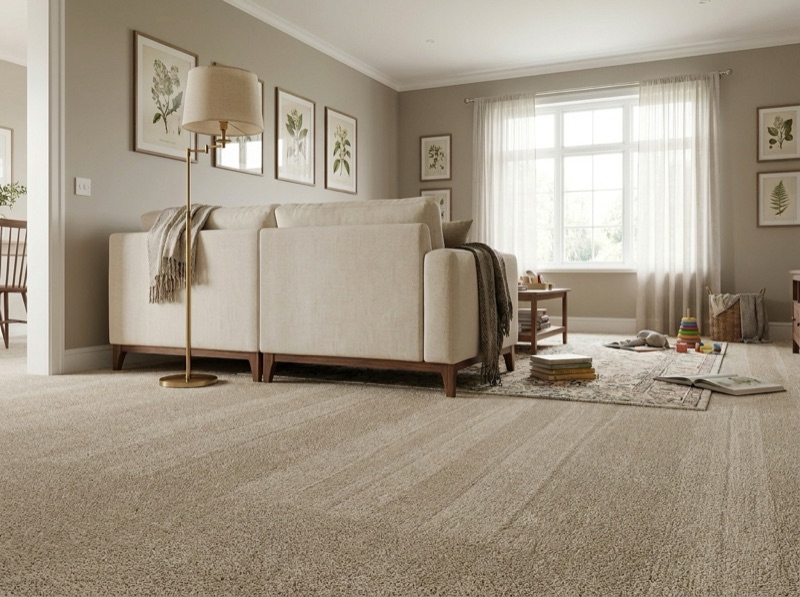
Broadloom's case is the feel of the room. It installs as one continuous roll, stretched wall to wall with no visible seams in most residential rooms, and that unbroken surface is what people picture when they imagine a plush bedroom or a formal living room. Underfoot it reads as a single soft plane rather than a grid of pieces, and in a large open room that uninterrupted feel is genuinely hard to match with any tiled product, carpet or otherwise.
Carpet tile's case is what happens after installation day. Because the floor is built from individual squares, a section that gets stained beyond cleaning, burned, or worn through can be pulled and swapped without touching the rest of the room, provided extra tiles were kept from the original order. That same modularity means a room does not have to age evenly. The traffic path can wear while the corners stay looking new, and only the traffic path ever needs attention.
Where each one actually struggles
Broadloom's honest weakness is that damage is a whole-room problem. A deep stain, a burn, or years of concentrated wear in one path do not stay contained to that spot the way they do with carpet tile. Fixing a damaged section usually means a patch that is never quite invisible, a full reseam, or in the worst cases pulling the whole roll and starting over, even when most of the room still looks fine. Wear also tends to show first and worst in the same lane every time, the path from the hallway to the kitchen, the space in front of a favorite chair, because that is where the fibers get crushed hardest and most often.
Carpet tile's honest weakness is the grid. Even with today's better pattern-blending styles, a close look at a large open room can reveal the seams between squares, especially under strong side light, and that texture reads a step less luxurious than an unbroken plush pile in a formal living room or a primary bedroom meant to feel indulgent. Carpet tile also depends on keeping a few spare tiles from the original run for the repair advantage to actually pay off later. Skip that and a future damaged square becomes a color-match guessing game instead of a simple swap.
The verdict, by use case
- A large, formal living room or primary bedroom meant to feel plush and uninterrupted: broadloom, for the seamless feel no tiled product fully matches.
- A home office under a rolling desk chair: carpet tile, since the chair wears one small path while the rest of the room can stay original for years.
- Hallways and stairs with a single dominant traffic lane: carpet tile, because that one lane can be replaced without redoing the whole run.
- A basement rec room with occasional dampness: carpet tile, since a damp square can be pulled to dry or replace without disturbing the rest of the floor.
- A guest bedroom or a formal dining room with light, even use: broadloom, where uneven wear is unlikely and the plush unbroken look matters more.
- A room that changes use often or takes heavy furniture traffic: carpet tile, for the ease of swapping a section as the room's job changes.
The repair question, plainly
This is where the two constructions genuinely part ways. A damaged carpet tile square gets lifted and replaced, typically without moving furniture out of the whole room, provided the original order included a few extra tiles set aside for exactly this. Broadloom repair is a harder job by nature: a patch can be cut and set into a damaged spot, but matching pile direction, wear, and slight color variance well enough to hide it takes real skill and does not always fully disappear. For a room that is realistically going to take repeated concentrated wear, that difference in repair effort is worth weighing before the material gets chosen on softness alone.
Uneven wear, named honestly
Not every room wears evenly, and that is really what this whole comparison is about. A desk chair rolls across the same narrow path day after day. A hallway funnels every trip between two rooms into one lane. A stair landing takes the same footfall pattern every single day. In all of those situations, broadloom ages as one piece, so the worn path drags the whole room's appearance down with it even though most of the floor barely got touched. Carpet tile lets the worn section be the only thing that ages, which is exactly the advantage it was built for.
Where a third material crashes the comparison
If the room in question sees real water rather than occasional dampness, a laundry hookup, a mudroom entry, a bathroom, the honest answer is neither of these two constructions. Luxury vinyl plank or tile take that room instead. And if the open question is still carpet versus a hard surface entirely, that decision belongs on a different page: carpet versus hardwood settles that one first.
What we carry on both sides
Carpet tile inherits the same brand lineup as broadloom carpet on our floor, since both are built from the same fiber families. Across both constructions we carry Mohawk, Pet Premier, Godfrey Hirst, SmartStrand, DreamWeaver, and Anything Goes. Samples of both live on the same showroom floor at 15570 Veterans Memorial Pkwy in Wentzville, so you can stand on a full broadloom pad and then step onto set carpet tile a few feet away and feel the difference in one visit. Call 636-332-0654 to check a specific line before making the drive.
Settling it
Name the room and be honest about what actually happens to its floor. Even, light use in a large room points to broadloom. A concentrated wear path, a desk chair, or a room where one bad spill should not mean redoing everything points to carpet tile. For the room-by-room case for carpet generally against a hard surface, see carpet versus luxury vinyl plank. The free in-home measure settles the rest, seam planning for broadloom or tile layout for carpet tile, in your actual room.
“I had a great experience with Flooring Correct, Jonah and Steven were top notch, had hardwood laid in many rooms, carpet in the bedrooms. I would reccomend Flooring Correct to anyone looking to get floors done correctly, and in a timely manner!!”
The questions this matchup always raises
Straight answers on seams, repair, wear patterns and which carpet brands carry across both constructions.
636-332-0654It can be close with a quality tile, but a large formal room built for a plush, unbroken feel still generally favors broadloom. Carpet tile earns its keep on repairability and uneven wear, not on matching broadloom's exact feel square for square.
Under close inspection or strong side light, yes, especially in a large open room. Pattern-blending styles reduce how obvious the grid is, but broadloom remains the seamless choice when that matters more than repairability.
A damaged square is lifted and swapped for a spare kept from the original order, usually without moving furniture out of the whole room. Without spare tiles on hand, matching a replacement later gets harder, so ask that they be set aside at installation.
It can be patched, but matching pile direction and wear convincingly takes real skill and rarely disappears completely. For a room with a known concentrated wear path, that is the strongest argument for choosing carpet tile instead.
Yes. Carpet tile and broadloom draw from the same lineup on our floor, including Mohawk, Pet Premier, Godfrey Hirst, SmartStrand, DreamWeaver and Anything Goes, since both are built from the same fiber families.
Carpet tile, in most cases. A rolling desk chair wears one narrow path, and carpet tile lets that single path be replaced without touching the rest of the room, which broadloom cannot do as cleanly.
Split it by how the room actually wears
Tell us the room and how it gets used. We will say whether it wants a seamless pull or a repairable grid, measure in your home, and quote from real numbers.
Free estimate
636-332-0654