 Flooring Correct
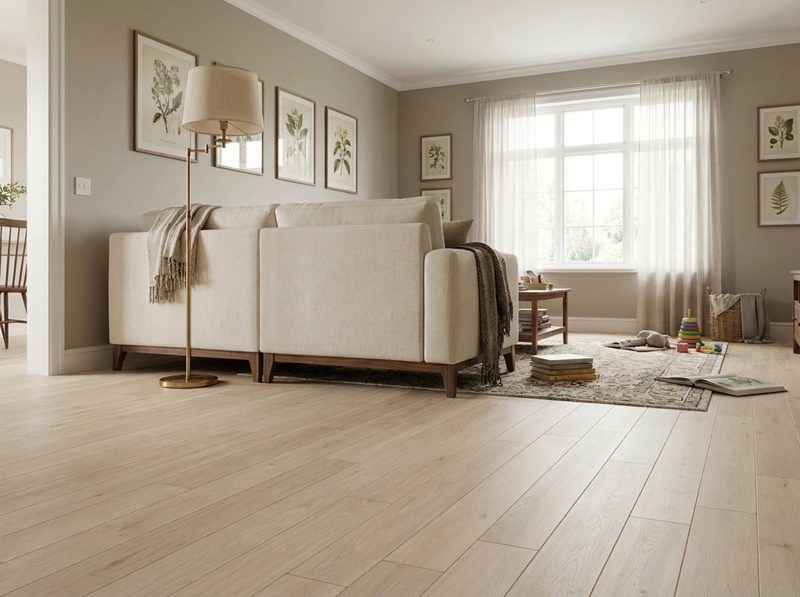
Engineered hardwood for houses
finished decades apart
Lake Saint Louis has been building without a pause since the 1960s, so what a board has to sit on can change between two houses on the same street. The era a room was last finished in decides an engineered floor here well before any sample does. The in home measure is free, and it is the only way to know which floor you have.
Cores, veneers and wear layers are explained on the engineered hardwood pillar, and none of that changes from one town to the next. What does change is the house. Lake Saint Louis has been building continuously for about fifty years, which means the wood question here is really a subfloor question, and the subfloor answer depends entirely on when your house was finished and how many times its rooms have been redone since. That is the part we come out and look at, and it is the part nobody can answer over the phone.
What pushes a Lake Saint Louis room toward engineered rather than solid
Two things do most of the pushing, and neither of them is a matter of taste. The first is where people want wood: not only the main level, but the lower level, the room over a garage, the space that used to be carpeted and now wants to look like the rest of the house. The second is that this city has houses from every decade since the 1960s, and an older room that has been re-floored twice is not always a good candidate for the kind of installation solid wood needs.
That is not a knock on either material. It is a reason to look before recommending. A room that is fine for solid stays fine for solid, and we will say so. A basement or a room that sits on concrete is a different structure with different rules, and engineered is usually the honest answer there rather than a compromise.
Below the main level, the surface underneath is the entire job
If the room you want wood in is below grade, the wood itself is the easy part of the decision. Everything hard is underneath it: how flat the surface actually is across the whole room rather than in the one spot people check, what covering is on it now and how it comes up, and how the room behaves through a Missouri summer. We take flatness across the room instead of trusting a level laid in the middle of it, because a floor that reads fine at the center can be out of tolerance at the walls, and wood installed over that will tell you about it later.
What we are reading below the main level here is usually somebody else's work. Fifty years of owners have finished and refinished these lower levels, so the honest question down there is what the last person did and how much of it is still visible. A slab that was never read before a floor went over it is the ordinary case here rather than the unusual one. So the covering already down is evidence rather than only a removal line. None of this is exotic. It is simply work that has to happen at the address rather than in a showroom conversation.
A tear-out here is short, and that turns out to matter
No housing unit in this city predates the 1950s, because there was no community here to build in until the 1960s. Even the oldest rooms in Lake Saint Louis are therefore working with one or two generations of covering rather than four. That sounds like trivia and it is not. It is the difference between lifting a floor and excavating one, and the demolition half of a wood job here is usually smaller than people brace for.
What it changes in practice is the demolition and the height. Every layer that comes up is a thickness the new floor no longer has to account for, and every layer that stays is one it does. A room on its second covering is a shorter and more predictable tear-out than a room on its fifth, and it makes the finished height easier to settle at the doorways and at the stair. What none of that does is answer the question for us, because which of those rooms you have is not visible from the street.
Where the wood stops, and what decides it
In the older plans in this city there are more doorways, which means wood can stop at a casing and the transition disappears into a piece of trim nobody looks at. In the newer plans there are fewer walls and longer sight lines, so the same stop has to be planned, because it will be seen from three rooms at once. That is a layout decision, not a product decision, and we make it at the measure with a tape and the doors open.
What a two inch chip cannot tell you about a wood board
Three things decide how an engineered floor looks once it is down, and a sample chip is too small to carry any of them. The wear layer is a figure on the specification sheet rather than something the eye can find, and it is worth asking for by name. The bevel is the small chamfer along the edge of a prefinished plank, and it is what draws the fine line you see at every joint and the grid you see across a room. Board to board variation only shows at length, because one piece cannot tell you how far the color travels across a floor.
So ask for full boards rather than chips, and put more than one of them down in the room they are meant for, in the light that room actually gets. That last part matters here, because so much of this city's wood goes below the main level, where fewer windows and more fixtures do the lighting. A bevel and a color run both read differently under it, and the moment to find that out is before the order rather than after it.
What gets recorded at a Lake Saint Louis wood measure
- Whether the room is below grade, over a garage, or on a level that has been finished and refinished since the house was built
- What is on the floor now, how many layers it is, and how cleanly it is going to come up
- The water history of the space, asked out loud rather than inferred
The rest of what a visit covers, from door clearances to stairs to how each room meets the next, is set out on the in home measure, and it is the same visit whichever material you end up with. There is one more thing we ask about rather than assume, and it comes from the same instinct. The two lakes here are private and not every development carries membership in the association that owns them, so we ask about your property rather than assuming it matches the one next to it. We take exactly the same approach to what is under your floor.
The wood lines we can put in front of you
Portercraft, Bella Cera, Paramount, Hartco, Jackson Hardwood, Casabella, Hudson Collection, National Flooring Products and Intermountain Wood Products are the engineered lines on our floor. Which of them belongs in your house is decided by the room rather than the rack, and that is the order we work in: see the space, understand what the floor has to sit on, then narrow the samples. Jonah Paup and his wife Audra run this business, the family has been in flooring since the early 1970s, and the recommendation you get is the one we would give a neighbor.
If your Lake Saint Louis room is better off with something else
Sometimes it is. If the room has always been solid wood territory and the structure supports it, solid hardwood in Lake Saint Louis is the page to read, and we will tell you at the measure if that is the better call. If the room is one that gets soaked, dropped on and lived in hard, the honest alternative is luxury vinyl plank in Lake Saint Louis, and upstairs the softer answer is still carpet in Lake Saint Louis. The town page covers how the city is put together, and what sits behind the number on any wood quote is set out on engineered hardwood cost factors.
“Amazing, quick, easy experience. My floors look great!! Jonah steered my in the right direction with his expertise on several options I initially wanted to do different, I couldn't be happier with deciding to go with his suggestions!”
Questions about what the wood is sitting on
Straight answers about engineered wood in a city where the subfloor under one house has nothing in common with the one next door. Call 636-332-0654.
636-332-0654What is down there now and how many layers of it there are, how cleanly it comes up, and what the water history of the room has been. A level somebody else finished can carry a covering over a covering, and the thickness of whatever stays behind changes the height the new floor lands at. We ask about all of it out loud while we are standing in the room rather than working it out from the outside of the house.
Not at all. It changes what we check. A room that age has often been re-floored more than once, so we look at how many layers are down, how they come up, and what condition the surface underneath is in. Then the recommendation follows the room rather than the calendar.
Both, and the checking matters more. We look at what is down now and how many layers of it there are, note every height the new floor has to meet, ask what the room has been through, and check door swings. A quote built without those is a guess with a number attached to it.
Usually it makes the tear-out simpler and the layout harder. A newer level is likely on its first covering, so what comes up is thin and predictable and the finished height is easy to settle. It is also more likely to be open, which means the run of wood is long and where it stops has to be decided on purpose rather than by a doorway.
Yes, the estimate and the in home measure are both free, and being ten minutes down the road makes them easy to schedule. We measure at your address because the subfloor is the deciding factor and it cannot be seen from here. Call 636-332-0654.
6.1 miles of road, and a Lake Saint Louis subfloor nobody has read yet
We come to Lake Saint Louis, look at how many layers are already down and how cleanly they come up, ask what the room has been through, note every height the new floor has to meet, and only then talk about boards. Free, at your address, and a ten minute drive for us. Call 636-332-0654.
Free estimate
636-332-0654