 Flooring Correct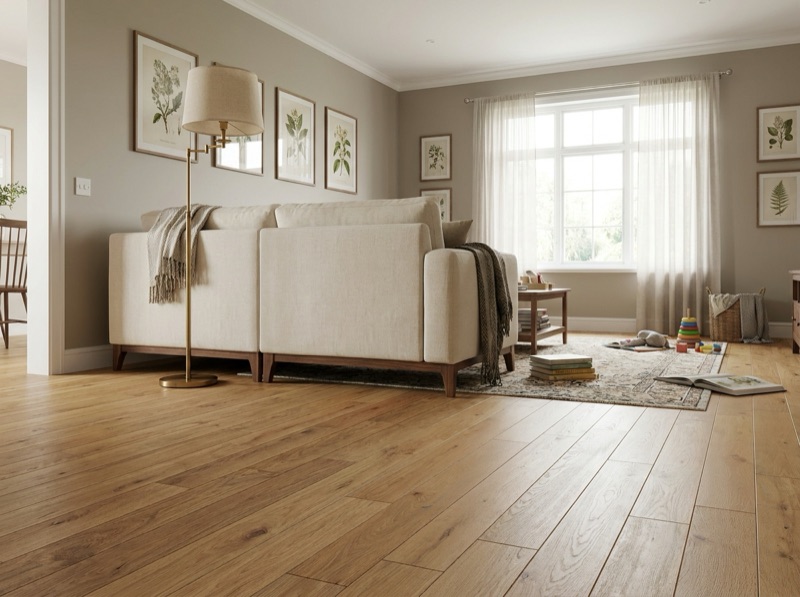
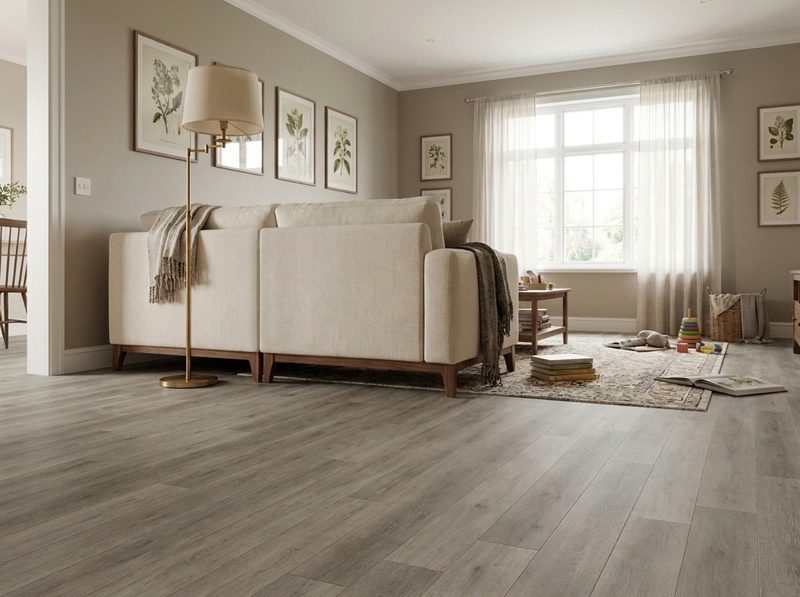
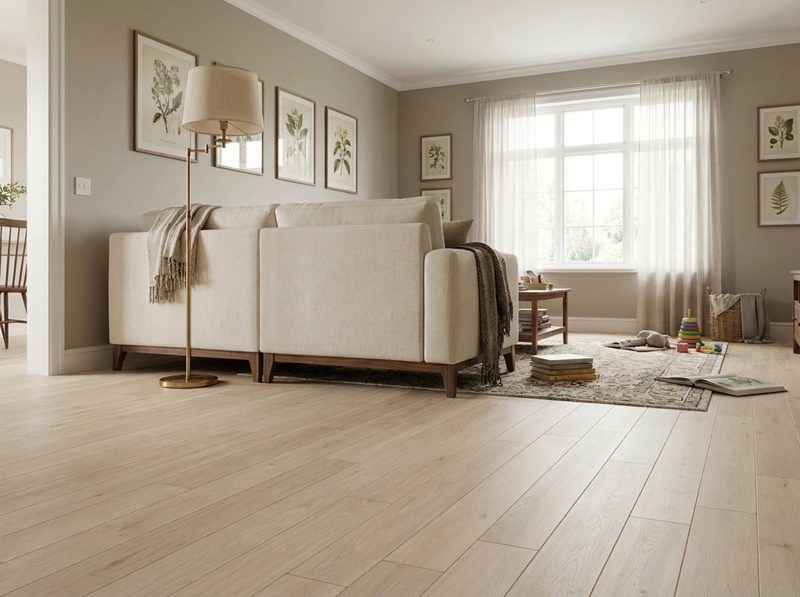
Solid hardwood in a city
with nothing old to uncover
In a lot of towns a hardwood conversation starts with what might already be under the carpet. Here it starts somewhere else. No house in Lake Saint Louis predates the 1950s, so there is no hundred year old oak waiting to be uncovered, and the wood going down is far more often a clean choice than a rescue. Clean choices still deserve to be made standing in the room. The measure is free.
Species, cuts, grades and finishes belong to the hardwood pillar and they read the same wherever you live. This page is about one intersection: solid wood going into the houses that are standing in Lake Saint Louis. The single fact that shapes it is how young the housing is. There is nothing here from before the 1950s, because there was no community here to build in, so the romantic version of a wood floor job, pulling back a carpet and finding hundred year old oak worth saving, is not the story on this map. What the streets that went up first can hold is a later wood floor that somebody covered over, which is a smaller find and still worth looking for. Most of the time, though, what you get is a straight choice, made new, and it lasts as long as you keep the house.
What a Lake Saint Louis carpet is actually sitting on
In an older river town the first move on a wood job is investigative. Lift a corner, see what generation of covering is down, find out whether there is a board floor underneath worth sanding. Here the odds run the other way, because even the earliest streets in this city went up decades after the era that produced original board floors. What the first building waves can leave behind is a wood floor a later owner decided to cover over, so we still lift the corner. We simply expect the answer to be a subfloor more often than a floor.
What we usually find under an old covering is a subfloor and, in a house that has been redone once or twice, the traces of the coverings before it. That still has to be looked at, since it decides how long tear out takes and what condition the surface is in. But it is a preparation question rather than a preservation question, and that difference sets the tone for everything else on the job.
A first wood floor is a decision rather than a restoration
When there is nothing to match and nothing to save, which is the case in most of these houses, every variable is genuinely open. Width, species, grade, direction and sheen are all yours to pick, and that freedom is more difficult than it sounds. People who come in expecting to be told what their house already wants find instead that the house is not telling them anything, and the decision comes back to them.
So we narrow it the useful way. What is staying in the room, what light does the room get, how far can you see across it from the front door, and how do you actually use it. Those four questions cut a wall of samples down to a handful faster than any specification sheet will, and none of them can be answered from our side of the showroom counter.
The living room sets the direction for everything joined to it
In most houses here the living room holds the longest run of continuous floor, so it decides which way the boards run, and everything connected to it inherits that decision. Board direction is not a style preference on its own. It answers to the structure underneath, to the longest sight line in the room, and to where the light comes from, and getting it wrong is the kind of mistake you cannot correct later without taking the floor back up.
We work that out at the measure with the doors open, standing at the point people actually enter from. In houses of the newer kind here, where the main level opens up and one room reads into the next, that decision reaches further than the room you are thinking about. In the older plans it is contained, and the wood can behave differently on the other side of a doorway.
A floor you keep, in a house people tend to keep
Most homes in this city are lived in by the people who own them, and that changes what solid wood is being bought for. It is not a floor chosen to photograph well for a season. It is one chosen to be walked on by the same household on the same route for years, and to be worth refinishing rather than replacing when that day comes. That horizon is exactly why solid still wins arguments in a city this new, and it is the reason we would rather talk you into the right species once than sell you a floor twice.
Ten minutes down the road, standing a board against what stays
Lake Saint Louis is 6.1 road miles from the showroom, roughly ten minutes, so take samples out to the house and stand them against the things you are not replacing. Cabinet doors, stair parts, trim, the fireplace surround if there is one. Wood against wood is where a choice is made or lost, and no photograph of a floor has ever settled that question honestly.
Sheen is the variable people give the least thought to and notice the most afterwards, because a large room throws light across a floor in a way a sample board on a rack never shows you. Two finishes that were interchangeable under the showroom lights separate the moment one of them is lying in your own room. What drives the number is set out on hardwood cost factors.
What a hardwood measure records in a house here
- Which way the structure underneath runs, and what that allows for board direction in the main room
- The longest sight line in the house, taken from where people actually come in
- What is down now, how many layers it turns out to be, and how cleanly it comes up
- Every height the finished floor has to meet, including doorways, the stair and any room staying soft
- Door swings and casing clearance, both of which a new wood floor can change
- What is staying in the room, since the wood has to sit beside it for a very long time
The solid wood lines we can put in front of you
Portercraft, Paramount, Hartco, Jackson Hardwood, Casabella, Hudson Collection, Durango and National Flooring Products are the solid lines we carry. Choosing between them is a room decision rather than a rack decision, which is why the samples travel to your house rather than the other way round. This is a family business, Jonah Paup runs it with his wife Audra, and we hold 146 Google reviews at a 5.0 average, so the advice you get is the advice we are willing to have written about afterwards.
When solid is not what your Lake Saint Louis room is asking for
There are rooms in this city where it is not the right call, and we would rather say that at the measure. Anything below the main level or sitting on concrete is engineered territory, and that argument is made properly on engineered hardwood in Lake Saint Louis. A room that takes a lot of water is better served by luxury vinyl plank in Lake Saint Louis, and upstairs the answer often stays soft, which is carpet in Lake Saint Louis. How the visit works is on the in home measure page, and the city itself is on the Lake Saint Louis page.
“Amazing, quick, easy experience. My floors look great!! Jonah steered my in the right direction with his expertise on several options I initially wanted to do different, I couldn't be happier with deciding to go with his suggestions!”
Questions about a first wood floor
Straight answers about solid wood in a city young enough that most rooms are getting their first wood floor, and about the older streets where that is not quite true. Call 636-332-0654.
636-332-0654Less likely here than in an older river town, and not a question anyone should answer from the doorstep. No house in Lake Saint Louis predates the 1950s, so there is no hundred year old oak to uncover. But wood was routinely covered over by a later owner in the streets that went up first, so we lift a corner and look rather than assume. In the newer half of the city there is usually nothing under there but a subfloor and the traces of whatever was laid before, which is a preparation question rather than a restoration one.
No. A newer house is often an easier candidate, because the tear out is a single layer over a subfloor that was set flat and has stayed dry. What we check is flatness, height at every transition, and whether the room is above grade, since that last one is what actually rules solid in or out.
6.1 road miles, about ten minutes each way. Sheen is the variable people most often wish they had looked at twice, so use the drive. Take boards home, stand them against your cabinets and trim, then come back and settle it.
That is a large part of why people choose it, and it matters in a city where houses tend to be lived in by their owners for a long stretch. We will talk through what the species and grade you are considering mean for that day before you order anything.
No. Direction, flatness, transition heights and tear out all have to be seen, and none of them can be described accurately down a phone line. The estimate and the in home measure are free and we are ten minutes away. Call 636-332-0654.
Have a first hardwood floor measured in Lake Saint Louis
We take board direction from the structure and the sight line, check flatness, note every transition height and look at what has to come up first. Free, at your address, and ten minutes from our door. Call 636-332-0654.
Free estimate
636-332-0654