 Flooring Correct
Carpet tile in
Dardenne Prairie,
Missouri
The rooms this material suits are the ones whose job keeps changing. In a city where 91.6 percent of homes are lived in by their owners, that describes a lot of lower levels.
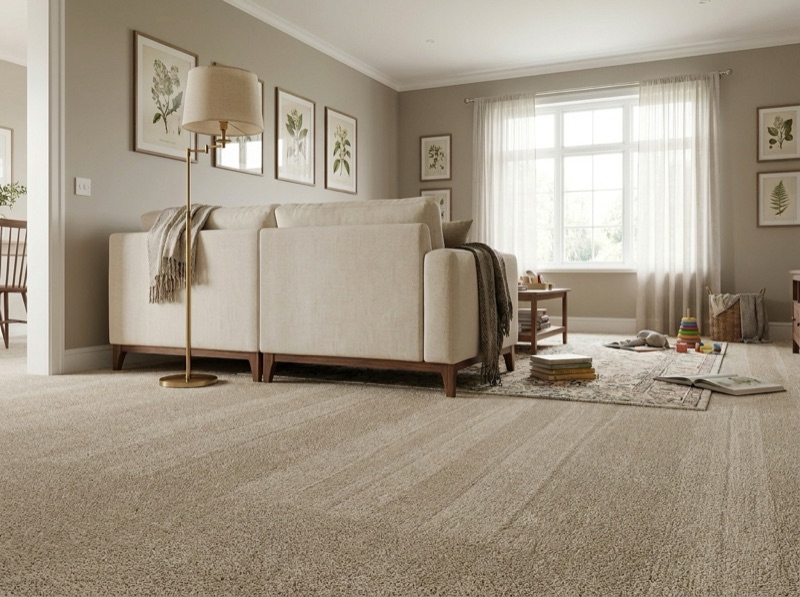
Carpet tile goes down in Dardenne Prairie houses for reasons that have very little to do with how it is made and everything to do with which room it is going into. This is a young city, 69.3 percent of it built in 2000 or later, and the spaces people call us about here are lower levels, bonus rooms and the flex room by the front door. Those rooms change purpose more than once across a long ownership, and modular squares are the covering that copes with that. The measure that decides it is free, and we are 10.9 road miles away. Call 636-332-0654.
The room that was finished last, and finished by you
In housing of this vintage the lower level is frequently the space the builder handed over unfinished. If that is your house, whatever is down there now was chosen by an owner rather than specified in a plan, which makes it the one room where the second decision is really a first decision. It also means the finish level down there is often a step behind the rest of the house, and people are more willing to experiment with it than they would be on a main floor everybody sees.
That willingness is worth using on a floor that can change with the room. A modular floor lets a room be one thing this year and another thing in four years without the covering becoming the reason not to change. A playroom becomes a teenager's space, a teenager's space becomes an office, an office becomes a gym. In a household planning to stay, that sequence is not hypothetical. It is the actual life of the room.
The floor usually outlasts the plan for the room
Rooms like this one do not usually get re-floored because the floor wore out. They get re-floored because the plan changed. A wall goes up to make a quiet office out of half the space, the bar somebody built when the room was first finished comes out, storage and living space swap ends. A covering laid as one continuous piece has to be handled as one continuous piece when that happens, so a floor with years left in it tends to leave the room along with the wall. Squares are a smaller unit of decision. The work stays inside its own footprint, and the part of the floor nobody is touching stays where it is.
So the room's next use is worth saying out loud at the measure rather than afterward. A lower level that is going to be divided later, a storage side that will be finished a few years from now, a flex room by the front door that is heading back to being a dining room: each of those is a different job from a room that is finished for good, and each is easier to allow for at the start. In a city this heavily owner occupied, the household that will make the change is usually the household choosing the floor now, so the answer to that question is generally standing in the room with us.
What we check under a twenty year old lower level
Below grade, the surface underneath decides what is allowed to go on top, so that is what the measure looks at first. Concrete moves moisture upward as vapor whether or not it ever feels damp to the hand, and a slab poured with a house finished around 2004 has had two decades of seasons to show what it is going to do. We check it rather than take the room's word for it, and if a floor drain, a sump or a past water event is part of the room's history, tell us at the measure rather than after.
The good news in a city built this recently is that we are usually looking at one covering over one slab, not four generations of patching. Flatness still gets checked, because squares telegraph a dip just as a plank floor does. What we are not doing here is guessing, which is the whole argument for measuring in the house. The in-home measure is free and it is where the numbers come from.
It stopped looking like a floor from an office building
The usual objection to carpet tile is not about performance. It is that somebody is picturing the flat commercial squares of twenty years ago and cannot see them under a sofa. That memory is out of date, and how the current lines are built and laid is set out on the pillar rather than argued again here. What matters in a house like this one is that a lower level finished by its owner is the room people are most willing to try a patterned or a quarter turned floor in, because it is the one room nobody is walked through on a tour. The seams are there if you go looking for them at floor level, and from standing height they read as the texture of the floor rather than as lines drawn across it.
If you want the honest comparison against a rolled carpet, we have written it out on the carpet tile versus broadloom page rather than argue it twice.
Above grade it earns rooms that work for a living
This is not only a below grade material. Plans from the 2000s tend to include a room near the entry that has been an office, a dining room and a music room at different points, and a bonus space over the garage that swings further in temperature than anywhere else in the building. Both are rooms where a floor that can be lifted, swapped and reconfigured is a better bet than one that commits the space to a single use for the next decade.
Home gyms belong in that list too. Dropped weights and rolling equipment are exactly the kind of localized punishment a modular floor absorbs without the whole room paying for it.
Where a rolled carpet is still the better answer
Bedrooms, generally. That is why the upstairs of a Dardenne Prairie house usually ends up on carpet in Dardenne Prairie even when the lower level goes modular, and why the reasoning behind it sits on the comparison page rather than being run through twice here. Staircases are their own trade and we would want to talk through the specifics of yours rather than assume squares belong on them. If the room in question is a kitchen or a full bath, we will point you somewhere else entirely and explain why.
Saying no to a material is part of the job. We will tell you when the one you came in asking for is wrong for the room, including when it is this one.
The lines these squares come from
The bench we work from covers Mohawk, Pet Premier, Godfrey Hirst, SmartStrand, DreamWeaver and Anything Goes, and the pet focused options in that group are worth asking for in a room that doubles as somewhere the dog sleeps. Stock changes, so a call to 636-332-0654 ahead of the drive is worth the minute it takes, and the city itself is covered on the Dardenne Prairie service area page.
“The job was done quickly and done very well- thanks Randy. ... All in all, it was a good experience with Flooring Correct. I would recommend them to anyone”
Dardenne Prairie questions about modular squares
Straight answers about lower levels, owner finished space, layout and where a rolled carpet still wins in a house of this age.
636-332-0654They start from the same place and then diverge. 50.3 percent of Dardenne Prairie's housing went up in the 2000s, so a street like yours was usually poured by one builder in one season and finished to one specification. What happened afterward is individual. One owner finished the space in year three and another in year twelve, one put a bathroom down there and one did not, one runs a dehumidifier all summer and one has never needed to. The measure is about the second half of that rather than the first.
It changes what we expect to find. Owner finished space varies more than builder specified space, so the measure looks at how the existing floor was fixed down and what the walls and the slab are doing at the perimeter before anything is quoted.
Not the current product. Texture, tonal ranges, patterned runs and plank formats have moved it a long way from flat commercial squares. The residential lines and the contract lines are separate parts of the catalog, and what we would put down in a lower level here comes from the first one. The rack is about seventeen minutes from Dardenne Prairie whenever you want to look at what is being made now.
That is close to the ideal case for it. A room that has been an office, a dining room and a music room is a room whose next use is unknown, and a covering that can be lifted and reset in sections is easier to live with than one that commits the space until it is torn out. It sits above grade too, so the slab questions that dominate a lower level do not apply, and the decision comes down to how you want that room to feel underfoot and how much of the house's traffic passes through it.
It is a separate decision and it depends on the staircase, so we would want to look at yours rather than answer in general. Stairs take concentrated wear and the fixing detail matters more there than anywhere else in the house.
Yes, and it is worth thinking about in a house you plan to stay in for a long time. Ask for two tones from the same line rather than one flat color, because a floor with some movement in it hides ordinary life instead of displaying it. Two tones also keep the floor from belonging to one use. A single flat color chosen for a playroom still reads as a playroom floor once the room is an office, while a range of tone in the same line reads as texture and lets the furniture say what the room is now.
Get a lower level in Dardenne Prairie measured
Tell us the room and whether it sits below grade. We drive the 10.9 miles, read the slab under a house that has had twenty years to show what it does, and quote with a spare box built into the plan.
Free estimate
636-332-0654