 Flooring Correct
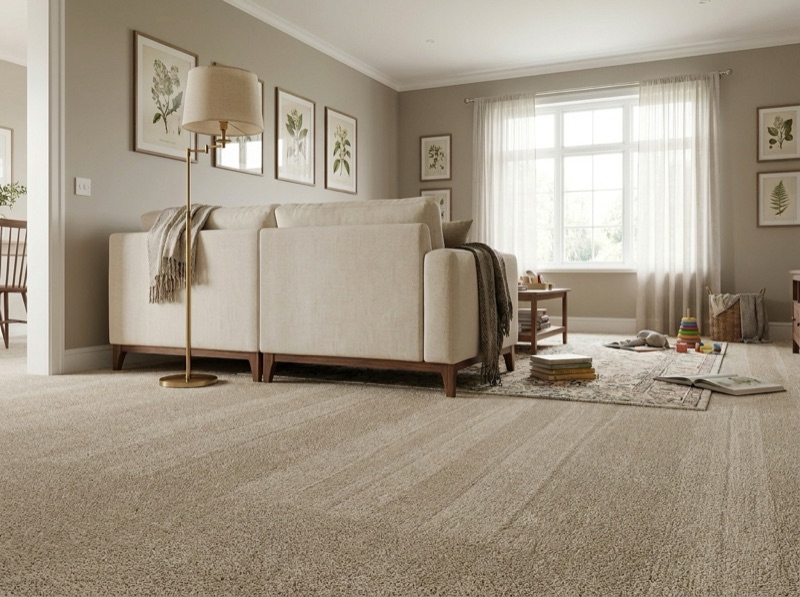
Olefin carpet fiber
What is olefin carpet fiber?
Olefin, also called polypropylene, is a synthetic carpet fiber that will not absorb water and holds its color against sunlight, since pigment sits inside the fiber rather than on its surface. The weakness sits on the other side: a fiber this water resistant also resists springing back once crushed, so olefin favors a low, dense loop or cut pile over a high-traffic room.
Every carpet fiber makes a trade of some kind. Olefin makes the starkest trade of the common ones. It is close to immune to two things that ruin other carpets, standing moisture and sun fading, and in exchange it gives up almost all of its ability to spring back once something heavy presses it flat. Nearly everything else worth knowing about the fiber follows from that one trade.
What the fiber is actually made of
Olefin, more precisely called polypropylene, starts as a synthetic resin melted and pushed through fine openings to form a filament, the same basic process behind nylon and polyester. Its molecular structure will not take on water, which is unusual among the common carpet fibers and is the source of nearly every advantage it has. Color is typically added while the resin is still molten rather than dyed onto finished yarn afterward, a version of the solution-dyed idea the carpet page introduces, which is why an olefin carpet resists fading even under a window that gets sun most of the day.
What that buys you on the floor
Because the fiber itself does not absorb water, an olefin carpet is hard to stain with anything water based, and it will not wick moisture up from underneath the way some other fibers can. Sunlight that would gradually wash color out of a fiber dyed on the surface has almost nothing to attack here, since the pigment sits inside the strand rather than on top of it. That combination is why olefin shows up heavily in loop constructions and in rooms where light and moisture matter more than heavy foot traffic.
The failure mode: crush, not wear
The same rigid, water-resistant structure that gives olefin its strengths also resists bending back into shape. Nylon and triexta fibers both have real spring and recover from being flattened. Olefin has very little. Once it is crushed under a rolling chair leg or a heavy piece of furniture left in one spot for months, that spot tends to stay flattened rather than lift back out. This is why olefin is built almost exclusively into low, dense loop and cut pile rather than a tall plush construction: a short, tight fiber has less distance to fall and less room to show the damage.
There is a second property worth knowing before you choose it. Polypropylene fiber has a mild natural affinity for oil, so a grease spill or a stain tracked in from a driveway tends to be more stubborn on olefin than a water-based spill would be. The fiber also has a lower melting point than nylon, which makes it more sensitive to concentrated friction, the kind produced by a chair leg dragged repeatedly across the same spot rather than lifted. Neither the oil affinity nor the friction sensitivity shows up in an ordinary room, but both are worth raising if your room has one of those conditions.
Checking a sample yourself
- Press a fingernail firmly into the pile, hold it a few seconds, then let go and watch how quickly, or whether, it stands back up.
- Set an olefin sample next to a nylon or triexta one and repeat the same press. The resilience gap becomes obvious in a few seconds rather than staying an abstraction.
- Ask which construction is a tight loop versus a taller cut pile. A denser, lower pile will show crush marks far less than a taller one built from the same fiber.
- Ask the showroom which lines carry an added stain treatment beyond the base fiber, since not every olefin construction handles an oil-based spill the same way.
Where the trade makes sense
Olefin earns its place in rooms where its strengths outweigh its one real weakness: below-grade rooms and basements, where a slab moves vapor upward continuously and our basement guide covers what that rules in and out, three-season rooms and sunrooms with long daily light exposure, and anywhere the goal is a durable loop that will not fade rather than a soft pile getting walked hard every day. It is a poor match for a busy hallway or a stairway, the two places in a house that ask a fiber to spring back the most, which is closer to what nylon and triexta are built for. If moisture below grade or fading light is the actual concern in your room, that is exactly the kind of detail worth bringing to the measure rather than guessing from a sample at home.
What else people ask about olefin carpet
Fading, basements, crushing and oil stains, the four questions that come up most.
636-332-0654Not the way most carpets do. Because the color is built into the fiber itself rather than applied afterward, olefin resists the gradual sun bleaching that shows up first in a window bay on other fibers. It is one of the reasons the fiber turns up so often in sunrooms and rooms with long daily light exposure.
It can be, largely because it will not absorb the moisture a below-grade slab pushes upward even when the floor feels dry. The tradeoff is resilience under heavy foot traffic, since olefin has little spring once it is crushed, so a dense, low pile suited to a family room does better than a tall plush construction down there.
The same rigid fiber structure that keeps olefin from absorbing water also keeps it from bending back into shape once it is flattened under sustained weight. Nylon and triexta both have more natural spring, which is why olefin is built almost exclusively into low, dense loop and cut pile rather than a tall plush pile.
Generally yes. Polypropylene fiber has a mild natural affinity for oil, so a grease spill or a stain tracked in from a driveway tends to be more stubborn on olefin than a water-based spill would be. Ask the showroom which specific line you are considering and whether it carries an added stain treatment beyond the base fiber.
Tell us about the room's light and moisture
If you are weighing olefin for a basement, a three-season room or anywhere sunlight lands on the floor for hours at a time, tell us which room it is and we will pull samples suited to that condition.
Free estimate
636-332-0654