 Flooring Correct

Can you put heated floors under tile?
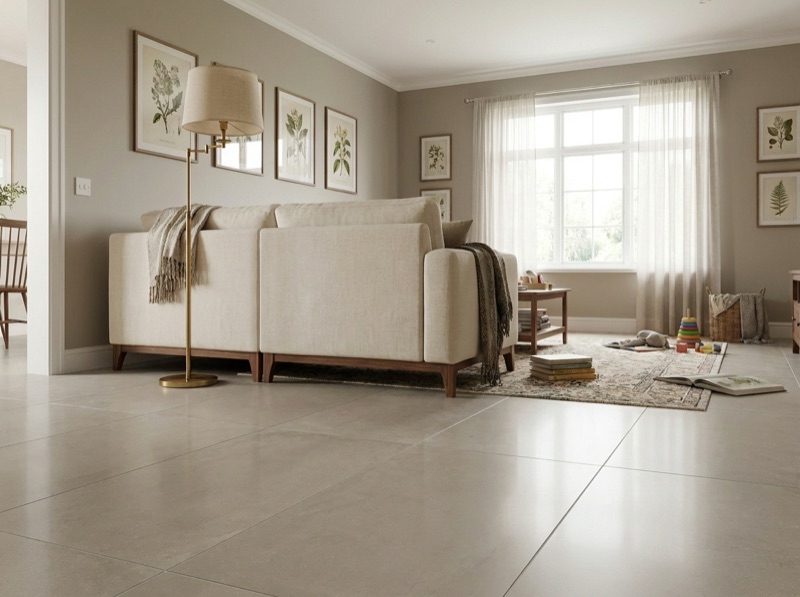
Yes, and tile is actually the material radiant heat pairs with best. The misconception is that heat under a hard, rigid floor is risky, but it's the opposite: tile has no wood core to expand or contract, so it tolerates sustained heat better than any other flooring. What needs planning is the height the system adds at doorways, which the free in-home measure accounts for.
The misconception: that heat under a hard floor is risky
A lot of people assume a hard, rigid floor and a heat source underneath it are a bad combination, the same way a chunk of ice cracks if you pour hot water on it. That instinct is reasonable, and it is also backwards for tile specifically. The belief usually comes from mixing tile up with solid hardwood, where heat and the humidity swings that go with it really are a legitimate concern, since wood expands and contracts as its moisture content changes.
Tile does not have that problem. Our tile page already notes that it pairs with in-floor radiant heat better than any other material we carry, and that is not a marketing line, it is a straightforward property of what tile is made of.
Why tile is the friendliest material for this, not the riskiest
Porcelain and ceramic are fired clay with no wood component anywhere in them, so there is nothing in the tile itself that swells, contracts or dries out as the temperature underneath it changes through a heating cycle. That is the actual reason tile is considered the safest, most straightforward surface to put heat under, not despite being hard and dense but because of it. The same density that makes tile cold in a Missouri kitchen in January is what lets it hold and release heat evenly across the whole floor instead of in patches, which is the entire point of a radiant system in the first place. A floating floor made of separate planks can telegraph the heating element underneath as faint warm and cool lines at the seams. A tiled field bonded solidly to the mortar bed underneath it does not have that problem, since the whole surface is one continuous, fully bonded layer over the heat source rather than a stack of individual pieces resting on top of it.
Where the caution is coming from, and why it doesn't apply here
The instinct is not baseless everywhere, which is part of why it sticks. Grout is more porous and slightly more flexible than the tile itself, and it is the one component in a heated tile floor that repeated warming and cooling cycles put a small amount of ordinary stress on over time, the same seasonal movement any tile floor already accounts for with soft joints. Some wood-look products carry real heat sensitivity too, which is a fair caution on those specific floors. None of that changes what happens under the tile body itself, which is the part actually sitting on top of a radiant mat, and it is why the caution gets misapplied to tile more often than it gets applied correctly.
How it actually goes in under tile
The common version is a thin electric mat or a run of heating cable set into the mortar bed directly beneath the tile, wired to a thermostat that reads a sensor embedded in the floor itself rather than the room's air temperature. Because it sits in that thin mortar layer under the tile rather than cast into a structural slab, it is not exclusively a new-construction feature. It shows up plenty in bathroom and kitchen remodels where the subfloor and tile are being redone anyway, which is the other half of the misconception worth correcting: this is not reserved for a full house renovation, any more than every tile job means tearing out the old floor is a given.
What actually gets decided at the measure
One thing moves from general trade knowledge into a decision about your actual room: the height the mat and its mortar bed add on top of whatever is already there. That matters at a doorway, at a shower curb, and anywhere the tiled room meets a different floor, because a floor that finishes higher than it started has to meet everything around it somewhere. If radiant heat is going in, or if there is already a system under the floor you have now, say so at the free in-home measure so the added height at doorways and thresholds is accounted for before any tile is ordered. That page asks for exactly this kind of detail out loud while everyone is standing in the room, alongside a slab underneath, a spot that leaked once, or a laundry that has flooded. It is a far easier conversation there than after the tile is on a truck. Call 636-332-0654 and mention it up front.
More on radiant heat and tile
Cracking risk, remodels versus new construction, and whether every tile floor actually needs it.
636-332-0654Not when the system is designed for it and installed to the tile manufacturer's own specifications. A properly wired mat brings the floor up gradually rather than in a sudden swing, and tile itself has no wood core to expand or contract as that happens. Problems trace back to installation, an uneven heating cycle or an unsupported spot under the tile, the same causes covered on our tile cracking answer, rather than to the presence of heat itself.
Yes, and it is a common addition during a bathroom or kitchen remodel where the tile is already being replaced. Since the mat sits in the mortar bed under the tile rather than in the structural slab, it does not require rebuilding the room from the studs out. It does add its own layer of thickness, which is why the buildup at doorways and thresholds gets checked at the measure.
No. Radiant heat is an optional add for anyone who wants tile without the cold-floor tradeoff, not a requirement. Plenty of tile floors go in without it and simply stay cool underfoot the way tile naturally does. It is worth raising if a January morning on a bare tile floor is the thing you are trying to avoid, and skipping it entirely if it is not.
Mention radiant heat at the measure
If heat is going under the tile, or is already under the floor you have, say so up front. The free in-home measure accounts for the height it adds at your doorways and thresholds before any tile is ordered.
Free estimate
636-332-0654