 Flooring Correct
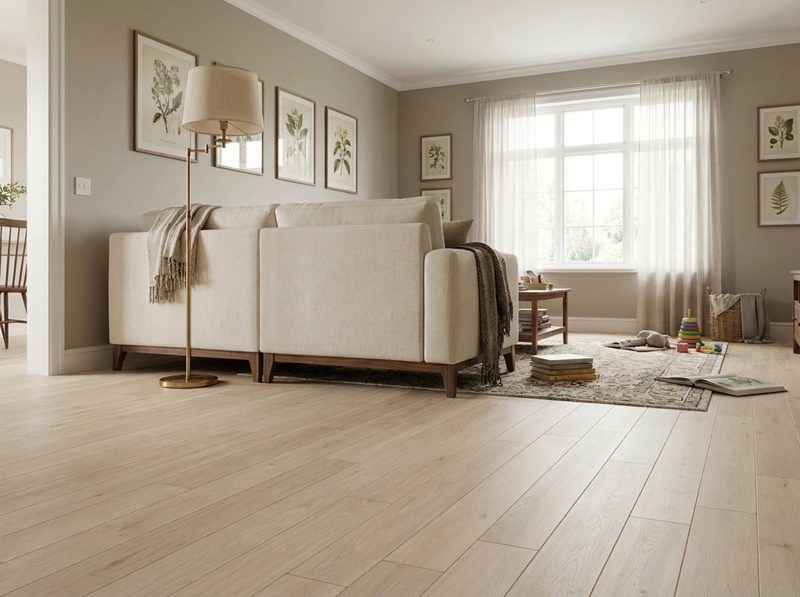
Do you serve O'Fallon?
Yes. O'Fallon sits in St. Charles County, and the Wentzville showroom is 10.9 road miles west of it. Both city ZIP codes, 63366 and 63368, get a free estimate and a free in-home measure. Most O'Fallon work is remodel work, so the useful question is which rooms come first and how the later ones stay matched.
Yes. O'Fallon is in St. Charles County, which is one of the four counties on our service area map. The more useful thing to say about O'Fallon is what its own permit record says: far more residential work here goes into houses that are already standing than into new ones, and <a href="/service-area/ofallon/">the O'Fallon page</a> lays that out. A remodel town buys floors in stages. Flooring bought in stages has a matching problem built into it, and almost nobody hears about it until the second order.
Two cartons of the same floor are not quite the same floor
Flooring is made in runs. Carpet yarn is dyed in lots. Wood is milled from a particular set of logs and finished in a particular batch. A printed vinyl or laminate plank takes its grain from a set of cylinders that wear and get replaced. Inside one run the color is held tight. Between runs it drifts, because dye chemistry, board selection, press pressure and cylinder age all move a little. This is not a defect and no manufacturer hides it. It is why cartons carry a run or lot number on the end label, and why the instruction sheet inside tells the installer to order the whole job together and to work out of several open boxes at once rather than finishing one before opening the next.
The drift is usually small, and small is exactly what makes it awkward. A difference you would never see between two samples held up at the rack becomes plain across a doorway, because the eye is very good at judging two large flat areas that meet along a straight line under the same light.
Why a lived-in house runs into this and an empty one does not
A new house gets its floors in an empty shell, every room at once, out of a single order. A house you live in gets them the way life allows. The main level this year because the carpet finally gave out, the bedrooms when a kid moves out, the lower level whenever the basement gets finished. Each of those is a separate order months or years apart, and by the third one the original run is often long gone. Working room by room is a normal way to do this and we are not talking you out of it.
What it does mean is that a decision belongs at the first order, not the last one. Which rooms are meant to read as one continuous floor, and which rooms are allowed to be different. Those are two different plans, they call for different quantities, and only one of them cares about run numbers at all.
Where a phased floor gives itself away
- A doorway finished flush, with no threshold in it. Two runs meeting on an open line read as two shades. A transition strip breaks the line and hides most of the difference.
- A long sightline. An open main level puts both areas in view from thirty feet away, which is the distance at which a subtle color shift stops being subtle.
- Raking light. Sun coming across the floor from one window exaggerates any difference in sheen between two batches of finish.
- Wood that has already ambered. A floor down for several years has changed color on its own, so even identical product from the identical run will not match the boards next to it.
- A discontinued line. When the product is simply gone, the question stops being about matching and becomes a question about where the change of material should happen.
How to check what is already down, before you order more
The evidence is usually still in the house. Go and find it before the next phase gets ordered.
- Look in a closet, a utility room, the garage shelving or under an appliance for a leftover carton or an offcut. The end label carries the maker, the style name, the color name and the run number, which is the whole answer on one sticker.
- Lift a floor register and look at the cut edge of the plank in the duct opening. Thickness, core color and whether you are looking at solid wood or a wear layer over a core are all visible from there.
- Photograph the floor in daylight and again with the lamps on, from standing height rather than up close. Color memory is unreliable in a way a photograph is not.
- If there is a plank or a piece you can afford to lose, inside a closet or behind a door, take it. A physical piece beats every photograph ever taken.
Then bring it in. Holding your actual floor against full size samples at the rack settles in ten minutes what a phone call cannot settle at all, and it produces the honest version of the answer as well. Sometimes there is a close match. Sometimes there is not, and nobody can promise a discontinued run can be found.
The carton worth keeping
When the first order lands, keep one full carton back, and keep it inside the conditioned part of the house rather than in a garage or a crawlspace where damp and temperature swings will get at it. It is the simplest insurance there is on a floor: a plank to repair a gouge with, a piece to carry to the showroom when the next room comes up, and a label with the run number on it that answers half of what the second order will ask.
Raise the staging question at the measure, because it is a tape measure question. Should the rooms you are planning for later be included in the first quantity, or is a deliberate change of material at the doorway the better plan. The rest of the four county map works the same way, and the nearest towns each have their own note, including St. Peters and Dardenne Prairie. Call 636-332-0654 and say which rooms are now and which ones are later.
Follow-up questions from houses done in stages
Offcuts, ordering ahead, and whether the doorway needs a strip in it.
636-332-0654Usually, yes. An offcut carries the finish, the sheen, the thickness and the edge profile, and those are the four things a match is judged on. What it will not carry is the run number, which lives on the carton label. Bring the offcut anyway and bring a daylight photo of the installed floor with it, because a piece that has sat in a garage for six years has not aged the way the floor in the hallway has.
Sometimes, and it is worth pricing both ways before you decide. Ordering everything together removes the run question entirely and gives you leftover material for repairs. Against that, material for rooms you are not touching yet has to be stored somewhere dry and conditioned for however long the wait is, and plans change. Ask at the measure which rooms genuinely need to match and order to that answer rather than to the whole house.
No, and plenty of open plans are better without one. A threshold earns its place where two floors of different thickness meet, where a room changes material, or where two production runs of the same product come together and you would rather the line be a deliberate detail than a mystery. Where the floor is continuous and the heights agree, running straight through the doorway looks better and there is nothing to catch a toe on.
Measure the rooms you are doing now, name the ones you are not
Tell us which rooms come first and which ones are meant to match them later. We measure what is there, look at whatever is already down beside it, and put the quantity question in the quote instead of leaving it for the second order to discover.
Free estimate
636-332-0654