 Flooring Correct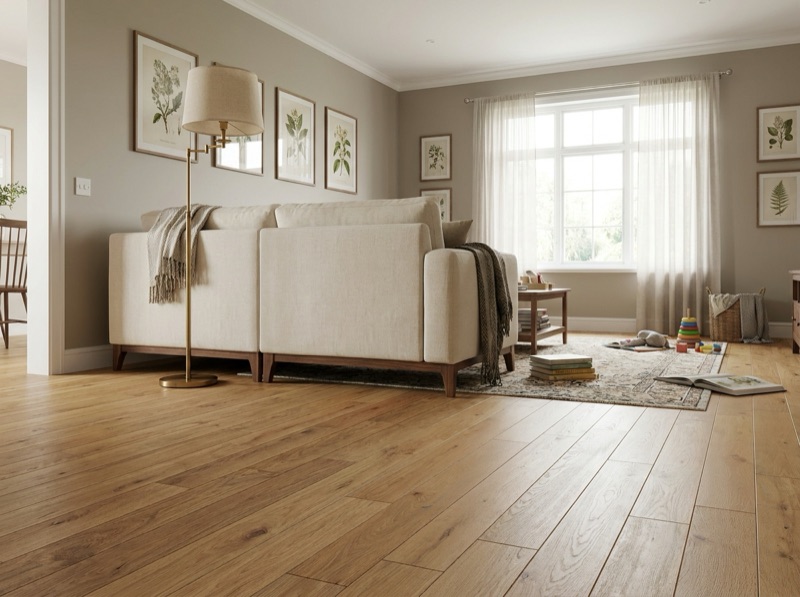
DCOF
What is a DCOF slip rating?
DCOF stands for dynamic coefficient of friction. It is a measured value for how much grip a tile surface gives to something already sliding across it while wet. For level interior floors expected to be walked on wet, 0.42 is the accepted minimum, and the figure belongs on the sample tag or the manufacturer sheet.
The decision in front of you is not whether a tile is slippery. Every tile is slippery under the right film of water, and every tile is fine under the wrong one. The decision is how much grip to buy for a specific wet floor, knowing that grip comes from texture and texture is one more thing to keep clean. DCOF is the number that lets you make that trade with something better than a thumb rubbed across a sample.
What the number is, and how it gets produced
Dynamic coefficient of friction describes resistance to sliding once motion has already started, which is the situation a foot is in when it goes out from under someone. It is measured with a machine that drags a weighted, standardized sensor across the tile at a controlled speed, over a surface wetted with a solution containing a wetting agent so the water actually spreads instead of beading. ANSI A137.1 defines the procedure and sets the mark: 0.42 or greater for tile going into level interior spaces expected to be walked on when wet.
Two words in that sentence do a lot of work. Level means flat, so a ramp or a floor sloped to a drain is outside what the threshold was written for. Interior means indoors. The number is a qualifying line for a defined condition, not a score out of one, and a tile at 0.42 has not scraped through while a tile well above it wins.
It is also worth knowing why the industry moved to a dynamic figure at all. An older static test measured the force needed to start a stationary weight moving, which described a foot that was standing still and about to fail rather than a foot that was already sliding. The newer method reads the condition people actually get hurt in. If you find an old spec sheet quoting a static value, it is not a version of the same measurement and the two should not be compared.
The three real options for a wet floor
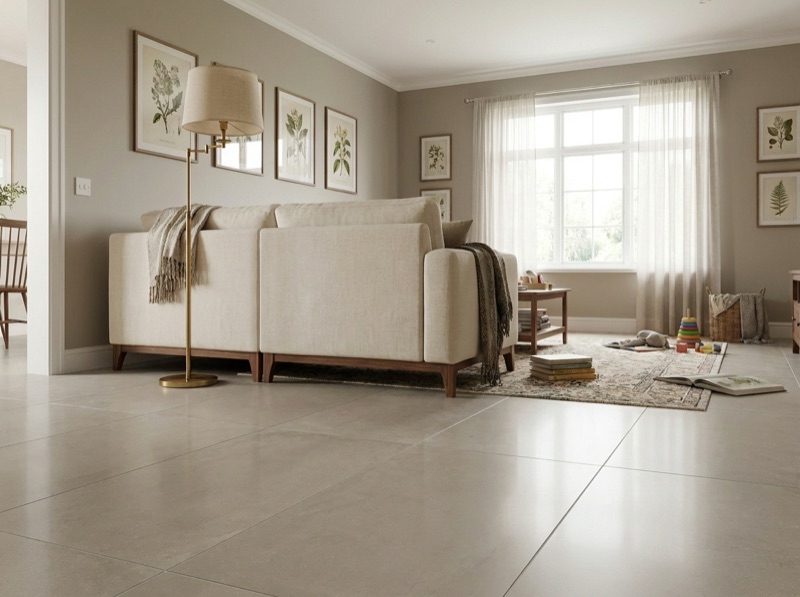
- Smooth and polished. High gloss, mirror finishes, polished porcelain and polished stone. They throw light around a room beautifully and they are the right answer on a wall, a backsplash or a floor that stays dry. On a wet floor they are the option you rule out first.
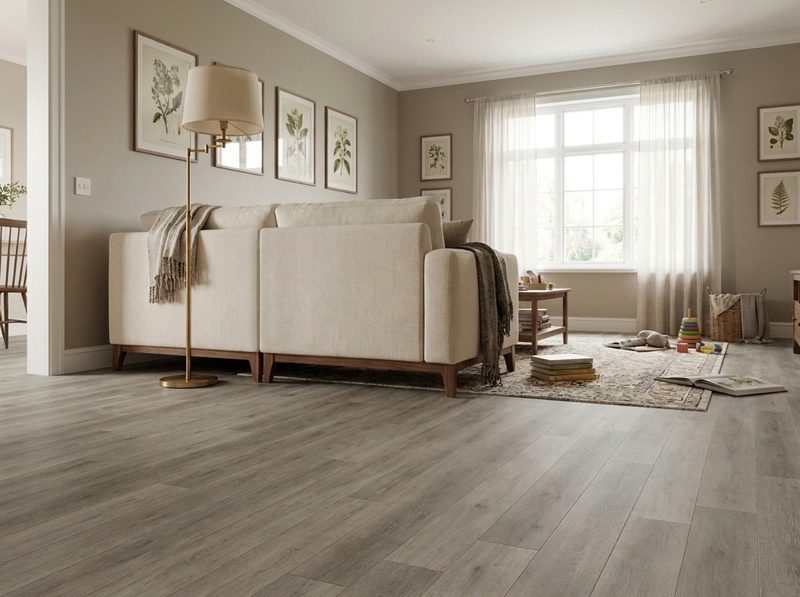
- Matte or lightly textured field tile that meets the threshold. This is the default for most bathrooms, kitchens, laundry rooms and entries, and there is far more of it than people expect. The texture is subtle enough that a mop still glides and visible enough that a wet foot has something to hold.
- Heavily structured, grit faced, or small format with a dense grid of joints. Shower floors, commercial entries, a sunroom that takes rain through an open door. Grip goes up sharply and so does the cleaning, and this is where mosaic sheets earn their reputation, since the joints themselves supply edges for a foot to catch.
The conditions that pick between them
Once the three options are on the table, the room chooses. Work through these honestly rather than optimistically, because the honest version is what you will live with.
- Bare feet or shoes. Wet skin behaves differently on tile than a rubber sole does, and the rooms with bare feet are the ones with soap in the water.
- Does water sit or pass through. A splash zone by a tub dries in minutes. A shower floor is wet as a permanent condition.
- Soap, shampoo and conditioner. Film is a bigger slip factor than plain water, and it also fills a shallow texture, which is how a floor gets more slippery over time without changing at all.
- Who uses the room. Someone unsteady on their feet, a parent carrying a toddler, a teenager who runs on wet feet. This is the condition that should outvote the others.
- What comes in the door. Snowmelt and road salt off a driveway make an entry a wet floor for most of a Missouri winter, whatever the room is called.
- Slope. A floor pitched to a drain is a different problem, and the threshold does not cover it.
Notice that most of that list is about the room rather than the tile. That is deliberate. The same tile is the right call in a hall bath used by two adults and the wrong call in a bath a grandparent uses every morning, and no figure on a tag knows which house it is going into. Say the awkward parts out loud when you are choosing, because that is the information that changes a recommendation.
What grip costs you
Texture is a trap for soil. A structured surface holds onto grease in a kitchen, body oils and soap scum in a shower, and grit anywhere near a door, and it takes a stiffer brush and more frequent attention than a smooth face ever will. That is not a reason to avoid texture where it is needed. It is a reason not to buy more of it than the room actually asks for, which is why a heavily textured tile run all over a main floor tends to disappoint the person who ends up cleaning it.
There is a look cost too. Deep gloss reflects light and makes a small room read larger, and giving that up is a real design decision rather than a technicality. A matte face hides film and dried water spots better than gloss does, so it usually looks cleaner between cleanings even where both are safe. This is a different dial from the abrasion class, and it is worth reading how the wear class works so you do not confuse the two numbers on the same tag.
What the figure does not cover
It does not cover exterior surfaces, ramps or sloped floors. It does not account for oil, wax or a coat of the wrong cleaner left behind, all of which change a floor's behavior far more than a tenth of a point of rating does. It does not describe socks on tile, which is its own hazard and one no product fixes. And it is a measurement, not a promise about what happens on a bad day.
The other half of the answer is not the tile at all. A mat inside every exterior door, a squeegee kept in the shower, a floor that drains where it should and grout kept clean so the texture stays open all matter alongside the number. Tile is one part of a wet floor, as the tile overview lays out, and the rest gets settled room by room.
What else people ask about wet grip
Whether more is always better, what a matte finish really tells you, and the part the joints play.
636-332-0654Higher is not automatically better, and treating the number as a score to maximize leads people to floors they resent cleaning. The threshold exists for a defined condition. Above it, more texture buys diminishing grip and adds real maintenance, and a textured floor that stops getting scrubbed loses its advantage as the texture fills with film. Match the tile to the room rather than to the highest figure on the rack.
No. Matte describes how a surface reflects light and DCOF describes how it behaves under a wet load, and the two do not track each other reliably. Plenty of matte tiles fall below the threshold and a few surprisingly smooth looking ones sit above it. The only way to know is the stated figure, which is why the tag matters more than the impression.
In practice yes, even though grout is not what the test measures. A field of small tiles puts far more joint length under a foot, and every joint is a slight recess with two edges, which is a large part of why shower pans are tiled in small formats. That effect disappears if the joints are ground flush or filled level with an epoxy.
Bring the tile, or bring the tag
The wet figure is printed on the sample tag and on the manufacturer sheet behind it. Bring the tile you are considering to the Wentzville showroom and we will read the number off the tag with you, and tell you what it does and does not cover for your room.
Free estimate
636-332-0654