 Flooring Correct
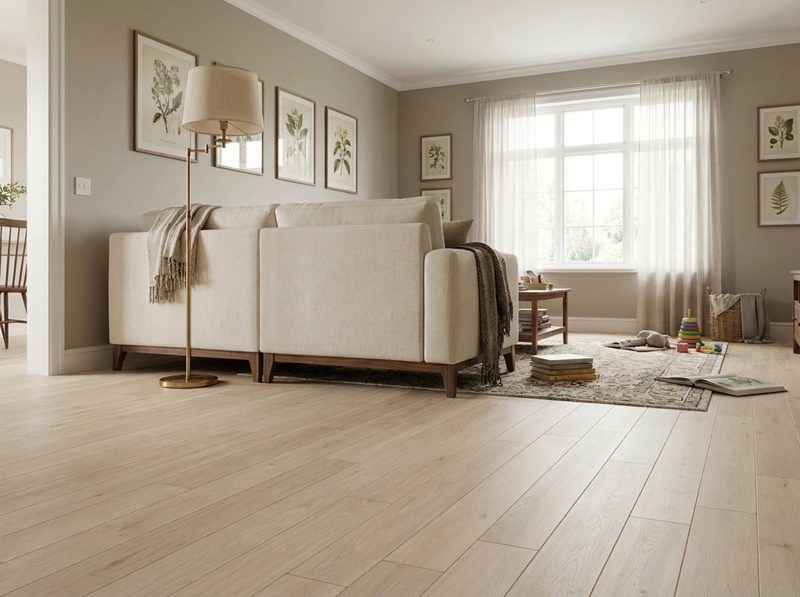
Do carpet tiles look commercial in a home?
Not if it is chosen with a home in mind. The office association comes from one specific look, a single flat low-contrast color on a tight, hard surface run the same direction across a wide open floor. Those are color, texture and layout decisions rather than properties of the material, and all three are yours to make.
The scope of where carpet tile actually gets used, offices, showrooms and schools among them, is covered in full on our commercial flooring page. That history is exactly why the belief exists, and it deserves a straight answer rather than a dismissal.
Where the assumption comes from
Most people who have seen carpet tile at all have seen it in a lobby, a classroom hallway or a cubicle floor, laid the fastest way a large commercial job usually calls for, every tile set the same direction in one flat color so the grid lines up in a uniform pattern across a wide open space. That look is real. The mistake is assuming it is the only thing the format can do, when it is a set of decisions made for a building that takes constant traffic and a cleaning routine that will never be gentle, not for how a bedroom or a family room is supposed to feel.
What actually reads as domestic
Layout is the lever most people reach for first, and the full menu of it, straight run, quarter turn, and what plank formats can do, is set out on our carpet tile page. Settle that part there. What the layout menu does not cover is everything else your eye is reading, and in a house that turns out to matter more.
Color depth is most of it. The office floor is a single flat, mid-tone, low-contrast color, picked so that nothing shows and nothing dates, and it is the flatness rather than the grid that tells you where you are standing. A color with visible movement in it, lighter and darker yarn worked through the same tile, breaks the association before the layout ever gets a chance to. The same goes for contrast against the room: a floor that relates to the wall color and the trim reads as a decision somebody made, and a floor that relates to nothing reads as a floor that came with the building.
Texture is the second thing, and it is the one people underestimate because a photo cannot carry it. A tight, low, dense loop is the surface built to survive rolling chairs and a cleaning routine that will never be gentle, and that hard, flat pile is a large part of what registers as commercial underfoot. Modular formats also come in softer and taller constructions, and they feel and read much closer to what people expect in a house. This is the one to test with your feet rather than your eyes, and it is worth asking at the rack for the softest construction in a line before you judge the format.
Scale is the third. A large square in a wide open floor plate looks like a wide open floor plate, because there is nothing in the room to interrupt the repeat. The same tile in a bedroom, a home office or a finished basement sits under furniture, gets crossed by a rug and meets a wall every few feet, so the room breaks up the grid long before anyone reads it as a pattern. A rug over the middle of it does more to domesticate a modular floor than any layout choice, and it is the easiest thing to try before you commit to anything else.
What follows from that
The layout decision belongs at the showroom, standing over samples set out the way they would actually be installed, not guessed from a single tile held up to the light. A room's own character plays into it too. A home office that leans into the practical logic of carpet tile, the rolling chair, the replaceable square, can lean into a straight-run layout without apology, since the room already reads as a working space. A living room or a finished basement meant to feel like the rest of the house wants the quarter-turn or the blended pattern doing more of the work, so the floor reads as a considered choice rather than a leftover from an office supply closet.
Settle it at the measure
Layout direction is one of the things the free in-home measure settles once the room's actual shape and light are in front of us, since a pattern that reads well in a wide open floor plan can behave differently in a narrow, sectioned room. Bring a photo of the room and, if you have one, a rough sense of where the light comes from during the day, because raking light from a window is exactly what makes a grid pattern stand out or disappear into the floor. That is the same question the measure settles for a stair carpet's nap direction or a hardwood room's board layout, just applied to a different material.
At the Wentzville showroom, samples of the same line can be laid out both ways on the floor while you stand over them, so the difference between a straight run and a quarter turn is something you see rather than something you have to take on faith. Call 636-332-0654.
What else people ask about the commercial look
Install time, hiding the grid, and how close plank formats get to broadloom.
636-332-0654It takes a layout that is set out and checked before any adhesive goes down, since the rotation has to stay consistent from the starting row outward and the cuts along the walls land differently than they do in a straight run. That is one of the details the in-home measure settles, once the room's real dimensions and its light are in hand rather than guessed at.
A quarter-turn layout or a pattern-blended line generally hides the repeating joint better than a straight run, since the eye has less of a uniform grid to lock onto. Bring the room's light exposure into that conversation, since a window at a low angle can make any joint more visible regardless of layout.
It can get close in overall feel, especially run in straight rows or a brick offset, though a repeating joint is still part of how the format works. The full continuous-versus-repairable comparison against broadloom is covered on its own page if that is the real decision on the table.
See the layout against your room
Tell us the room and where the light comes from during the day. We measure in person and lay out samples the way they would actually be installed, straight run or quarter turn.
Free estimate
636-332-0654