 Flooring Correct
Does floor tile need to be sealed?
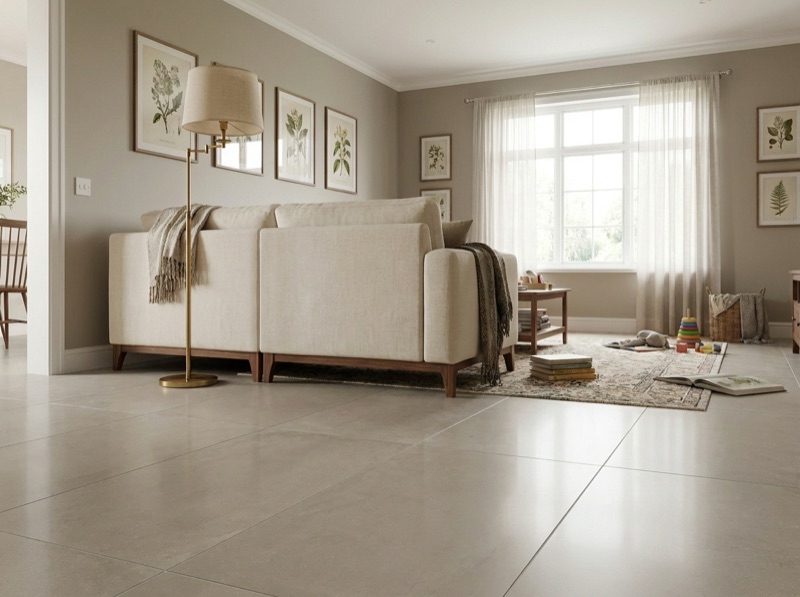
It depends what the tile is made of, not whether it's tile. Porcelain and most glazed ceramic don't need sealing, since the glaze itself is the water barrier. Natural stone is different: marble, travertine, slate and limestone are porous by nature and do need sealing, plus resealing on a schedule. Skipping that on stone, or worrying about it needlessly on porcelain, are the two opposite mistakes people make.
What you gain by leaving it unsealed: porcelain and most ceramic
Porcelain earns a pass on sealing because of what it is made of, not because sealing was skipped as a shortcut. Our tile page covers the density difference between porcelain and ceramic in full, and the practical result of that density is a surface dense enough that water has almost nothing to soak into. Most glazed ceramic gets the same pass for a different reason: the glaze fired onto the surface, not the clay body underneath it, is what actually meets the water, and a glaze is its own watertight layer.
What you give up is honest, if minor. Porcelain does not develop the character some homeowners want from a floor over the years, since there is nothing in it to weather or change. And a porcelain floor printed to look like stone will always be printed to look like stone up close, however convincing it is from across the room.
What you gain by sealing: natural stone
Stone is porous because it is quarried rather than manufactured, which the tile pillar covers along with what a stone floor asks of you once it is down. What is worth adding here is what a sealer actually is, because that is where the confusion starts. The usual sealer on a stone floor soaks into the pores and sits below the surface. It is not a film you can see. So it never looks new, it never looks worn, and it never announces that it has stopped working. It just quietly stops holding a spill back some time after it went on.
That invisibility is the whole reason stone care is a habit rather than a repair. Nothing about the floor tells you the sealer is finished, so it either gets renewed on a rhythm you keep or it does not get renewed at all. And a sealer was never a force field. What it buys you is the time between a spill landing and you noticing it, which is a genuinely useful thing to own and a very different thing from a surface that cannot be marked at all. The cleaner you keep under the sink matters as much as the sealer does, which is the other half of stone upkeep.
Where each side actually wins
A kitchen that gets real cooking, an entry with winter grit and wet boots, or a bathroom used every morning is where porcelain's no-maintenance case is strongest, because those are exactly the rooms where a sealing schedule is easiest to forget and hardest to afford forgetting. A formal entry, a fireplace surround or a low-traffic accent where the natural variation of real stone is the whole point is where stone earns its upkeep. If the look is what you are after and the upkeep is not, a stone-look porcelain answers the sealing question by never raising it, and the pillar makes that case in full. The narrower decision this page can help with is whether you want a floor that asks something of you every so often, or one that never asks anything at all.
A quick way to guess before you check
There is a tell you can look for without any tools. Natural stone never repeats a pattern exactly, since no two pieces come out of the ground the same way, so veining that looks identical from tile to tile across the floor is a sign you are looking at a printed porcelain rather than the real thing. It is not foolproof on its own, since high-quality porcelain now uses large digital print runs with dozens of unique faces, but seeing the same vein turn up on the third or fourth tile you check is a strong hint you are looking at porcelain, not stone.
The mistake this page is meant to prevent
It runs in two directions. One is buying real stone without knowing the sealing habit that comes with it, then finding an etch mark from a splash of wine or the wrong cleaner months later and wondering what went wrong. The other is worrying about sealing a porcelain floor that was never porous to begin with, sometimes even paying for a sealing service it does not need. Both come from the same gap: not knowing which material is actually underfoot.
If you are working from an existing floor rather than starting fresh, bring a spare tile, a box label, or even just a clear photo to the showroom, and we will tell you plainly whether it is porcelain, ceramic or a real stone, and what that means for how you clean it. If you are choosing new, ask the question in the showroom before anything is ordered, and the free in-home measure confirms the rest. Call 636-332-0654.
More on sealing and material identification
Telling porcelain from ceramic from real stone, what happens if stone goes unsealed, and where the grout question actually lives.
636-332-0654Look at a chipped edge or the underside of a spare piece if you have one. Through body porcelain carries its color all the way through, so a chip shows the same color as the surface. Plenty of porcelain is glazed instead and shows a paler body at a chip, the same as ceramic, which is why a chip test narrows it down rather than settling it. Natural stone shows visible grain, veining or pitting that no printed tile fully matches. Bringing a spare piece or a clear photo to the showroom is the fastest way to get a straight answer.
It stays porous, which means everyday spills, cooking oil and acidic liquids can soak in and stain before you get to them, and the stone is more vulnerable to etching from anything acidic. Sealing does not make stone indestructible, but skipping it entirely removes the buffer that gives you time to wipe a spill before it becomes permanent.
The tile itself, no, since the body is dense enough that sealing has nothing meaningful to do. The grout between the tiles is a different material with a different answer, and whether it needs sealing is covered on our tile page, since cement grout and epoxy grout are treated differently there.
Bring a spare piece so we can identify it
A chipped tile, a box label, or a clear photo is enough for us to tell you plainly what you have and whether it needs sealing at all.
Free estimate
636-332-0654