 Flooring Correct
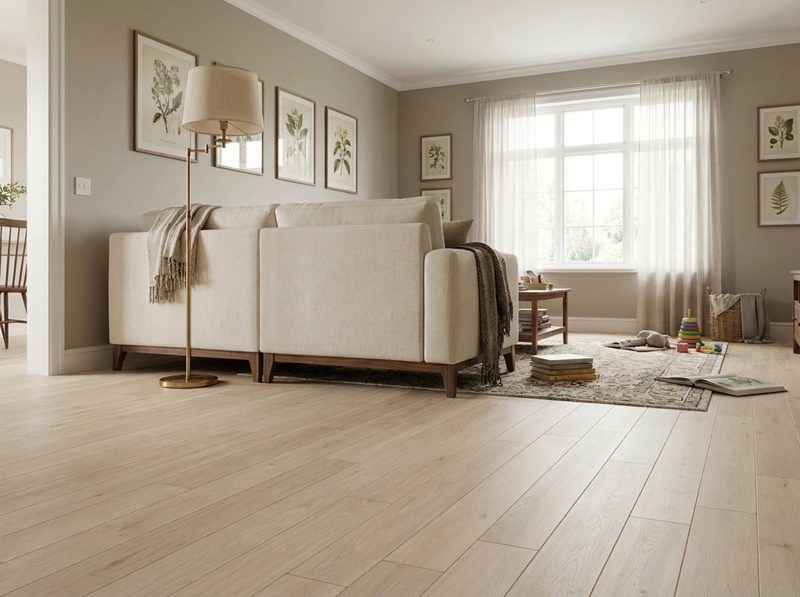
Does LVP fade in sunlight?
Yes, but slowly, over years of direct exposure rather than anything you would notice in a season. Ultraviolet light passes through the clear wear layer and breaks down the pigment in the printed layer underneath it. The step that decides how much it matters is direct, unfiltered sun through west-facing glass versus indirect light. Fade shows up as an outline, not an even shift.
Yes, over years rather than weeks, and the sequence behind it is worth understanding because one step in it decides almost the whole outcome.
Where the sequence actually starts
A plank is a stack, and light has to pass through the top of it before fading is even possible. The clear wear layer sits on top and does not carry color itself, so it is mostly a window. Underneath it is the printed layer carrying the wood or stone image, and that is where the actual pigment lives. Sunlight passes through the wear layer, reaches the print, and that is the first step in a process that plays out over years rather than a single afternoon.
What happens between year one and year five
Ultraviolet light breaks down pigment slowly, the same way it fades a car dashboard or a curtain left in a bright window. Nothing about a single sunny day changes a floor. What changes it is thousands of days of the same light hitting the same strip of floor while the rest of the room, protected by furniture, rugs or simple distance from the window, keeps its original color. The gap between the two is what eventually becomes visible.
The step that actually decides how much this matters
Every other factor in this sequence is roughly fixed by the product you bought. This one is not, and it is the step worth paying attention to. Direct, unfiltered sunlight hitting the same patch of floor for hours a day, especially through west-facing glass in the afternoon, is a completely different exposure than the same room lit by indirect daylight or light that has to cross the room first. A sunroom or a room with floor-to-ceiling west glass sees this decade over decade. A hallway lit indirectly through a doorway essentially does not. The floor is the same in both rooms. The outcome will not be.
Glass itself changes the equation too. Standard window glass blocks some of the ultraviolet spectrum but not all of it, and older single-pane glass blocks less than a newer low-e unit does. None of that is something the flooring showroom controls, but it is worth knowing before you assume the floor is the only variable in the room.
Why fade shows up as a shape, not a haze
The way this becomes visible is rarely an even, floor-wide shift that nobody notices happening. It shows up as an outline: the rectangle where a rug sat for years, the shadow line at the edge of a sofa, a lighter band running exactly where the sun crosses the floor each afternoon and a darker strip a few feet away that never sees it directly. That contrast, not a uniform lightening, is what actually reads as damage, because a floor that faded evenly everywhere would barely register.
What narrows the material choice down
For a room that genuinely gets hours of direct sun, this is worth raising before you pick a color rather than after. Mid-tone planks with real grain variation hide the gradual shift better than a flat, deep, uniform tone does, because there is already visual texture in the surface for a slight change to disappear into. A matte or low sheen finish helps for the same reason it helps with everyday scuffs, discussed on the pillar page: less reflected light means less contrast between a worn area and an untouched one. None of this stops the underlying process. It just decides how visible the result eventually is.
What you can do about the room, not just the floor
Sheer curtains, blinds, or a UV window film cut down the exposure at the source, which is the only step in this sequence that actually slows the clock rather than just hiding the result. Moving a rug or a piece of furniture every year or two so the same strip is not permanently shaded is the low-effort version of the same idea. Neither eliminates the process. Both change how long it takes to become visible, which for a room you plan to live in for years is often the more useful question than whether it happens at all.
What else people ask about fading
Warranty coverage, wear layer thickness, and whether window treatments actually change anything.
636-332-0654Not really, because wear layer thickness is about resisting scratches and wear, not blocking ultraviolet light. Fading happens to the printed layer underneath the wear layer, so a heavier wear layer does not meaningfully change how much light reaches the pigment below it.
Yes, and that is usually how fading actually gets noticed. The area under a rug or a sofa stays its original color while the exposed floor around it slowly shifts, and the contrast between the two, not an even change across the whole room, is what people see first.
It genuinely does, because it reduces the ultraviolet exposure reaching the floor at the source rather than trying to make the floor resist something it cannot fully resist. It is one of the few steps in this process that changes the timeline rather than just the outcome once it has already happened.
That depends on the specific product and manufacturer, and it is not something to assume either way. Ask about it directly when you are choosing a line for a room that gets significant direct sun, and we will pull the actual warranty language for that product rather than guess.
Narrow the color down for a sun-heavy room
Tell us which rooms get direct afternoon sun and which windows it comes through. We will steer you toward mid-tone, matte-finish samples that hide the process instead of showing it off, and settle the rest at the measure.
Free estimate
636-332-0654