 Flooring Correct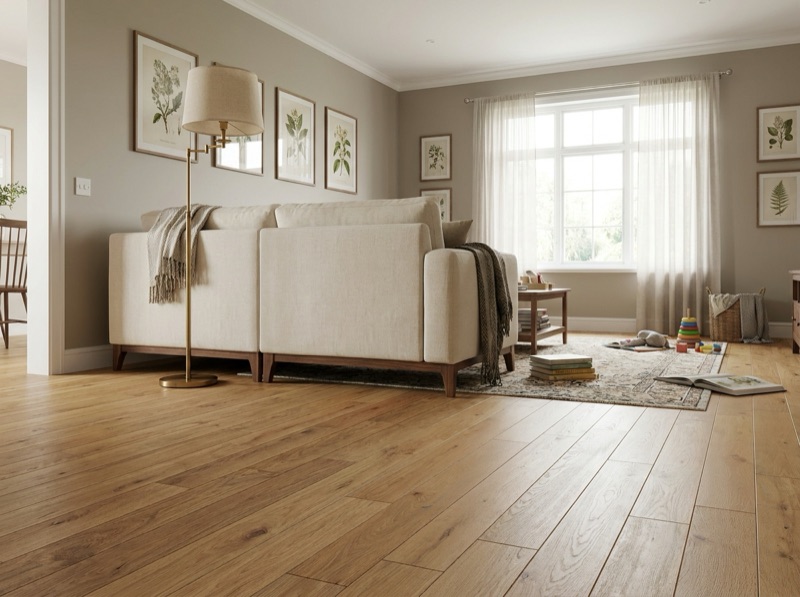

Does LVP need expansion gaps?
Yes. A floating luxury vinyl plank floor needs a small gap around the perimeter, hidden behind the base trim, so the connected field of planks can expand and contract with the seasons. You can check for it yourself by pulling a short piece of quarter round and looking behind it. A tight or missing gap is an early warning sign, not a normal variation.
Yes, and you can check for it yourself with nothing more than a flathead screwdriver and a loose piece of shoe molding.
The test you can run yourself
Pick any wall the flooring runs up to and gently pry off a short length of the quarter round or shoe molding covering the joint, or look behind a piece of furniture where the base trim sits a little loose. Behind that trim, between the edge of the last plank and the wall itself, there should be a visible gap rather than the plank butting straight up against the drywall or the baseboard.
What a visible gap actually tells you
A gap at the perimeter means the floor was installed the way most luxury vinyl plank wants to be, floating free over the subfloor rather than locked tight to the walls. The pillar page covers why the floor floats in the first place, and this gap is the physical proof of that decision. It gives the whole connected field of planks somewhere to go as the room's temperature and humidity shift through a Missouri year, expanding slightly in summer and contracting a little in winter, without pushing against anything solid on the way.
That is also why the trim covers it. The gap is not a flaw to hide, it is a working part of the floor doing exactly what it is supposed to do, and the baseboard or quarter round simply keeps it out of sight while leaving it free to close and open with the seasons.
What a tight or missing gap is warning you about
If the plank sits snug against the wall with no room at all, or if you press down near the edge of the room and feel the surface resist or see a slight ridge where two rows meet, that is the floor telling you it has nowhere left to expand into. The visible symptom of a floor that ran out of room is usually a subtle peaking along a seam or a section that no longer sits flat, and that specific failure is covered in full on its own page rather than here.
What this test does not tell you
A visible perimeter gap confirms the floor is floating and has room at the edges. It does not confirm the floor is glued down correctly if that is the construction you actually have, because a bonded installation follows a different set of rules entirely and does not need this gap in the same way. It also does not tell you anything about what is happening underneath the floor. A subfloor that was not properly checked for moisture or flatness before installation can cause problems that look similar to an expansion issue but have nothing to do with the gap at the wall.
It also will not tell you whether a large, open room got the breaks it may have needed partway through the run. Big open floor plans sometimes call for a transition strip or a control joint partway across a long, unbroken stretch of flooring, and exactly when that applies varies by manufacturer and product line. That figure lives on the specific product's installation instructions rather than as a single rule that applies to every plank we carry, so it is worth asking about directly for the line you are considering.
How much room the perimeter actually needs
A floating floor is left a small clearance around the perimeter, wide enough for ordinary seasonal movement and narrow enough that the base trim hides it without a struggle. There is no single figure that covers every plank. Each manufacturer publishes its own for each product, that number is printed in the installation instructions that come in the box, and it is what an installer works to rather than a rule of thumb carried over from another floor. If you want the figure for a specific line, ask for the line by name and the answer comes off that manufacturer's own sheet. That is also why a gap that looks wide is not automatically wrong: a thicker plank over a longer unbroken run has more movement to absorb than a small room does, and the instructions account for it.
What to look at in person, not on a screen
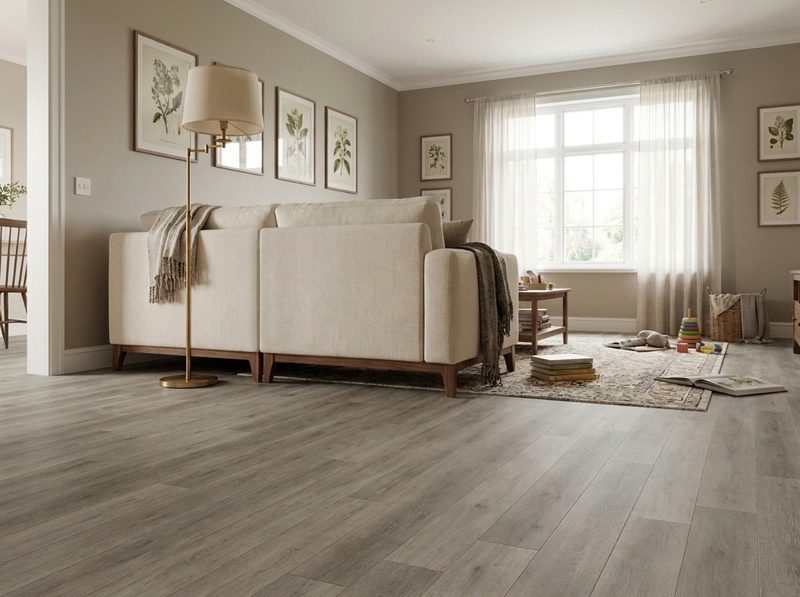
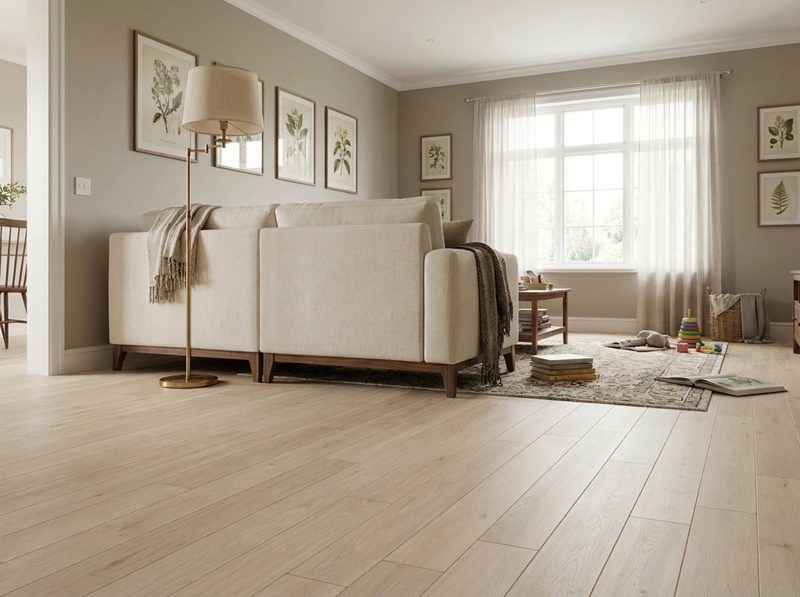
A photo of a finished room cannot show you a gap that lives behind the trim by design, and it cannot show you how a specific product's locking edge, core thickness or attached pad behaves at a transition. In the Wentzville showroom the product is out on the floor rather than in a binder, so you can pick up a full plank of the line you are considering, feel the texture and look at the locking edge on the actual product instead of a photograph of one. Samples go home with you as well, which is the only honest way to see how a plank reads next to your own trim and cabinets rather than under showroom lighting.
What else people ask about expansion gaps
Glue-down versus floating, large open rooms, and what to do if a gap looks uneven.
636-332-0654Floating installations do, since the whole field of planks is one connected unit that needs somewhere to move. Glue-down installations, where each plank is bonded directly to the subfloor, follow different rules and generally do not rely on a perimeter gap the same way.
Over time, as the floor tries to expand with heat and humidity and has nowhere to go, it can start pushing against the wall or against itself at a seam, which shows up as a slight ridge or a section that no longer lies flat. That is a different problem from a scratch or a stain and worth having looked at.
The overall size of the run matters more than the room's shape, and very large open areas sometimes need a break partway across rather than a single wider gap around the outside edge. Exactly where that threshold falls depends on the specific product, so it is worth checking the manufacturer's instructions for the line you choose.
It is worth understanding what you are looking at before doing anything to it. That gap is a working part of a floating floor, not a mistake, and it is normally covered by base trim rather than left bare. If it looks unusually wide or uneven, that is worth mentioning to us rather than filling in yourself.
See the real thing in person
A screen cannot show you a gap that lives behind the trim by design. Come pick up a full plank in Wentzville and look at the locking edge for yourself, then we will measure your rooms and settle the layout at the free in-home measure.
Free estimate
636-332-0654