 Flooring Correct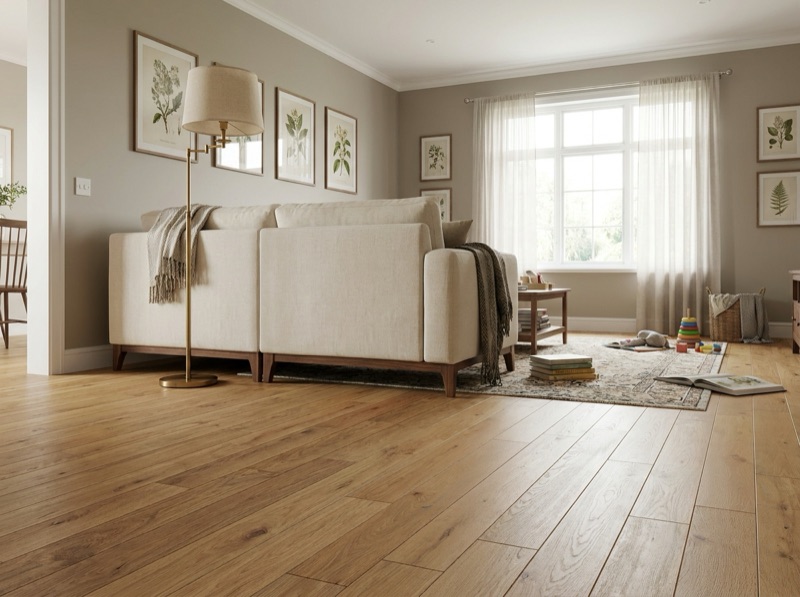
Should floors be lighter or darker than cabinets?
Either can work. What decides it is not a rule about light or dark, it is how much contrast you actually want between the two fixed surfaces in the room. Close values blend the floor and cabinets into one continuous plane. A wider gap, in either direction, defines the kitchen as its own zone. Start from the cabinets, since they are the one that is not changing.
Start with the cabinets, not the floor
The floor is the piece that is easiest to change again later and the cabinets are the piece that is not, so the sequence that actually works starts at the cabinets every time, never the other way around. Whatever the cabinet color and finish already are, warm oak, painted white, a dark stained maple, that is the fixed point the floor has to sit next to for years. Bring the actual cabinet door, not a memory of its color, because cabinet finishes carry an undertone that is hard to describe accurately and easy to see the moment a real floor sample sits beside it.
The step that actually decides the outcome
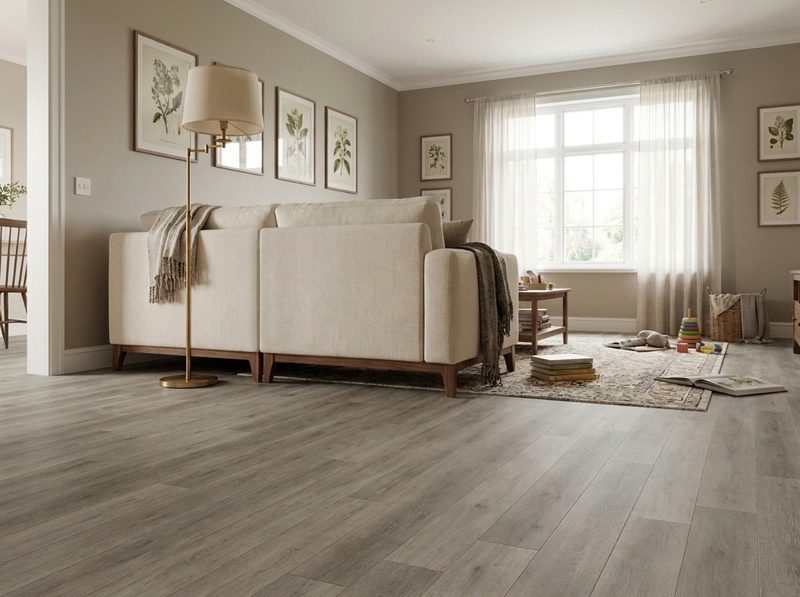
Once the cabinet is in hand, the real decision is not whether to go lighter or darker, it is how much contrast you want between the floor and the cabinet, and this is the step that actually settles the look of the whole kitchen. A floor close to the cabinet's own value blends the two into one continuous plane, which reads calm and makes a smaller kitchen feel less broken up into pieces. A floor with a wider gap from the cabinet, lighter under a dark cabinet or darker under a light one, defines the floor and the cabinetry as two distinct zones, which reads more dramatic and tends to suit a larger kitchen better than a small one. Neither is more correct. It is the amount of contrast, chosen on purpose, that decides which kitchen you end up with.
Where the counter surface fits into the decision
The counter surface is the third fixed element in the room, and it is worth setting the floor sample against it at the same time as the cabinet door, because a floor that reads well against the cabinet alone can still fight a counter surface with a strong pattern or a cool undertone. A busy stone-look counter surface generally wants a quieter floor underneath it, since two loud surfaces in the same small room compete rather than complement each other.
Checking it under the kitchen's own light
Kitchen lighting is unusual, mixing overhead fixtures, under-cabinet task lighting and whatever window light the room gets, often all at once, and a sample that looks settled under one of those can shift under the others. Set the floor sample against the cabinet door directly under the cabinet, not on a counter across the room, and look at it with the task lighting on, since that is the light the floor will actually be judged under most evenings. Morning and afternoon daylight change the read again, especially in a kitchen with a window over the sink or a door to a patio, so a decision made under evening task lighting alone can still surprise you at breakfast the next day.
What this does not decide for you
Contrast settles the look, but it does not settle the material, and a kitchen has real material requirements that a color decision does not touch: water, dropped pans and standing comfort, all covered on the kitchen page. It is entirely possible to want a high-contrast dark floor and land on a material that does not suit a kitchen at all, so treat the contrast question and the material question as two separate decisions that both have to clear before you order anything. A dark tone is available across several materials that handle a kitchen well, so wanting the contrast does not force a compromise on durability, it just narrows the shortlist rather than settling it outright.
Bringing it together at the showroom
Bring the cabinet door and a piece of the counter surface if you have an offcut, and we will hold full size flooring pieces against both under real light rather than a two inch chip. Our gallery has kitchens at both ends of the contrast range, worth a look before you decide which one you actually want to live in. The free in-home measure is where the final material gets settled against your kitchen's actual light and layout. Call 636-332-0654.
More on floors and cabinet color
Close matches, dark-on-dark pairings, and what happens when the island does not match the rest of the cabinets.
636-332-0654Not a mistake, but worth choosing on purpose rather than by accident. A close match blends the room into one calm plane, which some kitchens want, though it can also make a small kitchen feel like it has less going on to look at. It is a legitimate choice, not a fallback.
It depends heavily on the room's light and size. A dark-on-dark kitchen with strong natural light and enough square footage can look striking rather than heavy, while the same pairing in a small, dim kitchen with few windows is a harder combination to pull off well.
Usually the perimeter cabinets take priority, since they cover more of the room's sightline, but a strongly contrasting island is worth bringing to the showroom on its own. Sometimes the floor is chosen to bridge the two rather than match either one exactly.
Bring the cabinet door, we will narrow the family
Hold real flooring against your actual cabinet under the room's own light and we will narrow the field to a light or dark tone family before you look at another sample board.
Free estimate
636-332-0654