 Flooring Correct
What is the best flooring for a playroom?
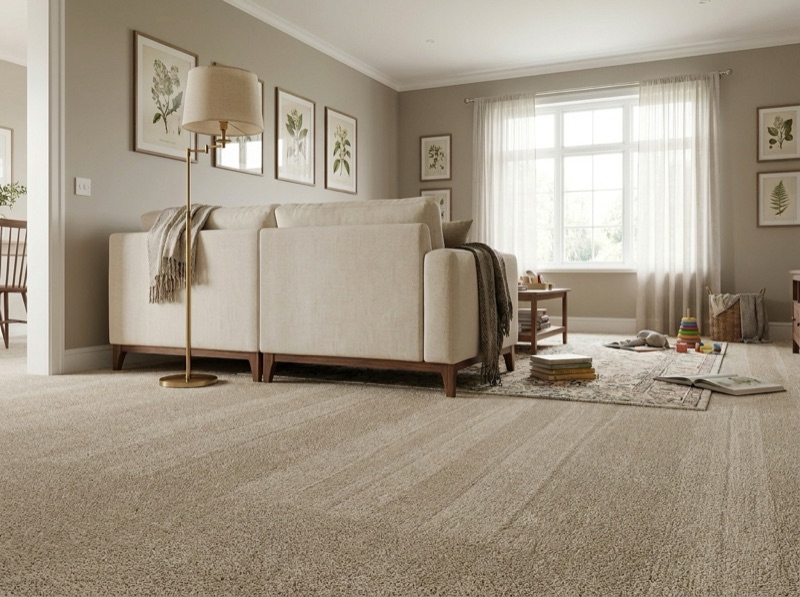
Carpet, chosen for density and a stain-resistant fiber, is usually the right call in a playroom, because kids sit and lie on this floor for hours, not just walk across it. The cushion underneath absorbs falls and quiets the sound of toys underfoot, and carpet tile is the fallback where a single stained square needs replacing.
A playroom is not a hallway with toys in it. Most rooms in a house get walked across, and a playroom is a room kids sit on, lie on and drop their full weight onto, often for an hour at a stretch. That difference is what actually decides the floor, and it comes down to what happens underneath the surface you can see, not the color on top of it.
What a playroom floor is actually absorbing
Every time a child sits, drops or throws a toy, the floor takes an impact the rest of the house rarely sees in the same way. Carpet meets that impact with two layers working together. The pile itself flexes and springs back, and underneath it the cushion compresses like a cellular sponge, spreading the load across a wider area and slowing it down before it reaches the subfloor. That is a mechanical fact about how carpet is built, not a marketing line, and it is why a hard surface feels harder the longer a body stays on it. Carpet is built with this kind of impact in mind in a way tile, hardwood and vinyl are not.
The same layered structure works on sound. Carpet fiber breaks up sound waves instead of reflecting them the way a hard surface does, and the cushion underneath absorbs the impact noise of a dropped block or a running foot before it turns into a bang carried down through the floor. In a house with more than one story, that is the difference between a playroom that stays contained and one that is heard everywhere else.
What that means when you are choosing the carpet itself
Comfort and quiet point toward carpet, but not toward just any carpet. A playroom takes real, repeated traffic packed into a small space, closer to a family room than a bedroom, so the fiber has to recover from being crushed the same way a hallway carpet does, while still feeling soft enough for a child to lie on. Carpet tile and broadloom both carry lines built for exactly this kind of use, and which one is right depends on the room's traffic and the household's habits more than a general rule. Bring the room's real conditions, spills, toy bins, whether shoes come off at the door, to the showroom rather than guessing from a chip.
Where a playroom carpet actually fails
The failure mode here is different from a hallway's. A hallway wears evenly along one path. A playroom wears in point loads instead, a toy bin, a bookshelf, a bin of blocks that lives in the same corner for years, pressing the same few tufts flat while the rest of the pile stands untouched. Move the furniture occasionally, and choose a low, dense pile, because it resists that kind of permanent set far better than a tall, soft one does.
The other failure is a stain the fiber was never built to handle. There is no such thing as a stain-proof carpet, in a playroom or anywhere else, and any sample that claims otherwise is worth a second look. What actually exists is stain resistance built into the fiber itself, which is different from a treatment sprayed on top and worn off by cleaning. Color and pattern hide a mark once it has already happened, but they do not stop it from setting in the first place.
How to check density and stain resistance yourself
Two checks travel well from the showroom floor into a real decision. Run the bend test the carpet page describes on every sample still in the running, because density is what resists the matting a toy bin causes over years in the same spot, and a playroom sample that fails it will not improve once it is on the floor. Then ask what the fiber is and whether the color runs all the way through it, which is what solution dyed means, since that is what keeps a spill from turning into a permanent shadow. The cushion underneath deserves the same scrutiny, because a firmer pad holds its shape under a bookshelf leg longer than a soft one built for a bedroom.
The other option: replace the damaged square, not the room
Playrooms and craft rooms are exactly where carpet tile earns its keep, because the odds of one permanent spot are high and the cost of that spot is one tile rather than the whole room. It lies flat without a stretch or a separate pad cut to fit, and a tile that gets crayon, marker or juice ground into it comes up on its own if a spare carton from the same run was kept aside.
For everything on fiber, pile and cushion beyond a playroom's specific demands, the carpet page covers it in full. Bring a photo of the room, what lives against which wall, and how the household actually uses it, to the free in-home measure. Fiber, density and cushion for a playroom get decided against your actual room, not a chip under showroom lights. Call 636-332-0654.
What else people ask about playroom flooring
Pad differences, carpet tile versus broadloom, and the honest truth about stain-proof carpet.
636-332-0654Usually yes. A bedroom pad is chosen mostly for softness, since almost nothing crushes it in a traffic lane. A playroom pad has to hold its shape under a toy bin, a bookshelf leg or a train table that lives in one spot for years, which asks for a firmer, denser cushion even under a soft-feeling carpet on top.
It depends on how much permanent staining risk the room carries. Carpet tile lets one damaged square come out without touching the rest of the floor, which matters where marker, glue and juice are a daily possibility. Broadloom gives a softer feel underfoot with no visible seam or grid, and plenty of playrooms use it successfully with the right fiber.
No, and any sample marketed that way deserves a second look. What actually exists is stain resistance built into the fiber itself, sometimes called solution dyed, which holds color through repeated cleaning far better than a surface treatment does. It reduces staining risk considerably. It does not make a playroom carpet immune to every marker or juice box.
Not necessarily. Plenty of households treat a playroom as its own decision, since the comfort and sound needs are closer to a bedroom or family room than to a kitchen or hallway. If the playroom is open to another living space with no doorway, that continuity argument matters more, and it is worth raising at the measure.
Bring your playroom's real conditions to the measure
Tell us what lives in the room, the toy bins, the train table, whether shoes stay on, and we will bring fiber and pad options built to take it. We measure in your house before anything gets chosen.
Free estimate
636-332-0654