 Flooring Correct
Berber or frieze,
and what the room is allowed to show
People walk in asking for one of these two by name. They are not opposites and they do not sit on the same axis, so the useful comparison is not durability. It is light, seams, and how much of daily life you want the surface to hide.
These are the two names people arrive already using, which makes them feel like a matched pair. They are not. Berber describes a look built on a loop, usually low and dense, often flecked with darker color. Frieze describes a cut pile twisted harder than any other, so the yarns curl instead of standing to attention. One is a flat, even plane. The other is deliberately disorderly. Choosing between them is really choosing how much your floor is permitted to reveal, and the room decides that more than taste does.
Two names that are not on the same axis
The carpet pillar sets out the family tree: loops on one branch, cut pile on the other, with frieze at the far twisted end of the cut side. Berber sits on the loop branch and inherits that branch's one real vulnerability, which is that a loop can be caught and pulled. But the snag question belongs to loops in general, and if that is your worry it is a construction decision rather than a Berber one.
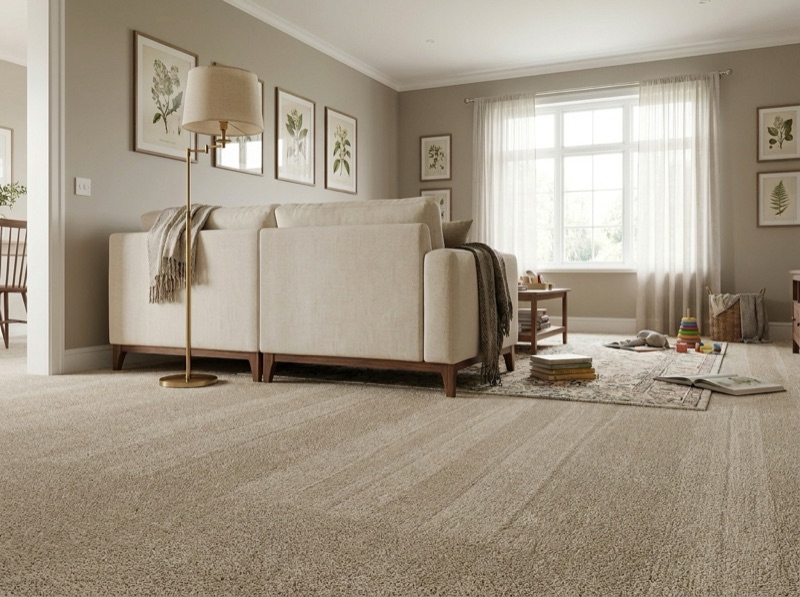
What is genuinely specific to these two names is what they do to a room visually. Berber gives you an even, quiet, almost architectural surface with a fleck that reads as texture from across the room. Frieze gives you a busy, informal surface with movement in it. Photograph each and they look like two colors. Put a lamp beside each in a real room and they look like different materials, because they handle light in opposite ways.
What window light does to each surface
A level loop presents a plane. Light comes in low through a window in the afternoon, hits that plane, and reflects fairly evenly, which is why Berber reads calm and looks tidy in a room with a lot of glass. The other half of that is less comfortable: anything disturbing the plane becomes visible in the same light. A crushed patch under a sofa leg, a slightly high seam, a ripple from a floor that was never properly stretched. A flat surface reports its own faults.
A frieze does the opposite. Every yarn curls in its own direction, so light scatters instead of reflecting and there is no plane left to disturb. That is why a frieze does not show footprints, vacuum lines or the shadow where a chair used to sit, and it is also why it never reads as formal. In a room with raking afternoon light, that scattering is a feature you can see from the doorway.
Seams decide this in any room wider than a roll
Carpet comes off a roll of fixed width, so a wide family room, a long lower level or an open plan main floor needs at least one seam, and it will be there for the life of the floor. This settles the choice more often than anything else on this page, and it rarely comes up until the measure. A level loop runs in straight, readable rows, so when two pieces meet the eye follows those rows across the join and reads any small offset or shade difference between rolls.
A frieze has no rows to follow. The face is randomized by design, so a seam disappears into it better than into nearly any other surface. If the room in question is wide, if the window light rakes across the floor where the seam has to land, or if the space is broken up so that seams cannot all be tucked under furniture, that alone can be the reason to take the frieze. It is not a small point, and it is a point the sample in your hand cannot show you.
The vacuum problem, running in both directions
Berber's fleck is very good at hiding crumbs, which sounds like an advantage and is partly a trap. Grit that you cannot see is still down there working at the base of the pile, and a low dense loop holds it well. So a Berber wants suction, wants the brush roll raised or off on many constructions, and wants somebody to move slowly, because one pass at walking speed does not lift much out of a dense pile.
A frieze hides soil even better, and its long twisted yarn can wrap around an aggressive brush roll. The failure mode there is a household that never notices the carpet getting dirty, because the surface does not announce it, and then wonders why the room smells faintly closed up. Both textures reward a deep clean every twelve to eighteen months, and with a frieze you run that on the calendar rather than on what your eyes tell you.
The lower level and the room above the garage
These two names get bought for two particular rooms more than any others. A finished lower level tends toward the Berber end, because the fibers that handle moisture and fading well are commonly built as low dense loops, and because a rec room is walked across rather than lounged on. Think hard before putting it down in a lower level that is also where the dog sleeps.
A bonus room over a garage is the frieze case, and for a reason that has nothing to do with looks. That floor is somebody's ceiling, it swings further in temperature than the rest of the house, and it usually ends up as a playroom, a teenager's room or a landing spot for everything that has nowhere else to go. A forgiving surface over a properly specified cushion answers all three: it hides the traffic, it softens the sound going down, and it does not report every rearrangement of the furniture.
How each one looks tired, and how long that takes
A Berber ages at the doorways and along the row structure. The loops in the walkway compress, the plane dips where everyone turns, and because the surface is even everywhere else, that dip is legible. It rarely looks dirty or shabby. It looks slightly dented, in specific places, and it holds that appearance a long time before anything else changes.
A frieze ages by relaxing. The hard twist that makes the curl is what the carpet is selling, and when a section of it loosens under constant traffic, the surface goes limp rather than flat. In a doorway you may see the yarn lying over rather than curling. The upside is that a limp patch on an already irregular surface is far less obvious than a dent in a flat one. The downside is the objection people raise at the rack and should raise: a frieze can look untidy in a formal room from the first day, before it has aged at all.
The middle answer that beats both in a lot of houses
A textured cut pile is where households most often land, and this comparison is a good example of why. It has enough twist to hide footprints and vacuum lines without going all the way to a frieze's informality, and it has no loops to catch. If what you liked about the Berber was the calm and what you liked about the frieze was the forgiveness, a textured cut pile gives you a serviceable share of both and asks for no compromises about animals or rolling chairs.
There is a second middle answer worth seeing. Cut and loop constructions sculpt both heights into a pattern, and the pattern camouflages soil better than a flat color can, because the eye reads a design rather than a plane. In a room that has to hide life but wants to look composed doing it, that is often the sample people carry home once they stop shopping by name.
Shop the twist and the pile height, not the word on the label
Both of these names cover a wide range. Two carpets sold as Berber can differ enormously in loop height, in density and in fiber, and two friezes can differ in how hard the twist is set and therefore in how long the curl survives. The variables that actually predict performance are the same ones the carpet page names: density you check by folding a sample back, and twist you check by looking at a single strand from the side.
So bring the room to the conversation, not just the name. At the in-home measure we work out where the seams have to fall, how the light crosses that spot at the times of day you use the room, and what cushion the texture you like actually wants underneath it. Then the choice between these two stops being a matter of vocabulary and becomes a decision about your room.
“Amazing, quick, easy experience. My floors look great!! Jonah steered my in the right direction with his expertise on several options I initially wanted to do different, I couldn't be happier with deciding to go with his suggestions!”
What gets asked once both samples are on the floor
The questions that come up when people stop shopping by name and start looking at what the surface will do in a specific room.
636-332-0654No. Berber describes the look and the loop construction, not the fiber, and it is made in several fibers. The confusion comes from below-grade rooms, where a moisture and fade resistant fiber in a low dense loop is a natural fit, so a lot of people meet Berber in a basement and assume the two things are the same. Ask what fiber the specific sample is.
They are not the same, though people use the words loosely. What defines a frieze is how hard the yarn is twisted, which is what makes it curl and what makes it forgiving. Pile height is a separate variable, so you can find a frieze that is fairly short and dense as well as one that is long and loose. Check twist and height separately rather than trusting either word.
Neither hides it especially well, and the color does more work than the texture. A mid tone or multi tone that sits between the animal's coat and the room's light will hide day to day life far better than a flat shade in either texture. What the texture decides is something else entirely: whether a claw has a loop to get under.
Not necessarily, but it shows its age differently. A Berber holds an even surface and then dents at the doorways. A frieze relaxes and goes limp in the walkway without ever looking flat. Density and twist predict how long each takes far better than the category name does, so compare two specific samples rather than two ideas.
Weight that sits in one place is the deciding factor, not traffic. Concentrated point loads compress any pile, and on an even surface like a Berber those compression marks are easy to read once the table moves. A denser, firmer construction and a cushion at the firm end of what the warranty allows matters more here than which of the two textures you pick.
You can, and some people love the clean look of it. Just know what you are trading: a bedroom is the room judged barefoot, and a low dense loop is a firmer, cooler surface underfoot than a twisted cut pile. If softness in the morning is part of why you are carpeting the room at all, the frieze end of the range is going to feel more like what you had in mind.
We will find your seam line before you settle on a texture
A room wider than a roll is going to have a seam, and where it lands relative to the window often decides between an even Berber and a forgiving frieze. Let us measure the room and show you the spot. The estimate is free and the number is 636-332-0654.
Free estimate
636-332-0654