 Flooring Correct
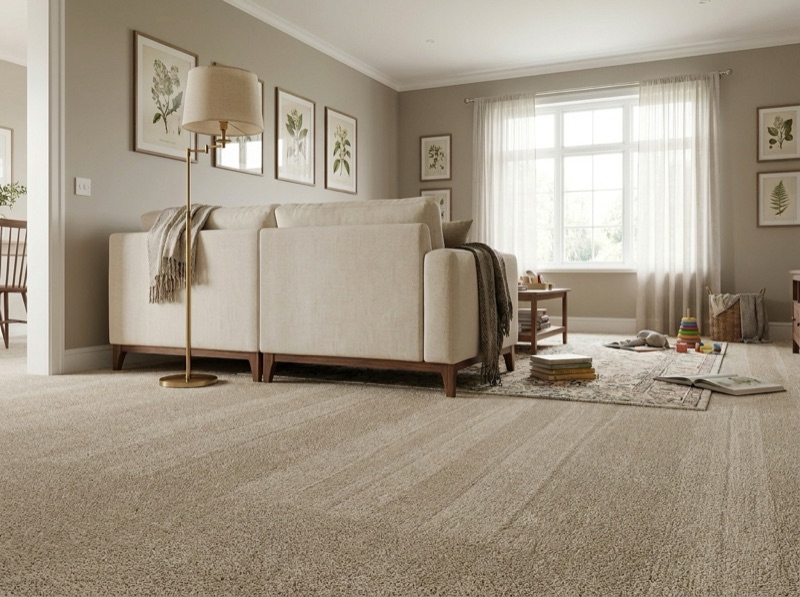
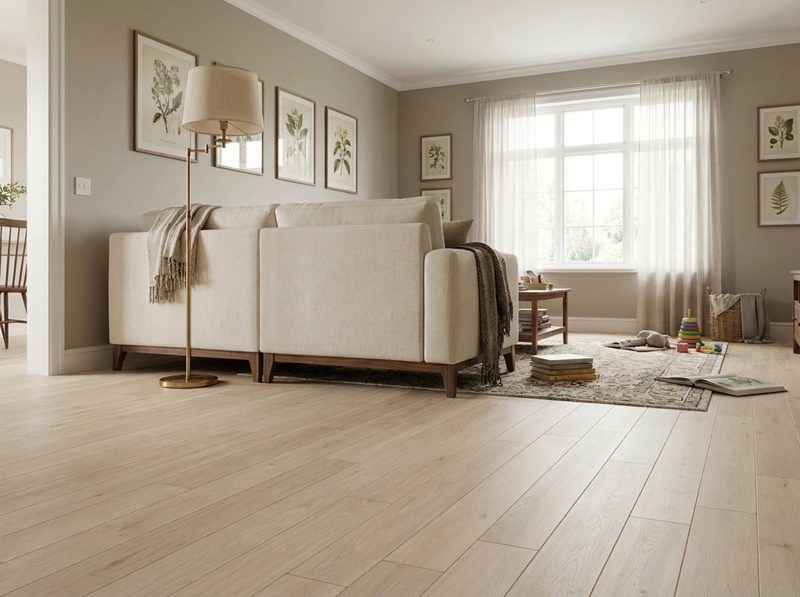
Cut pile or loop,
chosen by what lives in the house
Loop wears beautifully and hides a walkway, right up until something hooks a strand. Cut pile cannot be snagged and pays for that by showing every footprint. Pick by the hazards in your house, not by the sample that photographs best.
A loop is a continuous circuit of yarn that goes into the backing and comes back out. A cut pile is the same yarn with the top sheared open, so what stands up is a field of separate ends, each anchored at one point. That single structural difference explains every advantage and every failure on both sides of this comparison. The carpet page describes both constructions. What it does not do is walk through your house and count the things that hook, roll and scrape, which is what actually decides this.
One is a closed circuit. The other is a field of loose ends.
Because a loop is anchored at both feet, it holds its shape under load remarkably well, and a row of loops shares the load with its neighbors instead of standing alone. That is why a low, dense level loop shrugs off a corridor that would flatten a plush. It is also why a loop has a weakness a cut pile physically cannot have: a circuit can be caught, and once something has hooked under it and pulled, the yarn comes up out of the backing and it does not go back down.
A cut pile has no circuit to hook. You can drag a claw across it and nothing catches, because there is no bridge to get under. What a cut pile has instead is a dense field of independent tufts, each carrying its own share of every step and each free to lean, crush and open at the tip. Loop fails by being pulled. Cut pile fails by being flattened. Neither of those failures is a maintenance problem. Both are decided the day the carpet is chosen.
Claws come first, and the answer is not a subtle one
A dog turning at speed on a landing, a cat working a corner, a puppy that has decided the floor is interesting: all three are looking for something to get a nail under, and a loop offers one. What people picture is a small snag. What actually happens is a strand lifting into a raised line that runs across the row, because the yarn is continuous and pulling one part of it lifts the rest. Trimming the tuft level to the pile stops it from getting worse and leaves a visible thin spot behind.
So in a house with clawed animals, cut pile avoids the whole category. It is not that a loop will definitely be pulled. It is that if it is pulled, there is no repair that makes the room look untouched, and the damage lands wherever the animal happened to be standing rather than in a lane you could have planned around.
The machines in the room: casters, beater bars and the rolling cart
The second hazard is anything with a wheel. A desk chair rolled over the same eighteen inches of loop several hundred times a week is a slow, patient version of the claw problem, and a hard caster is very good at finding a loop to lift. A home office, a craft room, a corner where a rolling cart lives: each is a reason to keep the circuit off the floor, or to plan a chair mat in from the start rather than after the first pull.
Vacuums belong in the same paragraph. An aggressive beater bar is built to agitate a pile, and on a loop it is agitating a structure that can be caught. Many loop carpets ask for suction with the brush roll off or raised, which is a real change of habit for a household that owns one machine and uses it on everything.
What cut pile gives up in exchange for being unsnaggable
It shows you everything. A plush or a Saxony, where the tips are sheared level and stand up together, reads formal and holds a footprint like fresh snow. Vacuum lines stay visible and furniture leaves shadows. In some rooms the pile even takes a permanent shift in direction where light reflects differently from one patch to the next, and no cleaning corrects that because nothing is dirty. The surface itself has changed which way it faces.
That is exactly why the textured constructions exist. Twisting the yarn before it is sheared breaks the tips into slightly different directions, and a surface that is already irregular has nothing to disturb. A textured cut pile hides tracks. A frieze, twisted harder still, hides more than either. So the real cut pile decision is not whether to accept footprints, it is how much twist to buy in order to stop seeing them, and that is a question you settle by hand rather than from a photograph.
Where a loop is plainly the better floor
A low, dense level loop in a corridor, a rec room, a basement landing or a study is difficult to beat. It wears extremely well, it does not track, and it does not develop the shiny lane that turns up in the middle of a plush hallway. In rooms walked more than they are lounged in, a loop keeps looking like itself for a long time, and it asks the household to be careful about nothing except claws and wheels.
It also handles moisture-prone rooms differently, because loop constructions are frequently built in olefin, which resists moisture and fading and wants a low dense pile anyway. That is a large part of why below-grade rooms so often end up in a loop. If the room in question is a finished lower level with a sump in the corner, the construction and the fiber are pointing at the same answer, and the claw question becomes the only thing standing between you and it.
Stairs bend the carpet, and bending changes the argument
A stair is the one place a carpet is folded around a hard edge and then stepped on. That fold opens the pile at the nosing, and it opens rows of loops in a way that can leave the backing more visible along the front of the tread than it is anywhere else in the house. It also puts any damage exactly at eye level for anyone coming up the stairs, which is a different situation from a snag behind a sofa that nobody notices for a year.
For most stair runs we would rather set a tight textured cut pile, run the pile direction down the flight so it lies with the traffic instead of against it, and let a dense construction and a firm cushion do the work. Loop on stairs is not wrong, and it does wear well there, but a pulled loop on a stair is the least repairable damage in the house and it is the piece of carpet the most people see.
The answer that is neither: a carpet with both in it
Cut and loop constructions put both in the same carpet, sculpting the two heights into patterns and textures. That combination camouflages soil better than a flat color does, because the eye reads a pattern instead of a surface, and it takes some of the risk out of the loop question by making the loops shorter and surrounded. It is the answer for a room that needs to hide life and cannot commit to either extreme, and it is the one people overlook because it does not have a simple name to shop by.
There is a second version of neither. A basement office, a classroom or any room where one square is going to get ruined while the rest stays fine is often a carpet tile room, because a stained or snagged square lifts out and a new one goes down without touching the floor around it. If your worry about loop is really a worry about one spot, modular squares answer that better than either construction does on a roll.
Count the wheels, count the claws, then look at your vacuum
Count the wheels. Count the claws. Look at where the animals turn, not just where they sleep, because turning is when a nail digs in. Note which rooms have a door that opens onto grit, which have a chair that rolls, and which are lounged in rather than crossed. Then look at the vacuum you own and be honest about whether anyone will ever change its setting. That inventory decides this comparison faster than any sample rack does.
We do the same inventory at the in-home measure, along with the parts you cannot see from a sample: how many seams the room needs, where they will land relative to the window, which direction the pile should run, and what cushion the construction you picked actually wants under it. A loop and a cut pile do not want the same cushion, and that detail is quietly responsible for a lot of carpets that aged faster than their owners expected.
“Floors are PERFECT! ... Only mistake we made was not replacing the old floors sooner! ... You can trust them to guide you but let you make the decision. ...”
What people ask after they see a snag in a friend's house
The practical questions about pulled loops, vacuums, animals and rolling chairs, answered the way we answer them standing on the floor in question.
636-332-0654It can be stopped, not undone. Cutting the raised tuft level with the surrounding pile keeps it from lifting further, and in a busy pattern or a mid tone color the small thin spot it leaves is easy to miss. In a light, flat, level loop it stays visible. That is the honest answer, and it is the reason the construction question matters before the carpet goes in.
Differently, and often worse in one respect. A dog usually catches a loop by accident while turning, so the damage lands wherever it happened to be moving. A cat may decide a particular corner or stair edge is worth working at repeatedly, which concentrates the damage in one place. Either way, a cut pile removes the opportunity entirely.
It helps. A low, dense loop gives a nail less to get under than a taller, looser one, and density means the neighboring loops are supporting each other. It reduces the risk rather than removing it, so treat a low level loop as a reasonable compromise in a household with animals, not as a solution to the problem.
Often you need a different setting rather than a different machine. Many loop constructions want strong suction with the brush roll raised or switched off, so check what the specific carpet asks for and check whether your vacuum can do it. Vacuum often and slowly either way, because one quick pass at walking speed lifts very little out of a dense pile.
Usually a low dense loop, because the fibers that handle moisture and fading well are commonly built that way, and a below-grade room rewards a pile that stays low. Change that answer if the basement is where the dog sleeps or where the office chair rolls, in which case a tight textured cut pile is the safer floor for the same room.
It removes the caster problem from the area the mat covers, which is most of the risk. Make sure the mat is large enough for the full arc the chair travels, including the reach back to a printer or a filing drawer, because the pulls happen at the edge of the range where people forget the mat ends.
Walk us through the claws, the wheels and the stairs
Show us where the dog turns, where the desk chair rolls and how the stair flight is built, and we will tell you whether this room can live with a loop or needs a cut pile with enough twist to hide the traffic. The measure is free and the number is 636-332-0654.
Free estimate
636-332-0654