 Flooring Correct
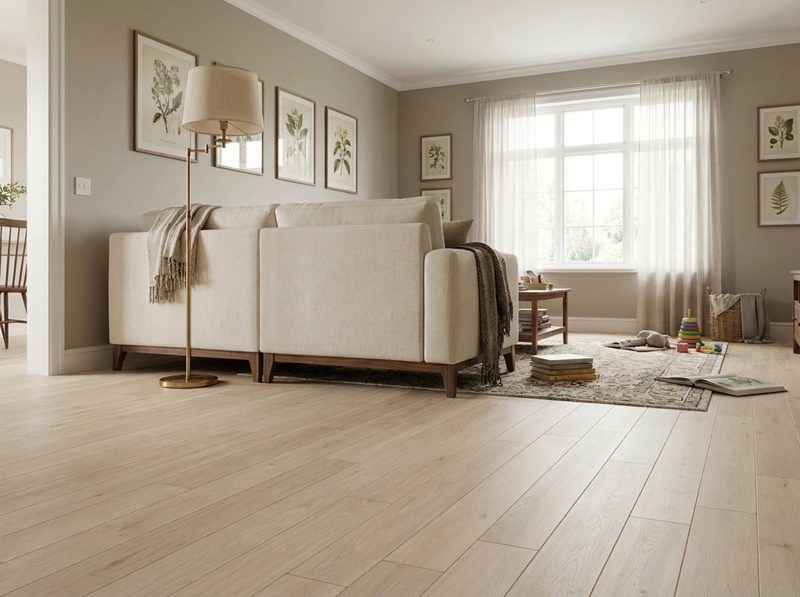
Laminate or sheet vinyl.
Start with the short wall.
People arrive at these two from the same place and then put them in the wrong rooms. The width of the room, where the water comes from, and how long the floor has to survive settle it faster than any sample does.
Almost everyone weighing these two got here the same way: several rooms need a floor at once and the plan has to stretch across all of them. Laminate already explains its core, its wear layer and its abrasion ratings. Sheet vinyl already explains rolls, backings and seams. What neither can do is stop the mistake we see most, which is laminate going into the laundry room and sheet vinyl going into the family room. This page sorts the rooms out, names what each floor does badly, and says where we would send you to a third material instead.
Two floors picked for the same reason, for opposite rooms
Laminate is a hard, printed wood look built on a dense fiberboard core, and its whole argument is the surface: a melamine wear layer loaded with aluminum oxide that shrugs off claws, chair legs and driveway grit. That belongs in living space, hallways and bedrooms, where the floor takes traffic rather than water.
Sheet vinyl arrives on a roll, and its whole argument is that it has no joints. That belongs in the rooms most likely to flood: laundry, utility, mudroom, hall bath. Put each one where its argument applies and both perform well beyond what people expect of them. Swap them and you have bought two floors that are quietly wrong.
Measure the short wall before you choose anything
A roll of sheet is about twelve feet across, so a room that fits inside that width gets a finished floor with no seam anywhere in it, and that single fact is most of the reason the category still exists. A standard laundry room, utility room or hall bath usually fits.
If the room is wider, you get a seam, and a seam is a decision rather than an accident. Done properly it is bonded or heat welded so it behaves like the rest of the sheet, and where it falls gets settled before the order goes in. Under a cabinet run or inside a doorway, you stop seeing it within a week. Laminate does not care about room width. It cares about run length, the expansion gap behind the trim, and a transition at every doorway.
Where the water starts matters more than how much of it there is
A washer hose and a toilet ring release water at floor level and it travels. That is the specific case sheet vinyl was made for, because water sits on the surface until somebody wipes it up instead of working down into a joint and reaching the subfloor. A laminate floor in that room has a joint every few inches and a wood fiber core behind them, no matter what the sample tag says.
A kitchen splash, a dripped glass, a wet dog crossing an entry, all of that is a different problem. Water resistant laminate with a treated core and sealed edges handles spills that get wiped up in a reasonable stretch of time, which describes normal life in a kitchen or an entry. So ask where the water in that room comes from, not how wet the room sounds when you name it.
What to ask for on a box and what to ask for on a roll
Laminate hands you a graded number and sheet vinyl does not. The Abrasion Class comes off a test rather than a description and it is printed on the carton, which makes it the one spec on a laminate you can hold a supplier to. Buy the class up for a kitchen, an entry, a hallway or a house with dogs, and the laminate page says what each class covers. Moving up a class is the upgrade people regret least, and it is decided once at the counter.
Sheet has no equivalent grade, so on a roll you ask for a specification rather than read one off a box. The thickness of the clear wear layer and the urethane finish over it are what predict how the floor looks in year five, and neither is going to be volunteered. A thin wear layer dulls where people pivot, so ask for both by name and ask for them against the room.
Both telegraph a rough subfloor, in different ways
A rough subfloor is the one condition both of these floors react to, and they react in opposite directions. Sheet vinyl reports it. Every nail head and old grout line under a thin sheet shows in the surface within months, which is unforgiving but at least visible, and the sheet vinyl page lists the prep that prevents it.
Laminate hides a flaw and then reports it another way. It floats, so it bridges a hump instead of following it, and the bridge is where the floor flexes, clicks underfoot and eventually gaps at the locking joints. Sheet vinyl shows you the bad subfloor. Laminate lets you feel it. Either way, prep is the line that moves the job.
Repair, spare boxes, and which one you replace instead of fixing
Laminate cannot be sanded and refinished, because the wear layer is thin by design. A deep gouge is not repaired, it is replaced, one plank at a time, so the plank you buy today has to still exist on the day you need it. That is what a spare box from the same run is for, and the laminate page explains why a later lot will not match.
Sheet vinyl repairs badly and replaces easily. A patch in the middle of a field is visible, so the usual answer to real damage is a new floor in that room, and because it goes in as one piece it is a short job rather than a project. The backing matters here. A fiberglass backed sheet fastened at the perimeter lifts out cleanly. A felt backed sheet glued across the whole floor does not.
Floors that get replaced on a schedule
Rental property and any house that turns over is a different calculation, because the floor has to survive people who did not choose it and has to come out without a large project. That is a strong argument for sheet vinyl in every wet and practical room, and it is why the category has held on in those buildings for decades.
For the dry half of the same unit, laminate at the heavier abrasion class is the better call. It gives a hallway and bedrooms a wood look that photographs well, it takes furniture being dragged, and a single damaged plank can be swapped between tenants if you kept the spare box. The one thing it will not forgive is a spill nobody mentioned until the edges swelled.
The rooms where we would send you to a third material
A basement that has taken on water before, or a slab with a moisture problem, is not a room for a wood fiber core, and we will tell you that at the counter instead of writing the order. Luxury vinyl plank or tile belongs there. A shower is tile, and not because a sheet would leak. A shower is waterproofed behind the surface, at the membrane, the slope and the curb, and neither of these products is part of that assembly.
And if the room is the main living space of a house you plan to keep, and you want the depth of a real milled plank edge underfoot, both of these are the wrong aisle. Look at engineered wood or at rigid core vinyl plank instead. The other comparisons weigh those against each other so you can rule out quickly rather than slowly.
What we roll out on the showroom floor
Sheet reads completely differently at full width than on a small chip, so we roll it out on the floor of the showroom and let you look down at it the way you will at home. Laminate gets checked by hand: whether the surface texture actually follows the grain it was printed with, how many board images there are before the pattern repeats, and how much the sheen throws light.
Then take two or three home, because grain and undertone shift under evening light and a showroom wall is not your hallway. The in home measure settles the rest: the short wall, where a seam would land, and what the subfloor is going to do to whichever one you pick.
“We are so pleased with our new floors! Everyone throughout the entire process was extremely nice and helpful. During installation, everyone was so professional, kind, and respectful. ...”
Asked once the samples are on the floor instead of the wall
Most of these come up while we are still rolling material out. Call 636-332-0654 and we will answer yours the same way.
636-332-0654Water resistant laminate can live in a laundry room that never has an incident, and that is the gamble. Water in that room arrives at floor level from a hose and runs, and laminate has a joint every few inches with a wood fiber core behind it. For that room we would rather sell you sheet vinyl and have you forget about it.
Not if it is placed on purpose and bonded or heat welded properly. Under a cabinet run, along a wall nobody walks, or inside a doorway, it stops registering within a week. The seams people notice are the ones nobody discussed before the order went in, which is why we ask about seam placement at the measure rather than on the truck.
Laminate, on scratches. Its wear layer is the harder of the two surfaces by a wide margin, which is the whole reason the category holds up in a house with animals. Sheet vinyl is softer, and a narrow hard caster or a dragged claw can mark it. Sheet still wins the room where the dog comes in soaking wet.
The printing is not. Current sheets carry a design layer with a long pattern repeat and a urethane finish over the wear layer, so they get damp mopped with a pH neutral cleaner. The waxing and polishing people remember belonged to a different generation of the product, and doing it to a current one hazes the finish instead of protecting it.
No, it just means the floor has a seam and you get to decide where. In a bath, that usually means running it along the tub wall or under the vanity toe kick rather than out in the middle of the room. If a seam in that room bothers you on principle, that is a fair reason to look at plank or tile instead.
Sometimes, and it depends entirely on what is under there and whether it is flat and sound. Sheet vinyl will print old grout lines and adhesive ridges through the surface within months. Laminate will bridge a hump and then complain about it at the joints. That call gets made in the house with a straightedge, not from a description over the phone.
Measure the laundry room across its short wall first
One dimension decides whether that room gets a floor with no seam anywhere in it, and it is a dimension people rarely have written down. We take it, we find out what the old floor and the subfloor under it will telegraph through a thin sheet or push back through a floating plank, and we tell you which rooms in the house should get which of these two. Call 636-332-0654.
Free estimate
636-332-0654