 Flooring Correct
SPC Or WPC,
Settled By The Room
Not By The Sample
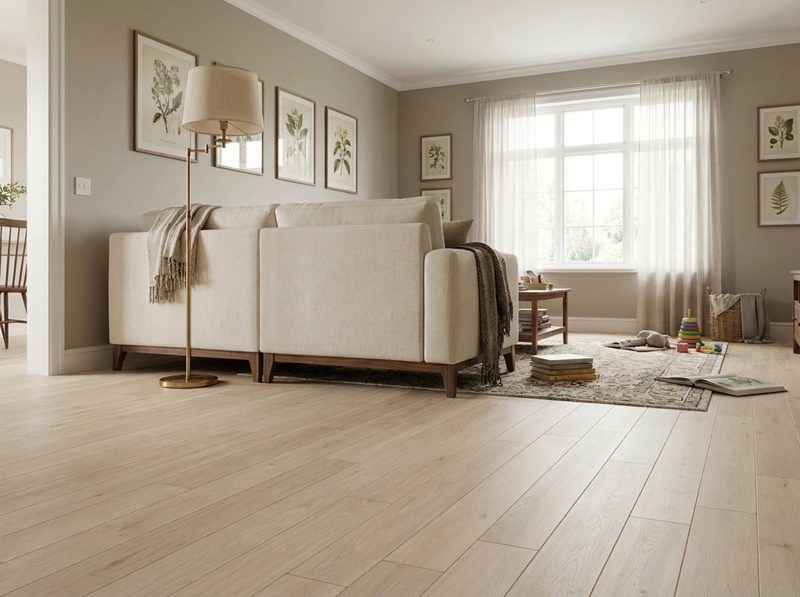
Both cores wear the same printed film and the same clear top layer, so the floor you see is not the thing you are choosing. You are choosing how the plank behaves in a room that bakes behind glass, over a slab that is not perfectly flat, and under a refrigerator that has to roll out one day.
How each core is built is on the luxury vinyl plank pillar. What is here is the decision that page leaves open: which core goes in which room, what each one takes from you in exchange, and the rooms where the honest answer is a third material. Two facts about your own house settle it more often than preference does. How far the room's temperature travels between February and August, and how flat the floor underneath really is. Call 636-332-0654.
Temperature swing picks the core before taste gets a turn
A dense stone plastic composite core barely registers a warm afternoon. A foamed wood plastic composite core registers more of one, and in a room that heats up behind west facing glass and then drops overnight, that difference turns up at the perimeter as movement the base trim has to swallow. So the opening question is not which plank feels better in your hand. It is which rooms are conditioned all year and which are not. A sunroom, a four season porch, a bonus room over an unheated garage: those are rooms where the plank spends its life expanding and relaxing, and the denser core does less of it.
Rooms that never leave the mid sixties to mid seventies are a different question entirely. Bedrooms, hallways, a home office, a finished basement with a system that actually reaches it. Nothing in those rooms is asking a core to hold still under heat, which frees you to choose on comfort instead of on stability. That is where the foamed core stops being a compromise and starts being the better floor for the people walking on it.
What the dense core buys, and the hardness you agree to live with
Pick the dense core when the room swings, when the floor takes a rolling load, or when height is tight. It is the thinner of the two, which matters at a doorway more than people expect: going over an existing floor or meeting tile at a threshold, a thinner plank keeps the reveal under a door casing sane. It resists denting under a point load, so a desk chair on casters, a piano foot or a loaded bookcase is less of a worry.
The bill comes as feel. A dense plank is firm and a little loud, it reads cooler underfoot in a basement in January, and it reports every ridge, hump and old grout joint beneath it. That is not a defect, it is physics, and it means subfloor prep on a dense core install is not a place to save time. An attached pad softens the sound a shade. It does not turn a hard floor into a soft one.
What the foamed core buys, and the dent you are accepting
Pick the foamed core when people stand on the floor and when the room is quiet by intention. It is warmer to bare feet, it is noticeably quieter under a dog and under kids, and it is more forgiving of a subfloor with small variation across it, which describes a lot of second floors. In a bedroom wing or a basement family room, that comfort is a real feature rather than a soft one.
What you accept is denting under concentrated weight. A refrigerator walked in on two wheels, a bar stool with a bare metal glide, an appliance dolly on a laundry day. None of it destroys the floor, but a foamed core takes an impression where a dense one would not. It is also the thicker plank, so height at the appliances, the transitions and the doors gets worked out before anything is ordered rather than discovered on install day.
A kitchen is decided by the island and the refrigerator
Kitchens get argued on looks and settled on hardware. A heavy island sits on the floor for the life of the room. A refrigerator has to roll out for a coil cleaning. A dishwasher has to come out for service and go back under a counter that did not move. Those three facts push most kitchens toward the dense core, because it takes the point loads and keeps the finished height low enough that the dishwasher still fits.
There is a real counter argument. If you cook every night and stand at that sink for an hour at a stretch, the softer floor is kinder, and the dent risk is manageable with a plan: a scrap of hardboard under the appliance wheels whenever something rolls, and glides rather than bare metal on the stools. Choosing comfort with your eyes open is a different thing from choosing it by accident.
Sound belongs to the household, not to the room
The showroom question is which floor is quieter, and the honest answer starts with who is underneath it. A dense plank over a second floor bedroom sends more of a footstep into the room below than a foamed one does, and in a house where somebody works from a first floor office that matters every weekday. In a ranch on a slab, the same difference is close to academic and you can spend the decision elsewhere.
Neither core is a sound isolation product. What moves the needle is the whole assembly: what the plank sits on, whether an underlayment is permitted, and whether the ceiling below is insulated. Choose the core for feel and treat sound as an assembly question.
Room by room, where we land when nothing unusual is going on
- Sunroom, four season porch, walkout with a lot of west glass: dense core, and the flatness underneath gets checked first because the plank will report it.
- Kitchen with a fixed island: dense core for the point loads and the appliance height, unless standing comfort is the reason you are redoing the kitchen.
- Finished basement family room: either core works over a slab that passed its moisture check. Foamed if the room is for sitting in, dense if a treadmill or a pool table is going in it.
- Upstairs bedrooms and the hall between them: foamed core, for the quiet and the forgiveness over a second floor that is never perfectly flat.
- Mudroom and back entry: dense core. Grit tracks in off the driveway all winter, and a thinner plank keeps the door swinging over the mat.
- Laundry room: dense core, and the plan for getting the washer back into place gets made before the floor goes down.
The rooms where the honest answer is neither core
A floor with a drain in it is a tile floor. A shower is a waterproofing job before it is a flooring job, and no rigid plank belongs in one. A room where you want a genuinely seamless surface, a small laundry or a utility bath, is worth a look at sheet vinyl instead of arguing about cores. A very flat slab carrying rolling traffic is usually a flexible glue down job rather than either rigid core.
Then there is the case where the floor is not the problem. If a joist bay flexes when you walk it, if a slab fails its moisture check, or if the old floor hides a soft spot near a bath, no core fixes any of it. That gets repaired first, and we would rather say so at the measure than sell a plank that is going to sit on a problem.
Settle the wear layer before you spend an hour on the core
People arrive with the core argument already running and the more consequential number unasked. The core decides how the floor feels and how it handles heat and an imperfect subfloor. The clear wear layer on top decides what the floor looks like in five years, because it is the only thing standing between the printed pattern and the grit that walks in. A 20 mil wear layer over a foamed core will look better in a busy hallway than a 6 mil wear layer over the densest core made.
So order the decision properly. Set the wear layer to the traffic the room actually gets, then choose the core for the room's climate and the people in it. That order stops the conversation that ends with a carefully specified core under a top layer that was never going to survive the dog. The comparison index holds the other matchups worth settling first.
Ten seconds standing on each one, then one straightedge
Put both cores under your foot at the showroom and most of the argument settles itself. People feel it in about ten seconds, firm and bright against soft and quiet, and the only question left is which rooms that difference belongs in. That part is a fact about your house rather than about the plank, and it comes off a straightedge laid across the floor and a reading taken on the slab. Book the in-home measure and we will bring both.
“We loved the service we received from Audra and Jonah during the process of choosing, ordering and installing our flooring and carpet. They kept us updated on the process every step of the way. The installation was completed to our satisfaction and the end result is awesome! ...”
What people actually ask once both planks are in their hands
The questions below are the ones that come up after the samples are down on the floor and the difference stops being theoretical.
636-332-0654Harder is better for stability, dents and height, and worse for warmth, sound and forgiveness over an imperfect floor. In a sunroom that is the trade you want. In an upstairs bedroom it is a trade you are making and not using, which is why we ask which room before we answer.
Blinds help and they are not a plan, because the room still swings when nobody is home to close them. If the space is not conditioned year round we point you at the dense core. If you want the foamed core anyway, the manufacturer instructions on expansion gap and room size get followed exactly.
It changes the height and it changes the flatness. A rigid dense plank reads the grout joints under it if they are wide or the tile is uneven, so those get filled first. A thicker foamed plank bridges small variation better but raises the finished floor, which then has to clear the doors and let the dishwasher back out.
The wear layer handles the claws and the core handles the noise. A dense core under a thick wear layer is the tougher floor. A foamed core is the quieter one, and quiet matters when the dog crosses the hall at five in the morning.
It is more forgiving of small variation, which is not the same as leveling. If the straightedge shows a real dip or hump, that gets ground or filled whichever core you buy, because a floating floor spans a low spot and then flexes there every time someone walks over it.
It reads cooler than a foamed core over the same slab, especially in January, and an attached pad narrows that gap without closing it. If bare feet in a basement family room are part of the point, that is a genuine reason to choose the foamed core down there.
We settle SPC against WPC with a straightedge on your floor
Flatness, the slab moisture reading and how much afternoon sun the room takes are all facts about your house rather than about the plank. The free in-home measure collects them, and then the core answers itself. Call 636-332-0654.
Free estimate
636-332-0654