 Flooring Correct
Wide Plank Or Narrow,
And What The House
Has To Say About It
Width is the first thing people choose and the last thing they think through. It sets how calm or how busy a room reads, how visible every seam is, how much movement the floor shows in a dry January, and how flat the surface underneath has to be before anything is laid on it.
What wood does with moisture is on the solid hardwood pillar, and how a vinyl plank is built is on the luxury vinyl plank pillar. This page picks a width. The thing worth knowing before you start is that width is not one decision, it is two decisions wearing the same name. In solid wood it is mostly a movement question. In vinyl it is mostly a flatness and pattern question. Answering the wrong one is how people end up unhappy with a floor they chose carefully. Call 636-332-0654.
Width means one thing in wood and something else entirely in vinyl
A solid board changes dimension across its grain as the air in the house changes, and a wider board has more width to change. The same seasonal swing that opens a hairline between narrow boards opens a visibly wider line between wide ones, because the movement is proportional to what is there to move. That is the whole reason a narrow board is the safer specification in a house that is hard to hold steady, and it has nothing to do with taste.
A vinyl plank does not care about humidity in that way, so width there is asking different questions. A wide rigid plank spans more of the floor at once, which means it bridges more of whatever is under it and reports the high spots harder at its long edges. Wide vinyl also shows more of the printed image per board, which puts more weight on how long the pattern repeat is before you start recognizing the same board across the room.
What a wide board does for a room, and what it does to a small one
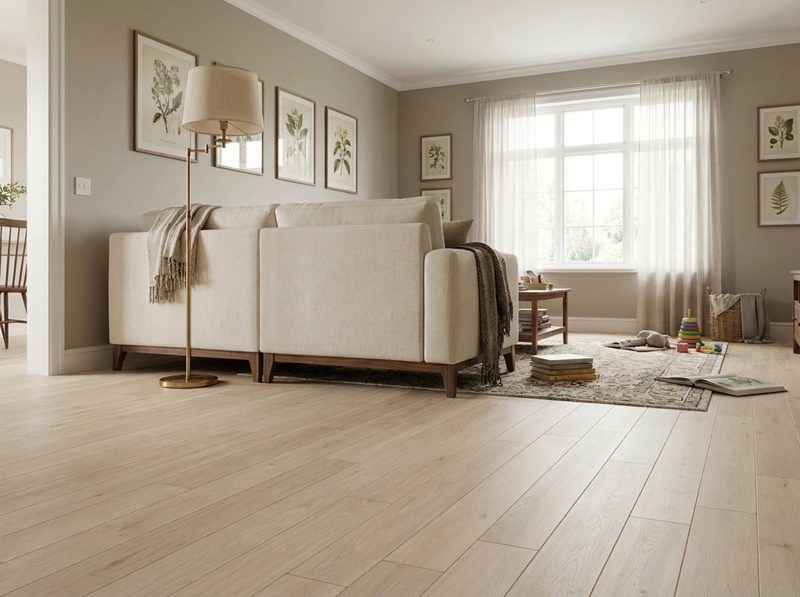
Fewer boards means fewer lines, and fewer lines make a floor read as one calm surface rather than a striped one. In a great room, an open kitchen or a long main level, that calm is the point, and it lets the grain of the wood be the thing you notice instead of the joinery. Wide boards also carry big furniture and tall ceilings without looking undersized, which is why they turn up in newer houses with a lot of open volume.
In a small room the same math cuts both ways. Fewer seams still helps a bedroom feel less busy, but a wide board leaves the layout less room to absorb error, and it is easy to end up with a full board at one wall and a thin rip at the other. That gets decided before the first row goes down, which is why we walk the rooms rather than take a width order over the counter.
Where narrow still wins, and why it stopped looking dated
A narrow strip floor is quieter dimensionally and busier visually, and both are useful. In an older house with plaster walls and period trim, narrow boards look like they belong, because they are what the house was built around. In a house that is hard to hold at a steady humidity, they show the least seasonal change. And in a room broken up by hearths, angled walls and cabinet returns, they work around obstacles with less waste.
There is an honest cost. More boards means more seams, more bevel lines, and a floor with more going on across it, which fights a room that is already busy with pattern. In a large open plan, narrow boards read as stripes running through the whole level, a look worth choosing on purpose rather than inheriting from a spec sheet.
The line between boards is drawn by the bevel, not by the width
People argue about width when what they are reacting to is the edge treatment. Before you settle a width, check that detail, because the same bevel draws a bolder grid on a wide board than it ever does on a narrow one. Whether your floor carries a bevel at all is a prefinished or site finished decision rather than a width one.
That means the two decisions have to be made together. A wide plank with a pronounced bevel and a heavy texture is a rustic floor whether or not you asked for one. A wide plank with a light bevel and a subtle grain is close to seamless. If your reason for going wide is a calm uninterrupted field, look at the edge detail on the sample before you look at anything else, because that detail is doing more work than the width is.
Stairs, halls and closets are where width turns into cuts
Open rooms flatter wide boards. The rest of the house is where the practical trouble lives. Stair treads want a board that fits the tread depth cleanly, and a wide plank rarely lands on that depth, so the tread ends up built from pieces. A narrow hallway can be crossed by a small number of wide boards, which leaves a long thin rip down one side unless the layout is planned to avoid it.
Closets, laundry alcoves and the space in front of a hearth are the other places a wide board gets cut down to something that no longer looks wide. None of this rules out a wide floor. It means the person measuring should be counting rips, treads and transitions in the house, not after the material is ordered.
A house that swings should think twice before going wide in solid wood
If the indoor climate is genuinely stable year round, a wide solid board behaves. If the house has no humidifier on the furnace, a bath fan that does not vent outside, a woodstove that dries the air out every winter, or long stretches empty with the system set back, that is a house that swings, and a wide solid board will show it as gaps in February and tight edges in August.
There is a way to have both, and it is the most useful thing on this page. Engineered construction is built to hold its width through that swing, which is exactly why wide plank wood is available in rooms and houses where a wide solid board would be a gamble. If you want the wide look and your house is hard to hold steady, the answer is usually a change of construction, not a change of width.
Which width, which room
- Open main level with tall ceilings and big furniture: wide, and the layout gets planned so the last row is not a sliver at the back wall.
- Older house with period trim and plaster: narrow, which matches what the house was built around and moves the least across a season.
- Bedrooms and a hallway upstairs: either, but check the hall width first, because that is where a wide board leaves an awkward rip.
- Kitchen with a big island: wide vinyl is the usual landing spot, on a subfloor that has been flattened for it rather than hoped over.
- Stairs: narrow simplifies the treads, and if the field floor is wide, budget the time to get matching stair parts specified properly.
- A house you cannot keep at a steady humidity: narrow in solid wood, or wide in engineered, but not wide in solid.
When width was never the thing bothering you
Sometimes the room reads wrong and the width is innocent. Which way the boards run changes a room more than an inch of width does: along the length of a room stretches it, across it shortens it, and running toward the light hides seams that would otherwise catch a low sun. Color and sheen do more to a small room than width ever will.
Mixed width floors are a real third answer, more traditional in feeling, and useful when a room is long and you want the eye to keep moving. The other honest answer is that in a basement, a mudroom or a bath, the room's requirements settle the material first and the width is whatever that material offers. The comparison index is where those material decisions live.
What we put on the floor before anyone picks a width
A sample the size of a hand cannot tell you what a width does to a room. What tells you is several boards laid out in the actual room, in the actual light, running in the direction they would run, with the door open. Book the in-home measure and we will bring the widths you are weighing, check the flatness across the room while we are there, and count the treads and the transitions. Or start at the showroom, where the widths are on the floor rather than in a rack.
“Floors are PERFECT! ... Installation was a breeze and EVERY person was helpful and hardworking. Only mistake we made was not replacing the old floors sooner! ...”
What people ask once the boards are down on the floor
These come up in the room, with boards laid out, which is the only place a width question can really be answered.
636-332-0654Usually a little, because there are fewer lines to break the surface up. The gain is smaller than people expect, and it can be undone by a bad layout that leaves a narrow rip at one wall. Direction of the run and a lighter tone do more for a small room than width does.
Yes, in the sense that the same seasonal movement is spread over fewer joints, so each one reads wider. It is normal movement rather than a defect. Holding the indoor humidity in a steady band year round keeps it small, and a narrower board or engineered construction keeps it smaller still.
There is no single number, and the honest trigger is the house rather than the board. If you want a wide floor and your house is hard to hold at a steady humidity, engineered is the construction that keeps the width and drops the risk. That conversation is worth having before you fall for a specific plank.
It is less forgiving, yes. A wide rigid plank spans more area and cannot follow a dip, so it bridges the hollow and rocks, or it telegraphs a hump along its long edge. Flattening is not optional under any rigid plank, and going wide raises the standard.
You can, and it is a fair thing to ask a supplier about. Wide boards show more of the image each, so a short pattern repeat becomes visible sooner. Look at a run of boards side by side rather than one sample, and check whether the boards in front of you actually differ from each other.
You can, and it is common, but the two get specified together so the species, color and finish match at the top and bottom of the flight. Stair parts are ordered as parts rather than cut from field boards, so this is a decision to make while the floor is being quoted, not afterward.
Lay the widths out in the room before you commit to one
Boards in your own light, running the direction they would actually run, with the hallway and the stair treads counted and the flatness checked across the room. That is what the free in-home measure produces, and it settles a width faster than any sample chip. Call 636-332-0654.
Free estimate
636-332-0654