 Flooring Correct
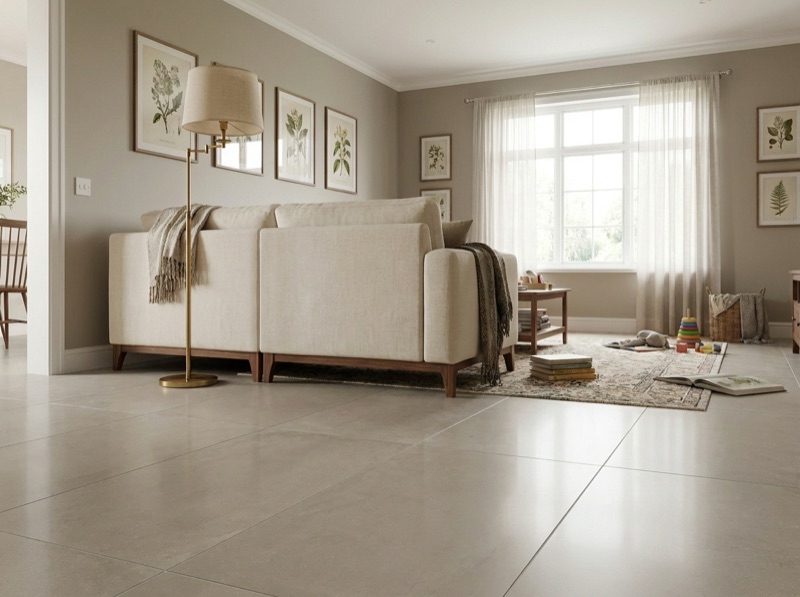
Porcelain tile
What is porcelain tile?
Porcelain tile is ceramic taken further. The clay is finer, the pressing is harder and the kiln runs hotter, so the fired body will not take up more than 0.5 percent of its own weight in water. That figure is the whole definition. It is why porcelain suits a shower floor or an entry, and why outdoor use still needs a stated frost resistance rating.
Ask ten people what makes a tile porcelain and you will hear that it is harder, or better, or the upgrade. None of those is the definition. Porcelain is defined by one measured property, how much water the fired body will drink, and nearly everything anyone likes about porcelain falls out of that property. The useful part is that you can get most of the way to checking it yourself, standing at a rack with a loose sample in your hand.
What your hands can check on a loose sample
Porcelain and ceramic are both fired clay, so a photograph will never separate them and a showroom light will not either. Your hands do better than your eyes here, because the difference is density, and density has weight, a texture and a color you can see anywhere the glaze stops. Try these in order on any sample you are allowed to pick up.
- Heft. Lift two tiles of the same size and thickness, one from each family. The porcelain is the heavier one, every time, because there is less air trapped inside the body.
- The back. Turn the tile over and look at the unglazed biscuit. Porcelain reads fine and tight, closer to the underside of a dinner plate. A more porous body reads coarse and chalky, closer to a flowerpot.
- A cut edge. Ask for a cut piece rather than breaking a sample. On a through body porcelain the color and speckle run the full thickness, so a chipped corner still looks like the tile instead of like a wound.
- Water. Put a few drops on the unglazed underside and wait. A dense body leaves the drops sitting on top of it. A porous one darkens beneath them and pulls them in, which you can watch happen.
What the water drop actually tells you
It tells you direction, not a number. The real test weighs a dry sample, saturates it under boiling or vacuum, then weighs it again, and the difference expressed as a share of dry weight is the water absorption. ASTM C373 is the method, and ANSI A137.1 draws the porcelain line at 0.5 percent. A tile either sits under that line or it does not, which is why porcelain is a fact about a tile rather than a compliment paid to it.
Absorption is worth caring about for three reasons in this climate. Water that gets into a porous body and then freezes has somewhere to expand, which is what ruins tile on an uncovered porch after a St. Charles County winter. A body that drinks can also stain from behind if the glaze is ever breached. And a body that does not drink stays dimensionally calm in a room that swings from a July basement to a January mudroom. The tile category page covers where each material ends up in the house.
It is worth being clear about what the figure does not promise. A low absorption body is not a stain proof floor, because staining happens at the surface and in the joints rather than in the biscuit. It is not an unbreakable floor either, since breaking strength is a separate test on a separate machine. And it says nothing at all about how the tile behaves when it is wet and someone steps on it. Density is one property, measured honestly, and the mistake people make is asking it to stand in for the other four.
Through body, color body and glazed porcelain
Three constructions share the porcelain name and they behave differently the day something goes wrong. Through body porcelain carries one color and one speckle from face to back, so wear and chips are close to invisible. Color body porcelain tints the biscuit to sit near the glaze color, so a chip reads as a scuff rather than a white flash, without carrying the full pattern through. Glazed porcelain puts a printed, decorated surface over a pale body, and that is how wood look planks, stone looks and concrete looks exist at all.
None of that makes glazed porcelain a lesser tile. It moves the question, though. On a glazed tile the glaze is the part that wears, so the abrasion class matters more than the body does, and that class is what PEI reports. On a through body tile there is often no class at all, because there is no glaze to abrade.
What the sample tag settles that your hands cannot
Four checks get you to the family. The tag gets you to the tile. Read it before anything is ordered, and ask us to pull the manufacturer sheet if the tag is thin.
- Wet slip resistance, which is a measured value and not something a fingertip can judge. The DCOF number is the one to find before a tile goes anywhere water lands.
- The abrasion class, if the tile is glazed and going on a floor.
- Edge treatment, meaning whether the tile was cut to size after firing or left with the softer pressed edge, because that decides how tight the joints can run.
- Shade variation, which tells you how much piece to piece difference the line intends. A low variation tile that arrives varied is a problem. A high variation tile that arrives varied is working as designed.
- Frost resistance and exterior suitability, which the manufacturer states or does not. Low absorption alone is not a rating.
What density does not fix
Porcelain is not forgiving underfoot. It is hard, it is cool, and anything fragile that lands on it loses. Those are real trades and they do not go away because the absorption figure is good. Neither does the work underneath. A porcelain floor is only ever as flat and as sound as the substrate it was set on, and a tile bridging a hump will crack or show a lipped edge no matter what it is made of.
In a shower it fixes even less, because a shower is a waterproofing job first and a tile job second. The membrane, the slope and the way the curb and the niche are detailed keep the wall dry. Porcelain is the finish over that work. And the joints between the tiles are their own decision with their own failure modes, which the grout entry takes apart. When you want to settle it in person, the Wentzville showroom keeps tile on the floor rather than on a wall. Pick pieces up, ask at the rack what you are holding, and call 636-332-0654 first if you want to be sure Jonah or Audra is free when you arrive.
What else people ask about porcelain
Outdoor use in a freeze thaw climate, what it takes to cut, and whether any of it needs sealing.
636-332-0654Some of it can. Low absorption is what makes exterior use possible, because there is little water in the body to freeze and expand, but the manufacturer still has to state that the tile is frost resistant and suitable outdoors. The installation matters just as much: an exterior setting bed, drainage so water leaves rather than sits, and enough wet grip on a surface that will ice.
Yes, and that is a labor question rather than a material flaw. A dense body wants a wet saw instead of a score and snap, cuts more slowly, and wears blades faster. Holes for a valve or a floor register need the right bit and patience. Large thin panels add handling requirements of their own. All of it gets accounted for at the free in-home measure rather than guessed at.
The body does not, and a glazed surface does not either. Cement based grout is the porous part of a tile floor and is usually what people mean when they ask. An unglazed through body porcelain or a polished porcelain sometimes gets a treatment to keep grout haze from staying in the surface during install, which is a different job from sealing a floor for life.
Pick both of them up before you decide
A screen cannot show you weight, a cut edge, or the way a glaze behaves when the light rakes across it. Tell us the room and we will put a porcelain and a ceramic in your hands at the Wentzville showroom.
Free estimate
636-332-0654