 Flooring Correct
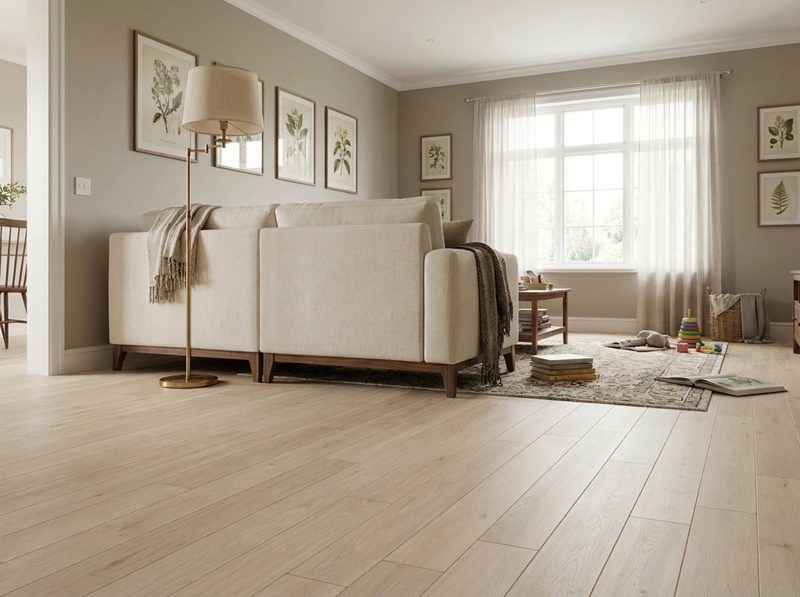
White oak flooring
What is white oak flooring?
White oak is a hard, straight-grained domestic species with a neutral to slightly cool tone, and it is the wood behind most of the light, gray-leaning floors homeowners bring us in photos. The look is not an accident of the species alone. It comes from a specific sequence of decisions, starting with how the log itself gets cut.
The white oak floor in a design magazine did not get that look from the species alone. It got there through a sequence of decisions made in order, starting before the wood is even a plank, and the earliest one in that sequence does more to decide the outcome than any stain or sheen chosen afterward.
Step one: the log gets cut a specific way
Before a white oak board is a board, it is a section of log, and how that log gets sliced determines almost everything about the grain you will see later. Plain sawn boards are cut tangentially, following the outer curve of the log, and they show the familiar cathedral-arch grain pattern, wide and varied board to board. Quarter sawn boards are cut close to radially, straight through the log toward its center, and they come out with a straighter, quieter grain and often a distinctive fleck across the face where the wood's rays get sliced through. Rift sawn sits between the two, cut at an angle that avoids the fleck but keeps the grain running straight and linear with almost no cathedral pattern at all.
Why this step decides more than any that follows
The cut happens once, at the mill, before a board ever reaches a stain or a finish, and it cannot be undone afterward. A stain color can be changed. A sheen can be swapped between orders. The grain pattern that the cut produces is permanent, and it is the single biggest reason two white oak floors, both genuinely white oak, both from decent lines, can read as completely different floors once they are down. The straight, quiet grain that most designers reach for when they say white oak specifically comes from a rift or quarter sawn cut, not from the species by itself.
Step two: grade sets how much character survives the cut
Grade decides how much of the tree's natural variation, knots, mineral streaks, color shift, stays in the run of boards. A clear or select grade keeps that variation to a minimum on top of whichever cut was chosen, which is why a rift and quarter sawn floor in a clean grade is the combination behind the quietest, most uniform white oak looks. A character grade keeps more of it, which reads as a warmer, busier floor even with the same straight cut underneath it. Our page on wood grades covers how grade works across every species, not white oak alone.
Step three: finish decides the color, not the grain
With the cut and the grade already locked in, finish is where the tone gets set. A water based finish stays clear and keeps white oak close to its natural neutral to cool tone, which is the base most gray-leaning and whitewashed looks start from. An oil finish, including hardwax oil, warms it slightly and gives a lower, more matte look. Both are legitimate choices, and neither one can undo a cathedral grain pattern that plain sawing already put there. The full range of finish and sheen options is laid out on our solid hardwood page. This is the step people assume controls the whole look, when really it is only adjusting what the first two steps already decided.
Step four: sheen, the last adjustment before it is done
Sheen is the final variable, and it works on top of everything else rather than changing it. A matte or low sheen hides dust and fine scratches and reads as the quiet, understated finish most of these floors are going for. A higher sheen reflects more light and puts more emphasis on whatever grain and texture is already there, straight or busy, depending on what the earlier steps produced. By the time sheen gets chosen, the floor's real character was decided three steps ago.
Seeing the whole sequence on one board
The fastest way to understand all of this is to hold the boards rather than read about them. Red oak and white oak are both on the floor here, and setting the two side by side is the quickest way to see the tone difference for yourself. Within white oak itself, ask what is on the rack and set a plain sawn face against a straighter-grained board, because the cut's effect lands in your hand faster than in any explanation. Bring a photo of the look you are after and we will work backward from it, cut, grade, finish, sheen, in that order, toward the boards that actually produce it. Samples go home with you, and a plank on your own floor under your own windows settles more than a rack under store lighting ever will.
What else people ask about white oak
Plain versus rift versus quarter sawn, why designers reach for it over red oak, and whether the cut affects durability.
636-332-0654It comes down to the angle the log is cut at. Plain sawn is cut tangentially and shows a wide, varied cathedral grain. Quarter sawn is cut close to radially and shows a straighter grain with a distinctive fleck pattern. Rift sawn sits between the two, cut at an angle that avoids the fleck while keeping the grain linear. All three are genuinely white oak, just cut differently.
Mostly the tone and the grain. White oak runs neutral to slightly cool rather than red oak's warm pink undertone, and a rift or quarter sawn cut gives a straighter, quieter grain than red oak typically shows. That combination is closer to the light, understated look that shows up in most current design photography, though red oak remains the harder-wearing, more classic choice for plenty of houses.
Not meaningfully for day to day wear. Cut is a grain and appearance decision, not a hardness one, since hardness comes from the species itself rather than which direction the log was sliced. Quarter sawn boards are sometimes described as more dimensionally stable because of how the growth rings run through them, which is worth asking about if stability in a particular room is a concern.
Narrow the look down to an actual board
Bring a photo of the white oak floor you keep saving. We'll work backward through cut, grade and finish to the specific boards on our floor that produce it, rather than guessing from the species name alone.
Free estimate
636-332-0654