 Flooring Correct
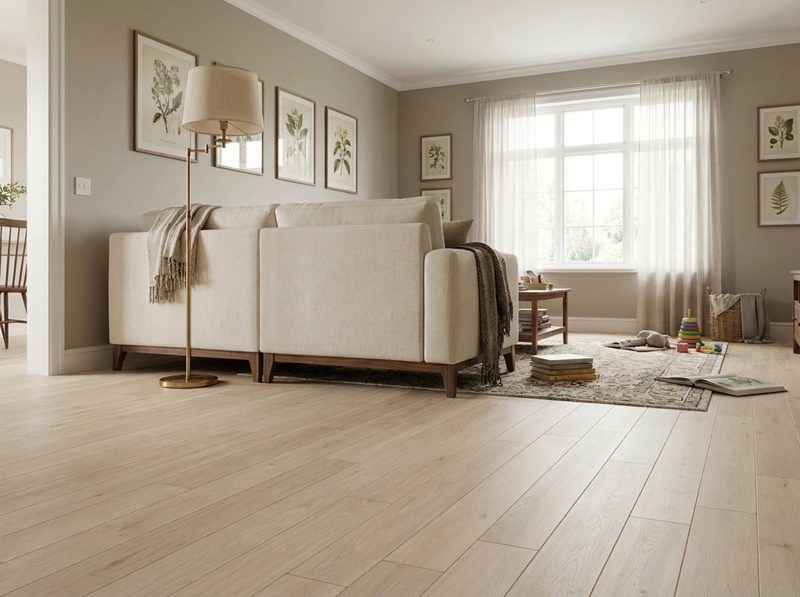
Red oak flooring
What is red oak flooring?
Red oak is a domestic hardwood with a strong, visible grain and a warm pink undertone that ambers with age. No other species accounts for more of the wood flooring in American homes, so plenty of houses here already have some. The real decision is usually not whether you like red oak, but what to do about the red oak already down.
If red oak already runs through part of your house, the question is rarely which species to pick anymore. It is whether to match what is there, break from it on purpose, or leave the existing floor alone because it has more life in it than it looks like at a glance.
The decision behind the decision
Red oak is the baseline American wood floor. Every other species tends to get described by how it differs from red oak, and no species is down in more houses. So an addition, a remodeled room or a redone stair rarely starts from a blank slate. Somewhere nearby there is already red oak, in a hallway, a dining room, or the whole upstairs, and it is going to sit next to whatever gets chosen for the new space. That existing floor is not a footnote. It is the actual constraint the decision has to work around.
Option one: match it as closely as new material allows
Buying new red oak and installing it to read as one continuous floor is the most common path, and it can work well when the existing floor is a species and a color still being milled today. It rarely means an exact match, though. Age, sun exposure and years of finish coats shift the tone of an existing floor in ways new boards will not start out matching, and a stain that reads right on paper can still land a shade off next to years of amber. This is a decision made with samples set directly against the existing floor, not from a swatch under showroom light.
Option two: get more out of the floor already down
Sometimes the honest answer is that the existing floor has more life in it than it looks like at a glance, and that is worth raising before anything gets ordered. Solid red oak can be sanded to bare wood and finished again, which resets color and sheen across the whole run at once. Next to a small addition, that often reads more consistent than introducing a second batch of boards that has to match a first. Our hardwood page covers what sanding and recoating actually involve, and how many times a solid floor can take it. Whether the floor in front of you is a candidate, and who would do that work, is a conversation for the phone rather than a page: 636-332-0654.
Option three: let the new room be a deliberate break
Not every room needs to match. A kitchen remodel that moves toward white oak or to a different material entirely, with a transition strip at the doorway, is a legitimate decision rather than a failure to match. This tends to work best where a real threshold already exists, a doorway, a change in level, a run of tile, because an unplanned break in the middle of an open room reads as an accident rather than a choice.
What actually decides between the three
How confident anyone can be in an exact match depends on how old the existing floor is, whether the same grade and width are still available, and how much of the room the light hits directly, since sun-faded boards are the hardest to match honestly. Confidence goes down the older the floor gets. A floor already showing wear across the whole space is an argument for dealing with that floor first rather than extending it, because bringing a whole run back at once resets everything instead of setting fresh boards next to tired ones. And a genuine style change, cabinets, trim, or a shift to a lighter whole-house palette, is the strongest argument for the deliberate break, because in that case matching the old floor was never really the goal.
What to bring in so we can actually judge the match
A photo taken in the room's own light tells us more than a description ever will, but the single most useful thing is a literal piece of the existing floor: a leftover board from a closet, a transition strip that gets replaced anyway, or a sample cut from an inconspicuous spot. Set next to new red oak on our floor under real light, that piece settles the color question faster than any of us guessing from memory. Pine shows the same principle from the other direction. Its softer grain reads very differently once it is down, which is exactly why a physical piece beats a photo every time.
What else people ask about red oak
Whether an exact match is realistic, what an older floor still has left in it, and why red oak warms with age.
636-332-0654Rarely exactly, and it is worth knowing that going in. Years of sun exposure and finish coats shift the tone of an existing floor in ways new boards will not start out matching, even from the same species and grade. A close, honest match made by setting samples against the real floor is a realistic goal. An exact match is not something anyone can promise from a swatch alone.
Not necessarily, and it is worth settling before any material gets ordered. Solid red oak that is structurally sound can be sanded back to bare wood and finished again, which resets color and sheen across the whole run at once and usually reads more consistent than laying new boards beside an older floor. How much wood is left above the tongue is what decides how many times that can happen. Call 636-332-0654 and describe what you are looking at.
Red oak has a warm undertone to begin with, and it ambers further with age and with certain finishes, particularly oil modified polyurethane, which yellows slightly as it cures and keeps shifting over years. That warming is one of the reasons an older red oak floor can be hard to match with brand new boards straight out of the box.
Bring a piece of the floor you're matching
A photo helps, but an actual board or a cut piece from a closet is what lets us judge the match honestly, against new red oak, under the same light it will actually live in.
Free estimate
636-332-0654