 Flooring Correct
Are dark hardwood floors hard to keep clean?
Not dirtier, just more visible. Dust, lint and pet hair are pale, and pale specks stand out against a dark background the way they never do on a golden oak floor. Sheen makes it worse or better: gloss throws light straight back at every particle, while satin scatters it into a soft haze instead. The floor is not the problem. Contrast and finish are.
The mechanism: contrast, not dirt
A dark hardwood floor does not attract more dust, more pet hair or more everyday grit than a light one. It collects roughly the same amount any floor in the same room collects. What changes is whether you can see it. Dust, lint and the fine hair that comes off a dog or a sock are almost always pale, and a pale speck sitting on a dark background reads instantly to the eye. The identical speck on a honey oak or a light gray plank blends into the wood tone and disappears until there is enough of it to matter. Nothing about the dark stain is dirtier. It is simply the better background for showing what was already there.
Sheen is the second half of the mechanism, and it matters as much as color. A high gloss topcoat behaves like a mirror: it throws light straight back at the eye, and every particle sitting on that mirror gets lit along with it. A satin or matte finish scatters the same light in many directions instead of one, which turns the identical amount of dust into a soft, low-contrast haze rather than a field of individual specks. Two dark floors, same stain, different sheen, read as two different maintenance problems.
What that means when you are actually choosing
The room's own light decides more of this than the stain chip does. A room with strong low, raking light, a west-facing window a floor sits in full sun through late in the day, or a glass door a morning sun cuts across, puts the surface of any floor on display. In that kind of room, a dark floor paired with a glossy finish is the hardest combination to keep looking presentable between cleanings, because the light is doing the finding for you. The same dark floor in a room lit mostly from overhead, without that low grazing angle, reads calmer and shows far less between sweeps.
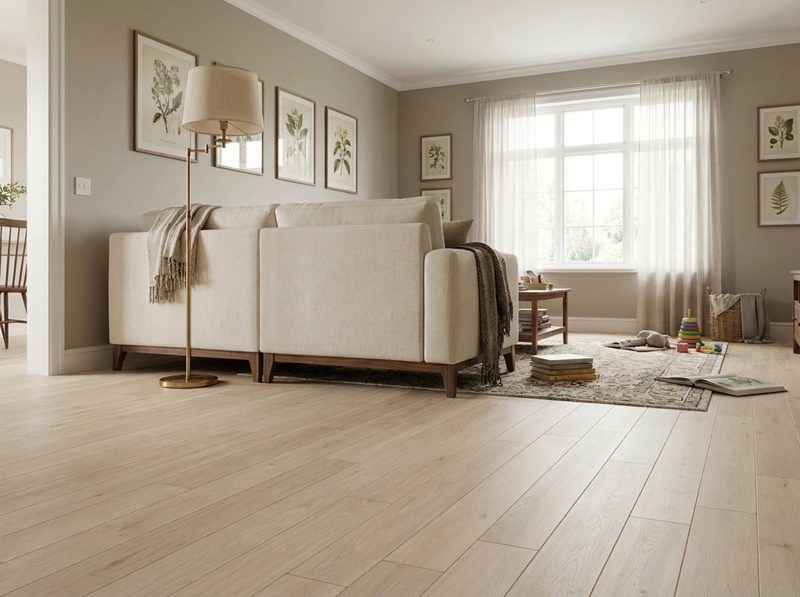
This is also a scale question. A dark floor under a large expanse of open plan, seen the way the wide runs in our gallery show a single wood tone carried through several rooms, reads differently than the same color contained in one small room with furniture breaking up the sightline. More open floor in strong light means more surface for dust to be found on.
The failure mode nobody warns you about
There is a second, separate way a dark floor shows more than a light one, and it is not dust. A scratch that only nicks the clear topcoat, without touching the stained wood underneath, catches light along its edge and reads as a thin pale line against the dark background. On a lighter floor that same scratch is nearly invisible, because there is far less contrast between the raw scuff and the surrounding tone. This is a finish issue, not a stain issue, and it is the reason a dark floor in a high traffic run, a front hall or a kitchen walkway, tends to show its wear sooner in photographs than it does in person.
The test that settles it in your own light
None of this needs to be taken on faith. Bring a sample of the dark stain and sheen you are considering home, set it on the actual floor of the room in question, and look at it at the time of day the room gets its harshest light, not at noon under flat overhead lighting. Wipe it with a dry cloth and look at what the cloth picked up against the sample's surface versus what it picked up against a lighter sample next to it. Run a fingernail lightly across the corner and watch how the mark catches the light. A few minutes with two samples in your own window tells you more than any showroom display can, because your light is the only light that matters for this decision.
If gloss and dark stain both appeal to you but the maintenance question worries you, satin in the same stain color keeps the tone and quiets the glare, and it is worth putting the two sheens side by side before you decide either way. Our hardwood page covers what the showroom carries by species and finish. What color reads calmest under your particular traffic and light is exactly what the free in-home measure is for. We look at the room, not a sample board, and you can ask us to bring both sheens. Call 636-332-0654.
More on dark floors and how they wear
Mopping frequency, sheen choice and how a scratch actually reads against a dark stain.
636-332-0654No. The dirt load is the same. What changes is how soon you notice it needs attention, because pale dust and lint stand out sooner against a dark background. A light floor in the same room is just as dusty between cleanings, it only looks cleaner.
It is the lower maintenance choice for visible dust, since it scatters light instead of reflecting it back at every particle. Some households still prefer the richer look of gloss and are willing to sweep more often for it. Bring both sheens home before you decide.
A scratch that only nicks the clear topcoat catches light along its edge and reads as a pale line against a dark stain, where the same mark is nearly invisible on a lighter floor. It is a contrast issue in the finish, not a sign the wood itself is more fragile.
See it in the room it's actually going in
Tell us which room and which way its windows face. We bring the stain and sheen samples that make sense for that light, not a generic board, and you can compare gloss against satin in the same visit.
Free estimate
636-332-0654