 Flooring Correct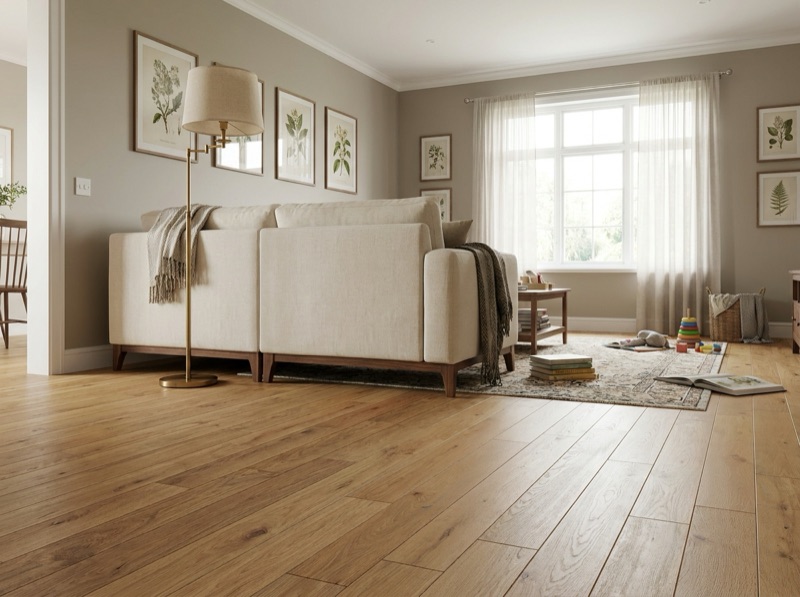

What floor colors hide dirt best?
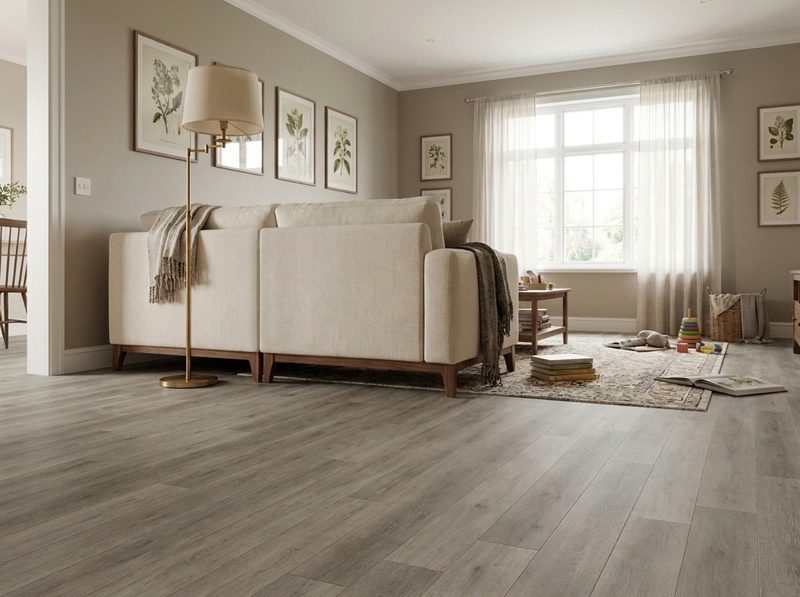
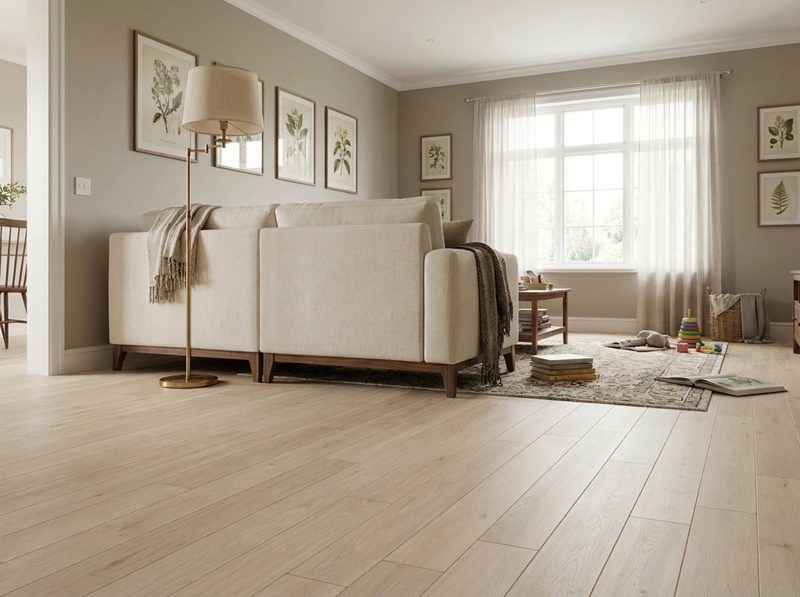
Variation beats any single color. A floor with real tone-to-tone movement in the face, in a matte or satin sheen, hides both pale dust and dark grit, because neither one gets a clean uniform background to sit on. Flat colors, light or dark, each hide one list and show the other. Sheen matters as much as the color name does.
Contrast is the mechanism, not the color name
A mark shows because it contrasts against a field the eye has already accepted as uniform, and our carpet page works that optical principle through in full. What changes on a hard surface is that nothing gets absorbed. A pile swallows a certain amount of what lands in it. Tile, plank and wood hold all of it on top, in plain view, where three things decide how plainly it reads: how much tonal movement the face carries, what the finish does with light, and what is happening in the joints between the pieces.
Take the first of those on its own terms, because variation on a hard surface is manufactured and it is worth knowing which kind you are buying. On wood it comes out of the species, the grade and the stain, so the difference between one board and the next is genuine and never repeats. On a printed vinyl or laminate floor it comes off a decor layer, and that layer holds a finite set of unique plank faces before the sequence starts over. Both hide dirt on day one. The printed floor keeps hiding it only if the repeat is long enough that you never learn where it falls, so ask how many unique faces the run carries and look at a spread of full-size planks rather than one. Relief helps more than print does either way. A wire-brushed or hand-scraped face breaks light with actual depth rather than a photograph of depth, and depth still works from the angles a photograph does not.
Sheen, and the angle the light arrives at
The old rule of thumb, dark floors hide dirt, is only half right and it misses sheen entirely. A dark floor with a glossy finish throws light straight back at every particle sitting on it, which can show dust worse than a lighter matte surface does. Sheen and contrast both matter, and either one alone can undo the other. Whether dark hardwood specifically is hard to keep clean day to day has its own answer here; this page is about the color and finish mechanism across every material we carry. Carpet is the one exception, because there the hiding is done by fiber and pile rather than by a finish.
Then there is the light itself, which people almost never account for and which moves more than the floor does. A window low in the sky, or a run of ceiling cans washing down a wall, sends light across the floor at a shallow angle instead of straight down onto it. Shallow light finds every particle, every fine scratch and every smear, because each one throws a small shadow. The same floor under flat overhead light shows none of it. That is why a floor can look spotless at noon and look filthy late in the afternoon with nothing having landed on it in between, and it is worth walking the room at both times of day before blaming the color.
The joints matter as much as the field
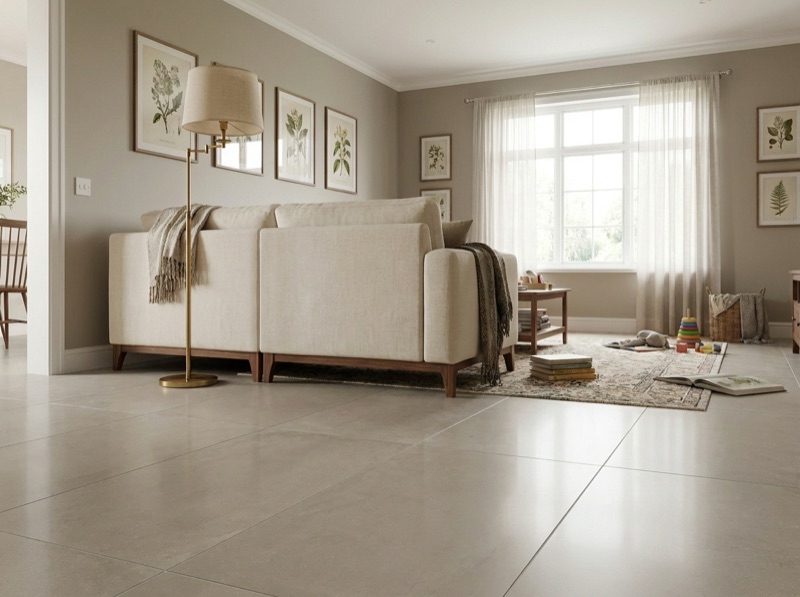
On a tiled floor, grit works its way into the joint lines faster than it marks the tile face, so a floor that looks clean at a glance can still need its grout swept and resealed on schedule. A grout color chosen close to the tile hides that better than a strongly contrasting grout, which draws the eye to every joint on purpose and will therefore draw it to every dirty joint too. A resilient floor with a click seam has a smaller version of the same issue at the plank edge, and any floor has it at the thresholds and the transitions. Neither is a reason to avoid either material. It is a reason to judge the whole assembly rather than the field color alone.
The failure mode: a chip that lied by omission
The mistake happens at the sample rack. A small chip under bright, even showroom lighting reads as one overall tone, and it is easy to judge it purely on whether that tone is light or dark. Scaled up to a whole room, under your own lighting, a flat color shows every mark it was ever going to show, and a variegated one that looked busy on the small chip settles down and does exactly the opposite. The chip is not lying about the color. It is just too small to show you the pattern that actually does the hiding, and far too small to show you a repeat.
How to check it yourself before you buy
Do not judge a sample on a clean showroom counter. Bring the thing that actually lands on your floor: a pinch of the dust that collects under your bed, a tuft of what the vacuum pulls out of the carpet now, or a handful of the grit that comes off your own driveway. Set it on a full-size piece of the sample, not the small chip, and look at it under the lighting in the room it is going into rather than the showroom's. That single test tells you more than any description of a color ever will, because it puts the actual mechanism, contrast and pattern, against your actual dirt.
Bring that same dust or hair with you when you visit, along with a photo of the room and whatever is already in it. We will set full-size pieces out at 15570 Veterans Memorial Pkwy and let you check them against what your house actually produces before anything is ordered.
More on finish, pattern and what actually shows
Matte against gloss, a printed repeat against true variation, and where grout fits into the picture.
636-332-0654In most rooms it does, though it trades one problem for another. A matte or low-sheen surface scatters light instead of returning it in one direction, so dust, hair and fine scratches all lose the highlight that made them visible from across the room. The trade is that a very flat matte can pick up a smudge or a bare footprint more readily than a satin does, and the finish maker's own cleaning instructions matter more on it than people expect. Satin sits between the two and is the safe answer when nobody wants to think about it.
No, and the difference matters. A repeating printed pattern shows its repeat once you know what to look for, which can eventually read as busy rather than calm. True variegation, where each plank or tile carries genuine, non-repeating variation in tone, keeps working precisely because the eye never locks onto a repeat. Ask whether a sample's variation is a printed pattern or a manufacturing variation before judging it by the chip alone.
Often, yes, because grit works into a joint before it visibly marks a glazed tile face. That is a maintenance rhythm rather than a flaw: sweep grit before it grinds in, and reseal cement grout when water stops beading on it rather than on a fixed schedule. A grout color close to the tile hides this better than a strongly contrasting grout, which draws attention to every joint on purpose.
Bring us your dust, hair or grit
Whatever collects fastest in your busiest room, bring a bit of it. We'll set full-size samples against it in person, at the counter or at the in-home measure, before you commit to a color.
Free estimate
636-332-0654