 Flooring Correct
How bold is too bold for tile patterns?
It depends less on the pattern than on how much floor it covers. A bold tile gains personality and a real focal point, and it gives up neutrality: you will either keep liking it or tire of it, with less middle ground than a plain tile leaves. Contained rooms, an entry or a powder bath, take more boldness than a large open floor you look at daily.
What a bold pattern actually gains you
A patterned tile floor does something a plain one cannot: it becomes a focal point rather than a background. In an entry, that means the floor is the first thing a guest notices, which is exactly the effect some homeowners want from that particular room. In a kitchen or bath, a bold tile can carry the whole space on its own, letting cabinets and walls stay simple by comparison. It is also genuinely forgiving of everyday mess in one specific way: a busy pattern hides crumbs, hair and light scuffs better than a plain tile does, because there is already so much visual information on the floor that small additions do not register.
What it costs you
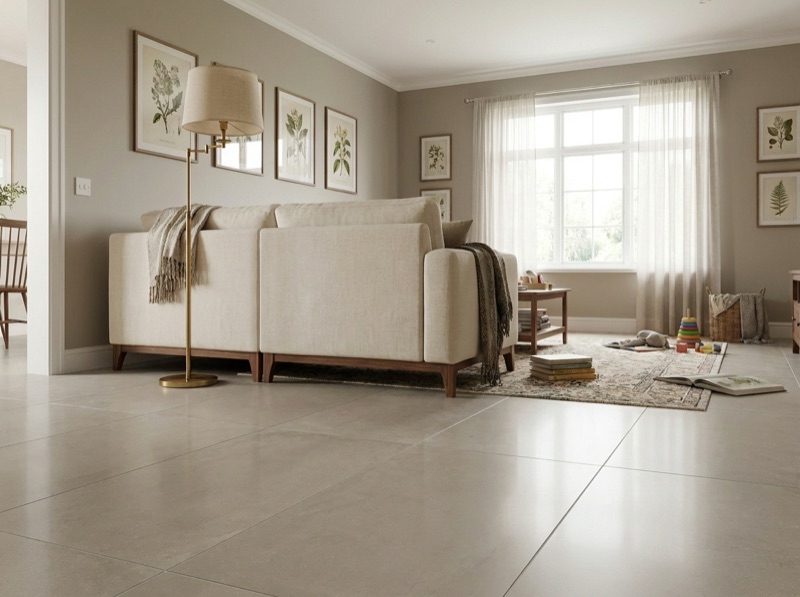
The honest downside is that boldness has less middle ground than a plain tile does. A quiet stone-look porcelain rarely provokes a strong reaction either way, which means it rarely gets old either. A bold pattern usually does provoke a reaction, and that reaction does not stay fixed. Some households love a pattern for years and never tire of it. Others find the same pattern starts to feel loud after living with it daily, in a way that a subtler floor never would have. There is no way to know in advance which household you will be, which is exactly why the room you put it in matters as much as the pattern itself.
Where boldness wins
Contained, occasional spaces are the safer bet for a strong pattern. A powder bath floor, an entry, a mudroom, or a kitchen backsplash-adjacent accent are all rooms you pass through rather than sit in for hours, and a floor you glance at reads differently than one you stare at during dinner. These are also usually smaller footprints, which limits how much of the pattern is repeating at once and keeps the effect closer to a design choice than an overwhelming field.
Where restraint wins
Large continuous floors are the opposite case. A kitchen open to a living and dining space, the kind of run shown carried through several rooms in our gallery, is somewhere you spend real time and where the eye needs somewhere to rest. A bold pattern repeated across that much square footage compounds on itself in a way a small sample never suggests. It is also the room most likely to already be carrying other bold decisions, cabinet color, a patterned backsplash, a strong paint choice, and stacking a loud floor on top of those competes with them instead of supporting them. A quieter floor lets everything else in an open room do the talking.
The mistake this page exists to prevent
The single most common way a bold tile ends up regretted is judged from one tile rather than a field of them. A pattern that reads as striking and controlled on a single showroom sample multiplies when it repeats across a hundred more of the same tile, because repetition is what turns a pattern from a detail into a texture the whole room is made of. A motif that feels bold but balanced up close can read as busy or even dizzying once it is tiled wall to wall. This is not a flaw in the tile. It is a limitation of judging boldness from a single square instead of the room it is going into.
The fix is simple: never judge a bold pattern from one sample chip held at arm's length. Get in front of the largest board of it you can, then step back the distance you would actually stand at in the room rather than the reading distance of a showroom counter. That one change in viewing distance is usually enough to tell you whether the motif holds together or starts to swim. Bring a photo of the space and a rough idea of how much floor the pattern would cover, and see how a contained accent or border can carry some of that boldness without covering the whole floor. We will set the options out on the counter with you, next to your cabinet door or a chip of the counter surface if the tile has to sit beside either. That comparison is what the showroom visit and the free in-home measure are for. Call 636-332-0654.
More on choosing a patterned tile
Small bathrooms, cleaning a busy pattern and pairing it with a backsplash.
636-332-0654It can, but a small bathroom is also exactly the kind of contained space where a bold pattern reads well, since you see it in short visits rather than for hours at a stretch. If you are unsure, a bold accent confined to the shower floor or a border rather than the whole room is a middle option worth asking about.
The pattern itself tends to hide light dirt and scuffs better than a plain tile does, since there is more visual noise for small marks to blend into. Grout lines are a separate question and get dirty at the same rate regardless of the pattern on top of them.
Not necessarily, and running two bold patterns at once in the same sightline is a common way a room ends up feeling chaotic rather than intentional. A common approach is one bold surface and the rest of the room kept quiet, whichever surface you want to lead.
Judge the pattern against your room, not a chip
Bring a photo of the room and roughly how much floor is in play. We set the options out on the counter with you, so the pattern gets judged next to the finishes it has to live with.
Free estimate
636-332-0654