 Flooring Correct
How do you pet-proof stairs?
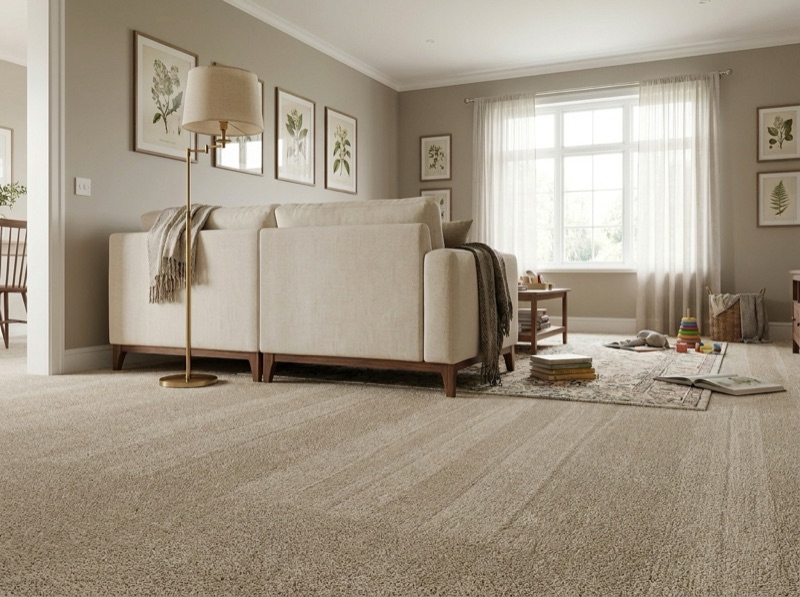
You don't, not fully. No fiber or finish is immune to a claw or a slick tread. What actually helps is ordinary: a dense, tightly twisted cut pile if the stair stays carpet, since a loop gives a claw something to catch, or the correct stair-nose hardware and a secured runner if it runs a hard surface, plus nails kept trimmed either way.
The myth: a material that makes a stair pet-proof
People shop for pet-proof stair carpet the way they shop for a stain-proof couch, expecting one product to remove the risk entirely. It does not exist. There is no fiber, pile or finish that a determined claw, a skid on a hard tread or a bladder accident cannot eventually mark. The phrase gets used in marketing because it sells, and because a stair genuinely is the highest-consequence surface in a house with pets, which makes the promise feel worth paying extra for.
Why the belief holds up so well
The idea persists because a stair really does behave differently than any other surface. Carpet is stretched around a hard outside corner at every nosing and walked on there specifically, which is already the toughest spot in the house for any pile to hold up, pets or not. Add a claw that catches a loop on the way down, or paws needing traction on a slick tread, and it looks reasonable to believe some special product must exist to solve it outright.
What is actually true instead
What actually happens on a pet stair is the ordinary stair problem, plus two specific additions. The ordinary problem is the nosing bend itself, which a dense, tightly twisted pile resists better than a soft or loosely tufted one regardless of what walks on it. The additions are a claw that can catch a loop, and paws that need real grip on a smooth tread the way a person's shoe does not. None of the three gets solved by a single labeled product. Each one is solved by a specific, ordinary construction choice.
The claw and paw part, specifically
- Cut pile over loop. A loop hands a claw a strand to hook, and on a stair the pull runs along the nosing where everybody sees it. That construction argument belongs to our best carpet for pets page, which settles it for the whole house rather than just the steps.
- Hardware and a runner, if the stair is not carpet. Both of those are stair decisions before they are pet decisions, and our stairs and hallways page covers the nosing and runner question in full. The pet-specific part is only this: a paw needs grip that a shoe does not, so whatever grip you were going to plan for people needs planning for the animals too.
- Nails kept short. A nail long enough to touch the tread ahead of the pad is the one that hooks a loop and the one that slides on a hard nosing. A trim on a regular schedule changes the outcome on a stair more than most material swaps do, and it is the only part of this you still control after the floor is in.
What follows once the myth is out of the way
Once you stop looking for a magic product, the actual decision gets simple: choose a resilient, densely tufted cut pile if the stair stays carpet, or choose the correct nosing hardware and consider a runner if it does not, and keep nails trimmed either way. Fiber and pile construction are covered in full on our carpet page, and the mechanics of density, twist and the nosing bend itself belong to our page on what carpet actually works best on stairs, which this page does not repeat.
What the measure settles
A stair with pets in the house gets one extra question at the free in-home measure beyond the usual tread and riser count: what the current wear pattern already shows. A worn nosing, a snagged loop already pulling, or a slick spot at the bottom tread tells us more about your actual pets than any general guideline can, and it is what the recommendation gets built on.
More on pets and stairs
Whether pet-proof carpet is real, when to keep the stair carpeted, and the labeling mistake worth avoiding.
636-332-0654Correct, and it is worth saying plainly rather than dancing around it. Every construction, however resilient, can eventually be marked by a claw, an accident or ordinary wear. What differs between carpets is how long that takes and how visible it becomes, not whether it happens at all.
Not automatically. Carpet stays the more forgiving default on a stair for grip and cushion, and a household with animals tilts that way more often than not. A hard surface can still be the right call, though it brings its own hardware and traction requirements, which our stairs and hallways page sets out in detail. It is a real choice, not a rule.
Buying on a marketing label instead of on construction. A carpet sold as pet friendly still needs to be checked for pile type and density the same way any other carpet does, because the label describes an intention, not a guaranteed result on your specific stair.
Get your stair's treads and wear pattern counted
Bring us the stair with the animals in mind. A pulled loop, a worn nosing or a slick bottom tread tells us more about your pets than any guideline does, and that is what the recommendation gets built on during the free in-home measure.
Free estimate
636-332-0654