 Flooring Correct
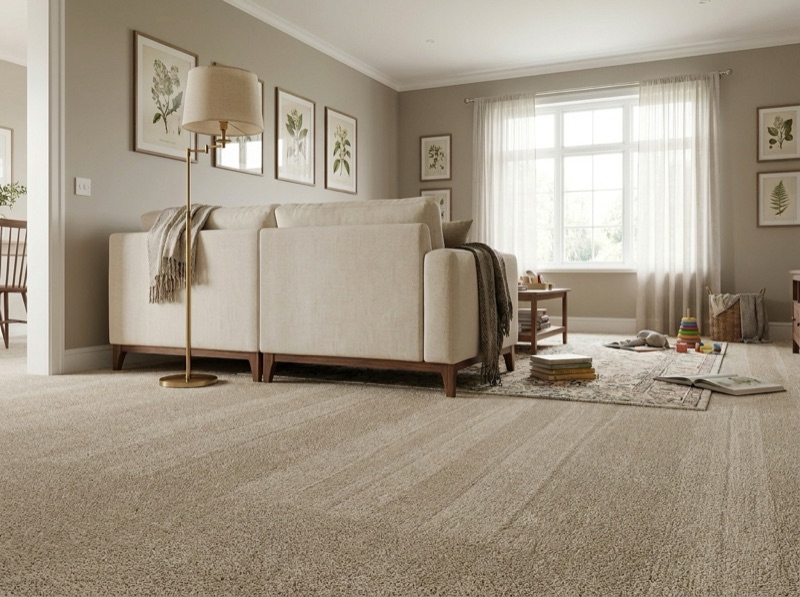
What carpet survives kids best?
A resilient, solution dyed fiber like nylon or triexta in a tight, dense twist holds up best against daily traffic, staining and crushing, but it is firmer and less plush underfoot. A soft polyester plush feels better for a nursery or bedroom but mats and stains faster under real traffic. Match the construction to the room rather than picking one for the whole house.
What you gain choosing for resilience
A carpet built for a household with kids leans on a resilient fiber, nylon or triexta, in a tight, dense twist, usually solution dyed so color survives repeated spot cleaning rather than fading under it. What you gain is straightforward: traffic lanes that spring back instead of staying crushed, spills that lift out instead of setting permanently, and a carpet that still looks presentable after the third juice box incident of the week. It is the carpet you stop worrying about.
What you give up to get it
That resilience comes at a real cost, and pretending otherwise is not honest. A tighter, denser construction is firmer underfoot and less plush than a soft cut pile, and it will not deliver the sink-in comfort a nursery or a formal bedroom is chosen for. Solution dyed fiber also tends to run in a narrower color range than fiber dyed after the fact, since the color has to be engineered into the yarn itself rather than applied to a finished carpet. You are trading some softness and some color range for durability, not getting both for free.
The softer carpet's case, and its real cost
The opposite choice, a plush or Saxony in polyester, has its own honest appeal. It feels genuinely better under bare feet and small knees, and it comes in deeper, more saturated color. Its real cost shows up over time rather than on day one: it mats in traffic lanes faster, it holds a stain longer without the fiber-level resistance a resilient construction has built in, and a plush pile shows every crawling toddler's path across it within a season. Comfort now, upkeep later.
Where each one wins in a house with kids
A family room, playroom or hallway with kids moving through it constantly is where the resilient construction earns its keep, because that is where crushing and staining happen daily rather than occasionally. A nursery or a bedroom, where the traffic is a few trips a day at most and comfort at floor level actually matters, is where a softer plush genuinely has the stronger case. Our bedroom page covers why comfort can win outright once durability stops being the constraint, and that logic applies just as directly to a kid's own room.
The honest downside of both
Neither construction is free of a real weakness. The resilient carpet will never feel as soft as the plush one, no matter how good the fiber is, and no amount of marketing changes that physical fact. The plush carpet will show wear and hold stains faster in any room with real daily traffic, no matter how carefully it is cleaned. Choosing one over the other is not solving the problem. It is deciding which honest limitation you would rather live with, room by room.
The mistake this narrows down
The actual mistake is picking one carpet for the whole upstairs based on how it feels in the showroom, then living with the wrong trade-off in every room it was never suited for. A resilient construction in a hallway and a softer one in a bedroom is not indecision. It is matching the fiber to what each room actually asks of it. Our carpet page has the full fiber and pile breakdown if you want to work through it room by room before the measure.
More on carpet for kids
Mixing constructions room to room, what solution dyeing actually changes, and where pattern helps.
636-332-0654It can, but it will be a compromise in one direction or the other, since the two rooms genuinely want different things from the fiber. A mid-density, textured construction splits the difference reasonably well if a single line across both rooms matters more to you than optimizing each one separately.
Not because of the dyeing process itself, that affects color permanence rather than softness. The feel comes from the fiber and twist chosen around it. Solution dyed versions exist in both resilient and softer constructions, so it is worth asking which base fiber you are actually comparing.
Often yes, on the staining side specifically. Variation in color and texture hides day-to-day marks better than a single flat shade regardless of which fiber it is built on, which is a real, separate advantage worth asking about alongside the durability-versus-comfort choice.
Match the fiber to each kid's room
Tell us which rooms are playroom-busy and which are bedroom-quiet, and we will pull resilient and plush samples for each before we measure and quote.
Free estimate
636-332-0654