 Flooring Correct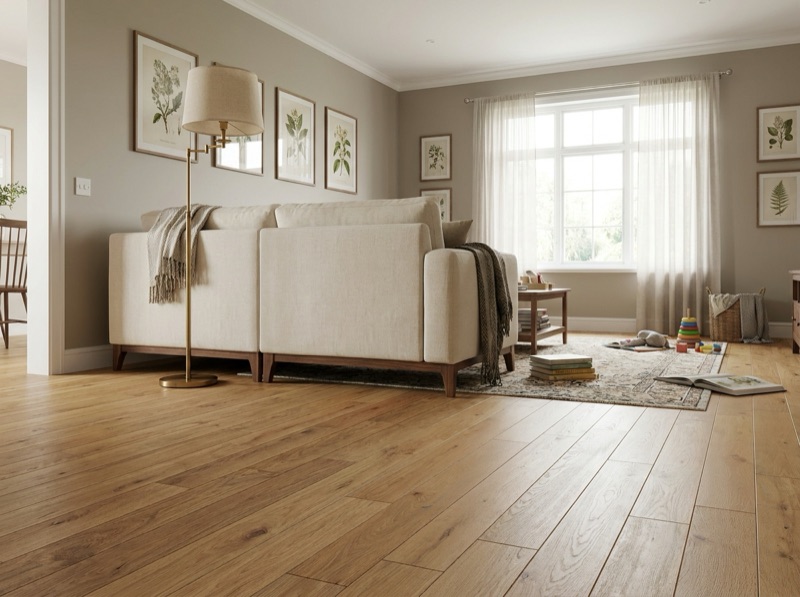
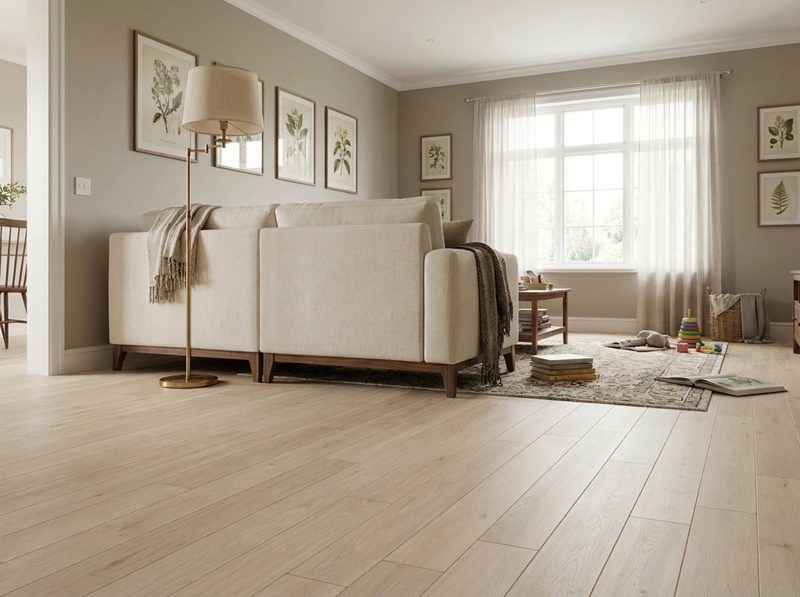
What wall colors work with warm wood floors?
Hold a paint chip against an actual board of your floor, in your own room light, not a photo of either. If the wood's warmth reads orange or red against the chip, lean the wall toward a warm white, greige or muted green. If it reads more amber or gold, cooler whites and blues usually settle rather than fight it.
The test you can run before you buy a drop of paint
Undertone is easy to argue about from memory and easy to see the second you compare two real things side by side. Take a handful of paint chips and hold each one flat against an actual board of the wood, or against a plank sample if the floor is not down yet, in the room where it will live. Do it once in the morning and once with the lamps on at night, because daylight and warm bulb light both shift how a color reads. Against a truly neutral chip, a warm wood's undertone shows itself almost immediately: it will read as leaning orange, red, pink, gold or amber, and one of those will be obviously more accurate than the others once the two are touching.
Reading the undertone once you see it
Once you know which way the wood leans, the wall color follows a fairly reliable pattern. A floor that reads orange or red, which is common in red oak and in cherry toned stains, tends to sit best against a warm white, a soft greige, or a muted, grayed-down green, because those colors share enough warmth to feel related rather than opposed. A floor that reads more amber or golden, which shows up in honey and caramel finishes, has more room to pair with a cooler white or a soft blue, because the contrast reads as a deliberate balance rather than a clash. A deep, chocolate brown floor, the kind walnut produces without any stain at all, tends to carry richer, more saturated wall colors well, including deep greens and warm charcoal grays, because a dark warm floor can hold its own against a bolder wall in a way a lighter one cannot.
What the same test does not tell you
A chip test settles undertone, and it stops there. It does not tell you how that wall color behaves across an entire room once it covers real square footage rather than a two inch square, and color intensifies at scale in a way a chip never predicts on its own. It does not account for a north facing room, which reads everything cooler over the course of the day, against a south facing one, which warms almost anything. It says nothing about the trim, the cabinets or the ceiling color already committed elsewhere in the room, all of which are quietly voting on the same decision. And it does not tell you anything about sheen, since the same wall color in flat, eggshell or satin reflects the floor's light back differently.
Taking the test further before you commit
The fix for most of that is simple: go bigger and go longer. A large sample square painted directly on the wall, or a large sample board propped against it, tells you far more than a chip, because it is closer to the actual surface area the finished room will show. Leave it up for at least a full day and check it again after dark. If the room has cabinets or trim already in place, bring those into the comparison too, because the floor is only one of several surfaces the wall color has to agree with, not the only one.
Why a screen cannot settle this and a real board can
Every version of this test online happens on a monitor, and a monitor does not reproduce undertone accurately, full stop. Screens shift warm and cool constantly depending on the display and the room it sits in, which is exactly the variable this whole question depends on getting right. At the Wentzville showroom the wood is out on the racks in full size boards rather than folded into a chip book, so you can hold your own paint chips, a trim piece or a cabinet door against real material instead of a picture of it. Showroom light is not your light either, which is the reason samples go home with you and get judged in the room they are going into. Our gallery shows finished rooms where that pairing already played out, but the only test that actually settles it is the one done with real material under your own light. Bring your chips, your trim sample and a cabinet door if you have one, and call 636-332-0654.
What else people ask about pairing wall color to wood
Color variation across boards, engineered and vinyl floors, matching versus contrast, and cooler toned floors.
636-332-0654Test against a few different boards rather than just one, since a species with real color range can show more than one undertone across the same floor. Pick the chip against the boards that cover the most floor, usually the ones in the main traffic path or under the window, since those are what the eye registers first when you walk in.
Yes. Undertone comes from the wood species and the stain or the printed finish, not from whether the plank is solid, engineered or vinyl, so the same chip-against-board test works the same way regardless of which construction is under it.
Either can work, and it is a style preference rather than a rule. Matching the undertone tends to read calm and cohesive, while a deliberate, gentle contrast can make a room feel more layered. What the test above rules out is an accidental clash, where a cool wall fights a warm floor without anyone intending it to.
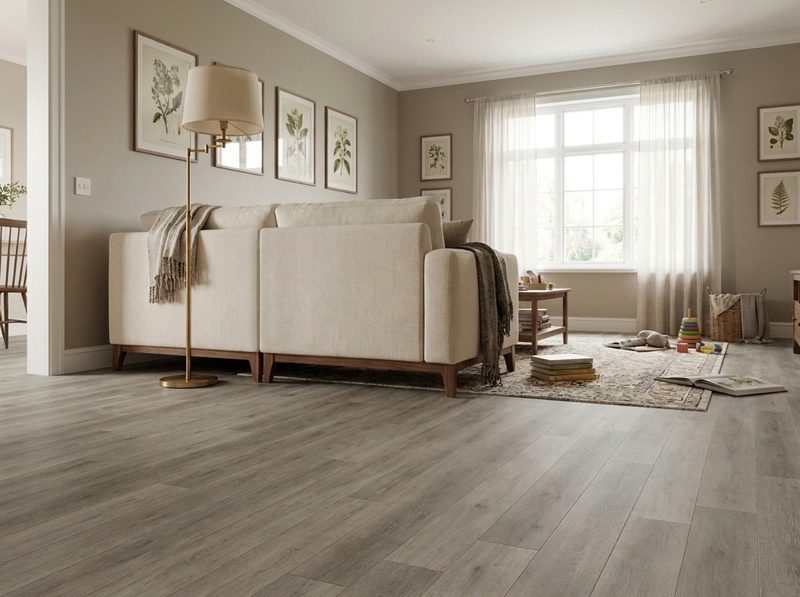
The mechanism is identical, holding a chip against the actual board in real light, but the result runs the other direction. A cool gray or ash toned floor generally settles better against cool or true neutral whites than against a strongly warm wall color, for the same reason a warm floor prefers a warm wall.
Bring your chips, we bring the boards
Tell us the room and what is already on the walls or cabinets. We set real samples against your own chips, then they go home with you.
Free estimate
636-332-0654