 Flooring Correct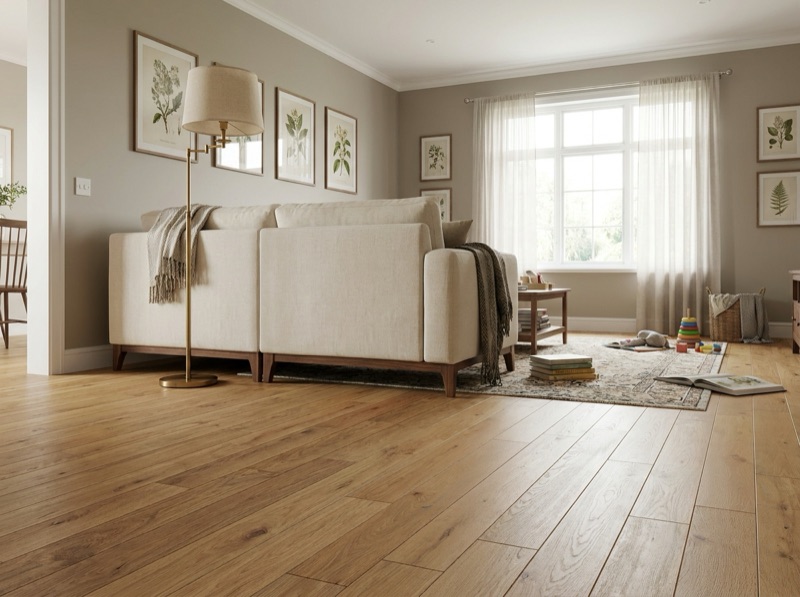
Oil Or Polyurethane,
And The Color
You Want In Year Eight
A finish is not a topcoat chosen at the end of the job. It sets the direction your floor's color drifts, it decides how a scratch gets repaired, and it dictates what may go in the bucket when you mop.
Three coatings compete for a site finished wood floor: hardwax oil, which soaks in, and two polyurethanes, water based and oil modified, which build a film on top. What each one is chemically sits on the hardwood pillar and there is no reason to say it twice. The decision this page makes is different. You are not choosing a chemistry. You are signing a maintenance agreement, agreeing to a color eight years from now, and picking what happens the first time somebody drags a chair back from a table.
Choose for the floor you will have in year eight, not the one under the plastic
Every finish sample you look at is at its youngest and best on the day you see it. That is the trap. An oil modified polyurethane ambers as it ages, which means the floor warms and deepens on a slow curve for years. A water based polyurethane goes on clear and stays close to clear, so what you approve is roughly what you keep. Hardwax oil sits down in the wood rather than on it, so the color is the wood plus whatever pigment went into the oil, and it deepens slightly with each maintenance coat.
So the useful exercise at the showroom is not to compare three fresh samples. It is to ask what each of them looks like once it has been in a house for a while, and then to decide whether that drift is something you want. Nobody regrets a warm floor they chose on purpose. People regret a warm floor they did not know they were buying.
Ambering is a gift to red oak and a problem where you want a pale floor
If your floor is red oak and you want the warm, honeyed American look, an oil modified polyurethane gives you that for free. The amber cast the coating develops sits on top of the pink undertone already in the species, and the two agree with each other. Traditional houses look right in it because it is what traditional houses have on them.
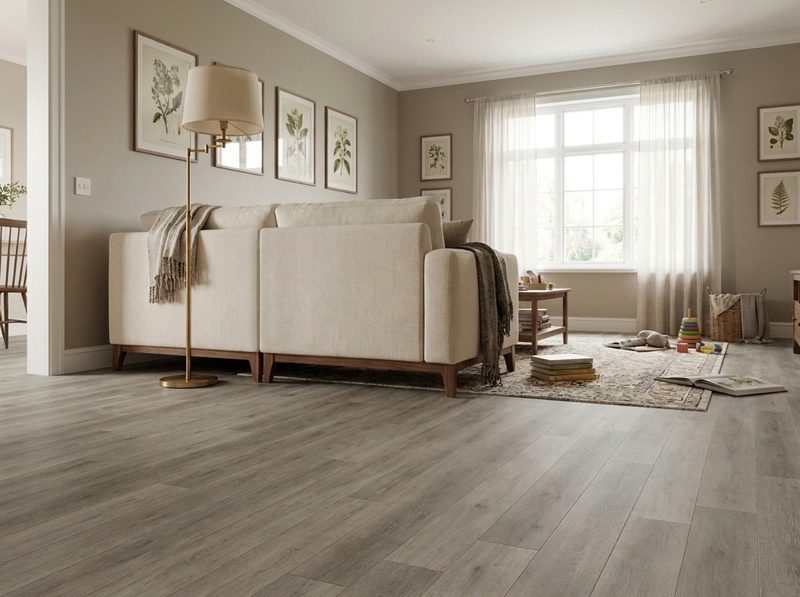
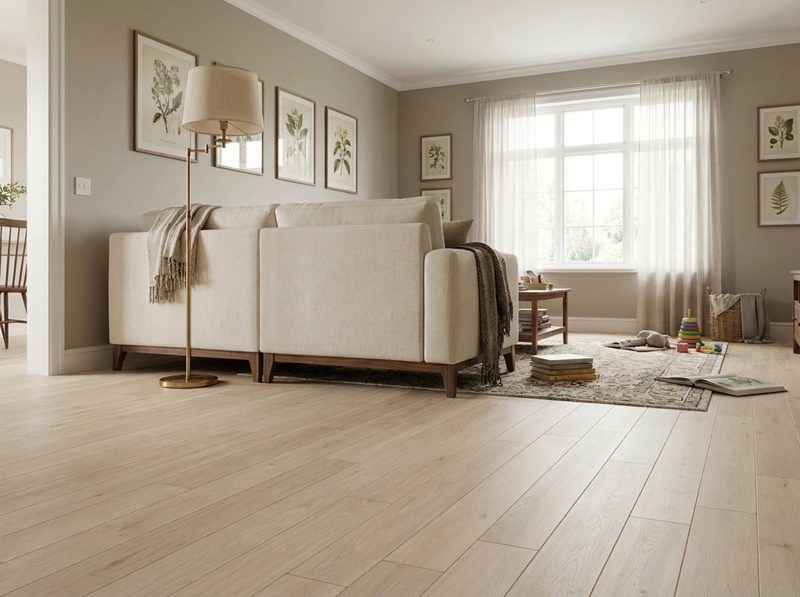
Now flip it. If you brought us a photo of a pale, cool, almost greige white oak floor, ambering is the single fastest way to not get that. The coating will add warmth the species does not have, and it will keep adding it. That project wants a water based polyurethane, and it is worth knowing why before a can gets chosen out of habit. A pale floor is a system, and the coating is the piece of it this page settles: it has to stay out of the way rather than contribute a color of its own.
Hardwax oil swaps a topcoat for a rag and a Saturday afternoon
Hardwax oil is the only one of the three that lets you fix a scuff by hand, in the spot where it happened, without a crew and without touching the rest of the room. It penetrates and cures inside the fibers, so there is no film to break, and a worn traffic lane can be cleaned and re-oiled by a careful homeowner over a weekend. The look is low, natural and matte in a way that reads as raw wood rather than as a coating, and people who love it love it strongly.
The honest downside is that it is a floor with chores. It expects a maintenance oil in the traffic lanes on a cycle rather than a recoat once a decade, and it is genuinely fussy about cleaners, because the wrong soap strips it. A household that will never do that is not a bad household, it is just the wrong household for hardwax oil, and it will look tired sooner than a poly floor would.
Polyurethane hands you a film, and a film has one failure mode
Both polyurethanes cure into a continuous layer over the wood, and that layer is what takes the abuse instead of the wood taking it. It is a real advantage. Spills sit on top and get wiped, grit abrades the coating rather than the fiber, and the floor holds up in a way an unfilmed surface does not.
The failure mode is that a film scratches as a film. A deep scratch reads as a pale line, because you are seeing the edges of the broken coating, and there is no way to touch that in without it showing. A polyurethane floor is repaired by area rather than by spot: the room is abraded and recoated, or in a bad case sanded and started again. This is not a defect. It is the trade you are making, and it is worth making with your eyes open, because the recoat is easy and pleasant if you do it while the wear is still in the coating, and expensive in time and dust if you wait until it is down in the wood.
The bottle under your sink outlives whoever installed the floor
More wood floors are ruined by cleaning than by traffic. Each of these three finishes wants a different routine, and the routine is not intuitive. Hardwax oil wants a soap made for oiled floors and is stripped by general purpose cleaners. Polyurethane wants a neutral cleaner used sparingly and nothing that promises shine, because shine in a bottle is a film on top of your film and it eventually clouds and peels. Every one of them hates standing water at the seams, and every one of them hates a steam mop, which drives moisture straight down into the joint.
So ask which cleaner your finish wants before the crew leaves, buy that one, and throw out the miracle product. It is the smallest decision in the whole project and it outranks the coating.
Sun, rugs, and the rectangle that appears when the rug moves
Wood changes color under daylight and the finish decides how visible that becomes. Put a large rug on an ambering finish in a room with big south facing glass and you are running a slow experiment: the exposed floor warms and the covered floor does not, and one day you move the rug and there is a rectangle. Water based coatings reduce the coating's own contribution to that, but they do not stop the wood underneath from responding to light, so no finish makes the problem vanish.
The practical answers are unglamorous and they work. Rotate rugs and move furniture a little through the year so the exposure evens out. Treat a room with hard afternoon sun as its own case. If you are laying wood in a sunroom or a wall of west glass, say so at the measure, because that room may want a different specification from the rest of the house.
Where each coating belongs, if we had to commit
- Pale white oak, contemporary, and it must stay pale: water based polyurethane, and nothing that ambers
- Traditional red oak in an older house, warmth wanted: oil modified polyurethane, where the amber is the point
- A hands on household that likes maintaining things and wants invisible spot repairs: hardwax oil
- Big dog, dining chairs, children who are hard on a floor: a polyurethane film, with the first recoat already planned
- A rental or a house being sold within a couple of years: polyurethane, because it needs nothing from whoever comes next
- A room with a wall of afternoon glass: a clear coating and a rug plan, whatever goes in the rest of the house
When the finish is not actually yours to choose
Two situations end this comparison early. If you are buying prefinished planks, the finish arrived cured on the board at the factory and there is no can in the conversation at all: you choose a product, not a coating. And if you already own a wood floor that is dull rather than damaged, the right move is often to abrade and recoat the finish that is on there rather than change systems, because switching from one family to another usually means sanding to bare wood first.
Come and see the three under one light at the showroom, then book the free in-home measure so somebody can look at your windows, your existing floor and your household before anything is ordered. Other decisions of this kind are collected on the comparison hub.
“Amazing, quick, easy experience. My floors look great!! Jonah steered my in the right direction with his expertise ...”
What people ask once the three sheens are in front of them
Color drift, spot repairs, cleaners, dogs and the floor you already own.
636-332-0654It used to be a fair complaint and it is largely out of date. Modern water based systems are available across the sheen range, and a matte or satin one reads as wood rather than as coating. If plastic is what you are worried about, the sheen is the lever, not the chemistry, so look at a low sheen sample before you rule the whole category out.
A polyurethane film takes claw traffic better than an oiled surface does, so that is where we would start. Be realistic about the rest: a dog leaves marks on every wood floor ever made, and the things that help most are keeping nails trimmed, putting a mat where the dog comes in wet, and choosing a lower sheen so the marks that do happen are harder to see.
Only over bare wood. Oil has to penetrate, and it cannot penetrate a cured polyurethane film, so switching means sanding the existing finish off completely first. That is a real job rather than a refresh, which is why the finish family is worth deciding at the start rather than trying out.
It is older, not worse. It builds beautifully, it is forgiving to apply, and the amber it develops is exactly right on red oak in a traditional house. What has changed is that many people now want a pale floor, and for that project the ambering works against you. Choose it deliberately and it is still an excellent finish.
The coating decides it more than you think. Use one that stays clear rather than one that ambers, keep the sheen low so reflected warm light does not exaggerate what is there, and manage the sun in rooms with heavy afternoon exposure. The species half of that answer sits on light against dark floors.
Often, and it is one of the better reasons to finish on site. We look at the existing floor at the measure, work out what is on it and how far it has already ambered, and aim the new work at where the old floor is now rather than at where it started. Bring us into the house before you decide, because a photograph will not tell us.
Bring the cleaner from under your sink and a photo of the room at noon
This decision gets made from the room rather than from a sample tag: which windows it has, what walks across it, how you actually clean, and whether wood in the next room has to agree with it for the next twenty years.
Free estimate
636-332-0654