 Flooring Correct
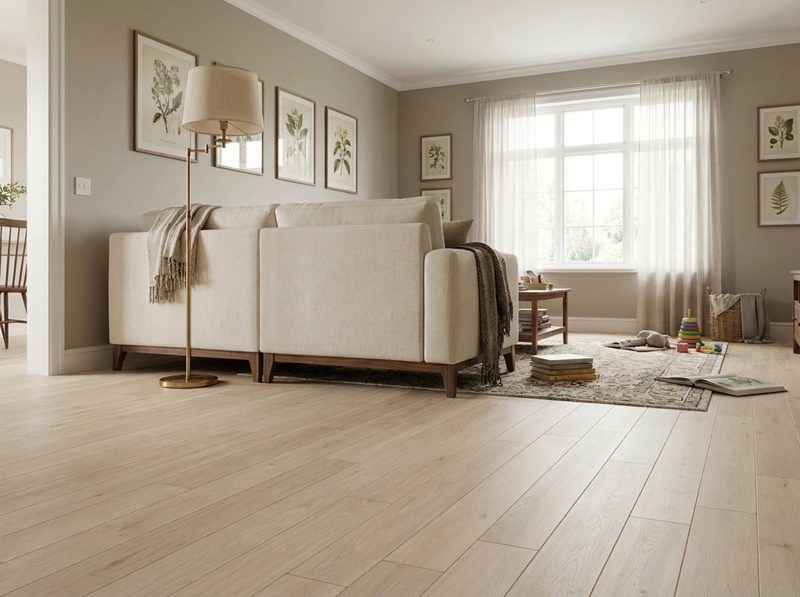
Maple flooring
What is maple flooring?
Maple flooring is a pale, close-grained hardwood known for a clean, even, close to uniform face rather than the bold grain patterns of oak or hickory. That evenness makes it genuinely testable on a sample: a raking light shows what figure is really there, and a small stain test shows whether it will blotch. Both take a minute and tell you more than a spec sheet does.
Maple is one of the few hardwoods where you can genuinely test the two things that matter most before you buy it, with nothing more than a sample board, a lamp, and a few drops of something wet. Neither test takes more than a minute, and both tell you something a spec sheet can't.
Two tests worth running before you decide
Maple's whole appeal is its clean, even, close to uniform face, tight grain, pale cream color, very little of the figure that gives a busier species its camouflage. That same evenness is exactly what makes it testable. A sample with real figure hides small flaws in its own busyness. A maple sample has nowhere to hide, which is a fair trade if you know what you are looking at.
Test one: rake a light across it
Hold the sample flat and shine a light across it at a low angle, from the side rather than straight down, the way late afternoon sun would cross a real floor. On maple, this is the fastest way to see what the wood is actually doing under its finish. A calm, quiet piece will look almost the same under raking light as it does under flat light, evenness held together at every angle. A piece with more figure in it, curly or birdseye maple carries visible movement in the surface, will show that movement clearly under the raking light and go flatter under straight light. Neither result is wrong. They are different products, and the raking light test is how you tell which one you are actually holding.
Test two: check how it takes stain
If the sample is unfinished or has an offcut edge, a small stain test tells you something maple is genuinely known for struggling with. Apply a drop of stain, or a wood conditioner followed by stain if that is how the finish will be done, to a small corner and watch how it spreads. Maple's tight, closed grain absorbs pigment unevenly without preparation, which is why it can blotch, patches that take color darker than the surrounding wood, rather than shading smoothly the way an open grain wood does. A test spot that comes out even and consistent is a good sign for whatever finish process produced it. A blotchy test spot tells you the floor needs a conditioning step before staining, not that the wood is defective.
What a clean result actually tells you
Passing both tests tells you the sample is genuinely representative of maple's calm character and that whoever finished it handled the staining process correctly. That is real, useful information, and it is more than most people check before choosing a floor. It confirms the look you are seeing is the look you will get across a full room, which matters more with a uniform species like maple than with a busier one where board to board variation is expected anyway.
What neither test tells you
Both tests are about appearance, and appearance is only half the decision. Neither one tells you how the floor dents under an impact, which comes down to hardness rather than grain, and maple actually rates harder than people expect given how delicate it looks. Neither test tells you how well the finish will hide the scratches maple's smooth, pale face shows more readily than a busier wood does, which is a separate, honest conversation covered in full on how hardness and finish actually divide the work. A sample that passes both of these tests can still be the wrong floor for a house with a big dog and a lot of grit at the door, and that is a household question, not a grain question.
Run the same test on our floor, not just a chip
A small sample can only tell you so much, even with both tests run properly, because a chip can't show you what a whole room's worth of boards looks like together or how the light in your own space moves across it. Our showroom rack has full size maple boards for exactly this reason, along with the sheens and finishes that change how much of maple's natural character shows through. Bring your own light if you can, a lamp from home, a phone flashlight, whatever your room actually uses, and run the same raking test on the real thing before you decide. Call 636-332-0654 or come by 15570 Veterans Memorial Pkwy.
What else people ask about maple
Scratch visibility, staining dark, kitchens and open plans, and whether it works as a wide plank.
636-332-0654Its grain is fine, even and pale, with very little natural pattern to visually break up a mark the way a busier wood's grain does. The scratch itself isn't deeper or worse than it would be on another species, it's simply more visible against a calmer background, which is a look tradeoff rather than a durability one.
It can, but it takes more care than an open grain wood does, since maple's tight grain is what causes uneven blotching without proper preparation. A wood conditioner applied before staining is the standard fix, and it's worth seeing a stained maple sample in person before committing to a dark color across a full room.
Its clean, quiet look suits a modern space well, which is a real part of its appeal. Worth separating from that is the room question itself, and a kitchen carries its own water and impact considerations that apply regardless of species, covered honestly on our kitchen flooring page.
Wide maple exists, though its calm, even grain reads differently at a wide width than a busier species does, since there is less figure per board to fill a wide face. Setting a full size wide board on the actual room's floor is the only reliable way to judge that before ordering.
Run the test on the real floor, not a photo
A screen can't show you raking light or how a stain test actually spreads. Bring your own lamp if you want, and we'll set full size maple boards under it so you're judging the real wood.
Free estimate
636-332-0654