 Flooring Correct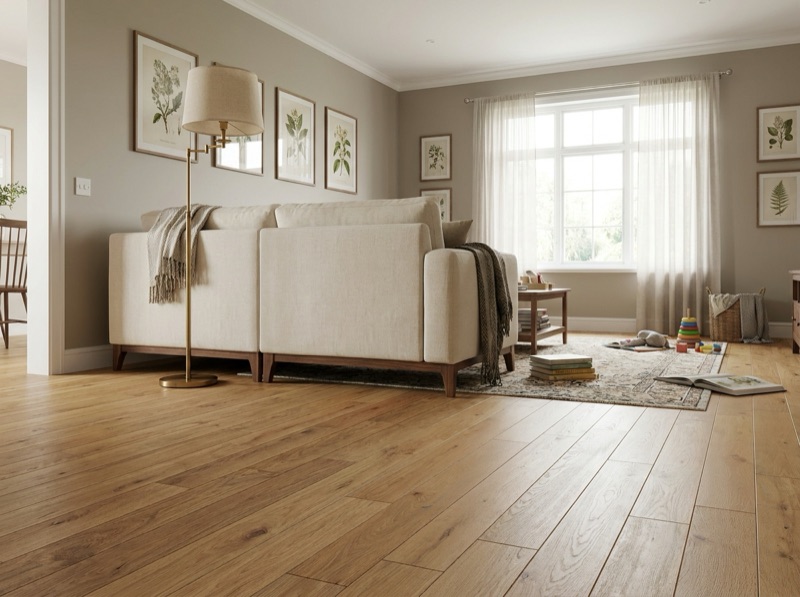
Hickory flooring
What is hickory flooring?
Hickory flooring is the hardest of the common domestic hardwood species, milled from a wood known for its dramatic board to board color swing, from near white sapwood to deep brown heartwood. That swing hides scuffs and small dents better than a calmer species does. The tradeoff is a floor that never reads as uniform, which is a real cost for some rooms and the whole point in others.
Hickory is a genuine tradeoff, not a floor with one obvious answer, and the two sides of it pull in opposite directions hard enough that it is worth naming both before either one gets picked for you by a single showroom photo.
What you gain: the hardest domestic on the rack, and a floor that hides its own wear
Of the species commonly milled for flooring in this country, hickory rates hardest, and that is a real, checkable fact rather than marketing language. The full ordering against the other domestics is covered here. What matters just as much in a working household is what hickory looks like while it is taking that wear. Its color swings hard, board to board and sometimes within one board, from pale near white sapwood to deep brown heartwood, and that swing does real camouflage work. A scuff or a small dent has to compete with a floor that is already busy, and busy wins.
What you give up: the calm, uniform look most people picture
That same swing is the cost. A lot of buyers picture a new floor as a single, consistent color running the length of a room, the way a photo of a finished space usually shows it, and hickory does not deliver that no matter how carefully the boards are sorted. Two boards from the same bundle can look like they came from different trees, because in grain and color terms, they essentially did. If the goal is a calm, quiet, uniform surface, hickory's own character is working against that goal by design, not by accident.
Where the gain wins
Put hickory in a room that already asks a lot of a floor, an entry, a mudroom, a kitchen, a hallway with real daily traffic, or a house with a large dog, and the camouflage earns its keep every single day. It is also the honest answer for anyone who wants a floor to read as lived in and rustic on purpose rather than as a backdrop that has to stay pristine.
Where the give-up wins
Put the same floor in a formal dining room, a quiet primary bedroom, or a house going for a calm, minimal, monochrome look, and hickory's own strength becomes the wrong tool for the room. Maple or a straighter grained white oak delivers that uniform read far more naturally, at a real cost in dent resistance and camouflage that is worth conceding honestly rather than glossing over.
What grade does to the swing
The tradeoff is not fixed once the species is settled. Grade is the lever, and on hickory it is a bigger lever than on almost any other wood, because grade decides how much of that near white to near brown color swing survives into the run that actually arrives at your house. How grading works, and what each grade keeps or sorts out, is covered in full on its own page and applies across every species. The hickory specific part is the one worth saying here. On a quiet wood, the grade choice changes how many knots you live with. On hickory it changes the temperature of the whole room, because the boards it sorts out are the ones carrying the extremes. Ask to see the same hickory line in two grades before deciding, since a written description of the difference does not prepare anyone for how far apart the two look once they are down.
The honest downside of both sides
Neither side of this tradeoff is free. Choose hickory for the character and durability, and you give up predictability. Matching a single damaged board years from now against a floor with that much natural variation is genuinely harder than matching a quieter species. Choose a calmer species for the uniform look, and you give up some of hickory's forgiveness. A smooth, quiet floor shows the scuffs and dents a busier one would have swallowed. Sheen and finish shift both outcomes somewhat, a matte surface hides more on any species, but they do not erase the tradeoff underneath.
The mistake this page is meant to prevent
The mistake is picking hickory purely because it tops a hardness comparison, without picturing what that hardness actually looks like on your own floor. Hardness is one property. Character is a different one, and hickory's character is not subtle. Stand a full size hickory board next to a full size white oak or maple board before deciding, and ask yourself honestly which one you would want to live with in the room it is going into, not which one wins on a spec sheet. That short comparison answers the character question a spec sheet never touches.
What else people ask about hickory
Small rooms, grade selection, households with kids, and whether it fits a minimal design.
636-332-0654It can read that way, since a small room shows fewer boards at once and each one's color swing stands out more. That is a real consideration, and it is worth setting full size boards on the actual floor before deciding, since a small chip in a showroom rack cannot show what a whole small room will look like.
Grade is the lever that pulls on it, and hickory responds to it more than most species do, simply because it has so much variation to sort in the first place. Which grades a given hickory line is offered in is a question for the counter rather than something to assume from a catalog, and the way grading works across every species is covered on its own page. Either way, it is worth standing in front of two grades of the same line rather than picking one off a description.
Favorably on camouflage, since hickory's grain and color swing hide the small dings a busy household produces better than a quieter species does, and it rates harder against dents too. What it does not solve is scratching, which lives in the finish rather than the wood, and that is a separate question worth reading on its own.
It can, but it works against the effort rather than for it. A minimal look generally wants calm and uniform, and hickory's natural variation pulls the eye toward the floor rather than letting it recede. A quieter species like white oak or maple tends to suit that particular goal more naturally.
See the swing before you commit to it
Take full size hickory, white oak and maple boards home and look at them in your own light, morning and after dark. A short comparison answers the character question a spec sheet never will, and the free in-home measure settles the subfloor and the transitions before anything is ordered.
Free estimate
636-332-0654