 Flooring Correct
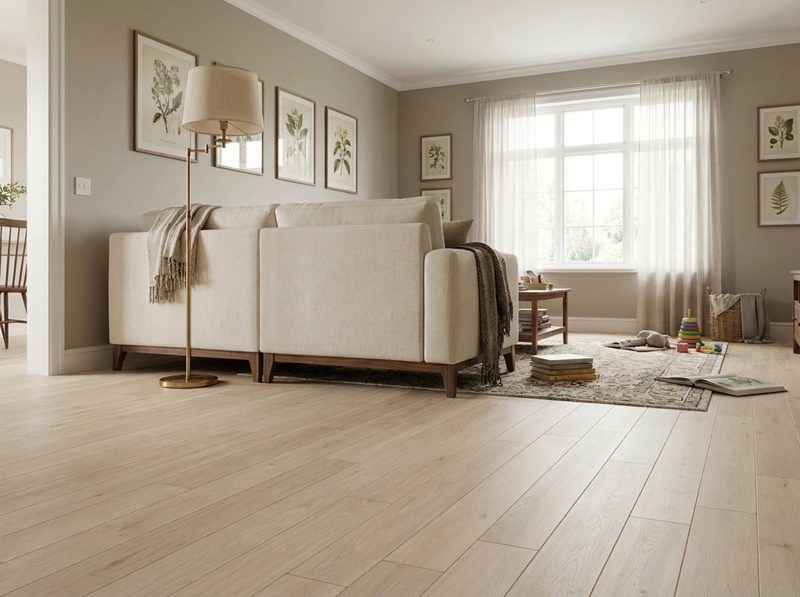
SPC rigid core
What is an SPC rigid core?
SPC stands for stone plastic composite, a core of finely ground limestone bound with PVC and pressed dense with little or no foaming. That density is the whole point. It gives the plank the least movement under heat and the best resistance to denting of the vinyl cores, and it makes the board thin, hard and firm underfoot.
Every core choice in vinyl is a trade between stability and comfort, and stone plastic composite sits at the far stable end of it. What you gain is a plank that barely moves and barely dents. What you give up is warmth, quiet and any forgiveness for a subfloor that is not flat.
What the density buys
The core is limestone powder bound in PVC and pressed with very little air in it. Density produces the two properties people actually buy SPC for, and both of them are about what the floor refuses to do. You will also see SPC expanded as stone polymer composite on tags and in brochures. It is the same construction under either name, and the trade uses both.
The first is dimensional stability. A dense mineral filled core expands and contracts less for a given temperature change than a foamed one does, so a floating field grows less on a hot afternoon and shrinks less overnight. In a room with a lot of glass that is the difference between a perimeter gap that copes with the movement and one that runs out of room.
The second is resistance to indentation. A hard core has nowhere to give when a refrigerator wheel, a chair leg or a dropped tool concentrates weight onto a small area. Published values for both properties are tested to standard methods and printed on the product spec sheet, and they vary line to line, so read the sheet for the specific plank rather than treating SPC as a single number.
There is a quieter third benefit. A dense core reaches its stiffness in a thinner board, which helps where door clearance is tight or where the new floor has to meet an existing one at a threshold without a ramp.
What the density costs
Hard is hard. An SPC plank is firm underfoot and stays firm. Standing on it for a long stretch feels different from standing on a foamed core, and people notice it in kitchens where they cook and in rooms where they work at a desk.
It is also louder. A thin dense board over a hard subfloor both reflects and transmits impact sound readily, which is why so many SPC lines are sold with a pad already bonded to the back. That layer is doing real work and it is described on the attached pad page.
And it reports the subfloor. This is the honest one. A thin rigid board bridges a small dip and then telegraphs anything larger, either as a visible line or as a spot that moves when you cross it. Rigid is not the same as level, and assuming otherwise is the most expensive misunderstanding in this category.
Cold is the last of it. Nothing about a mineral core holds warmth, so a floor like this on a slab sits at slab temperature until the room warms it back up.
Rooms where the stability wins
Sunrooms and four season porches come first, because they carry the largest daily temperature swing in a house and a floating floor has to absorb every degree of it. A room with a full wall of west glass belongs in the same group even if nobody calls it a sunroom.
Kitchens come up constantly here and this is not the page that settles them. That room has several demands pulling against each other, and the kitchen page ranks them for a household rather than for a core, with give underfoot counting for more than most people expect when they start from a spec sheet. Take the ranking from there.
Entries and mudrooms are third, where grit gets pressed under a boot heel and a dense core takes less of a dent from it. What resists the scuffing itself is the clear layer above the print rather than anything under it, which the wear layer page sets out. Light commercial spaces with foot traffic belong here too, though the moment a rolling load enters the picture the conversation moves toward a bonded installation instead.
Rooms with heavy stationary loads are a fourth. A laundry, a utility room, a home gym with a rack that lives in one corner. Appliance weight and leak risk belong to the laundry room page. What belongs here is narrower: what a core does under a levelling foot that never moves, and a dense one takes less of a permanent set than a foamed one does.
Rooms where the firmness loses
Bedrooms are the clearest case. Almost nothing in a bedroom tests a floor, so the only thing left worth optimising is how it feels first thing in the morning, which is the whole argument on the bedroom page. A firmer core wins nothing there and gives up something real.
Finished basements are the case that does not resolve cleanly, and it is worth saying so. The slab argues for the dense core: a rigid plank bridges the minor variation a poured slab almost always has, and the basement page puts rigid core vinyl at the front of the list below grade for that reason. Comfort argues the other way, because a thin dense plank laid straight onto a slab gives up warmth and adds reflection. A bonded pad, a foamed core or rugs over the top each pull some of that back, which is why so many basement jobs land on a rigid core with a pad already bonded to it.
Rooms over occupied space are third, because impact sound heading downward is worse through a dense core than through a foamed one, everything else being equal.
The downside on the other side of the trade
Conceding one core's weaknesses without conceding the alternative's would be a sales pitch rather than an answer. A foamed WPC core is warmer, quieter and more forgiving over minor variation. It also dents more readily under a concentrated load and moves more with temperature, and it is thicker, which can become the deciding constraint at a door or a threshold long before comfort is discussed. Both sides are laid out on the WPC page, and the category overview sits on the luxury vinyl plank page.
There is no version of this where one core is correct everywhere in a house. Most homes doing vinyl throughout are better served matching the core to the room and matching the look across rooms, which is a decision far easier to make with boards in your hands than with two specification sheets side by side.
The mistake this page is trying to prevent
The mistake is buying rigid core in the belief that rigid solves the subfloor. It does not. A dense plank is more tolerant of small variation than a flexible one and considerably less tolerant than people have been told, and the gap between those two positions is a floor that either sits quiet for decades or announces a bad spot inside the first season. What a rigid core actually does with an uneven deck is also why loose lay behaves so differently over the same floor.
That question gets settled by looking at the floor rather than by choosing a core. Flatness, moisture and the height at every doorway are all on the list at the free in-home measure. Call 636-332-0654 and tell us which rooms and what is underneath them.
More on dense cores in practice
Water, radiant heat and what a mineral core feels like in a Missouri winter.
636-332-0654No. Both rigid vinyl cores are unaffected by water, which is the point the category is built on and which the luxury vinyl plank page sets out in full. Density changes stability, hardness and sound. It does not change how the core behaves when a glass goes over, and neither core swells the way a wood based one does.
Usually, inside the limits the manufacturer publishes, and a dense mineral core passes heat through more readily than a foamed one does. The constraints are a maximum floor surface temperature and a slow ramp at the start of the season rather than a step change. Read the instruction sheet for the line, and raise radiant heat before anything is ordered.
On a slab, yes, until the room warms it. A mineral core stores no heat of its own and concrete underneath it stays close to ground temperature all year. A bonded pad helps a little, area rugs help more, and in a room where that is the deciding factor a softer core or a different material entirely is the better conversation.
Rigid is not the same as level
Before a core gets chosen, the subfloor gets looked at. Tell us what is under the room and whether anything down there has moved, and the flatness question goes into the quote rather than onto install day.
Free estimate
636-332-0654