 Flooring Correct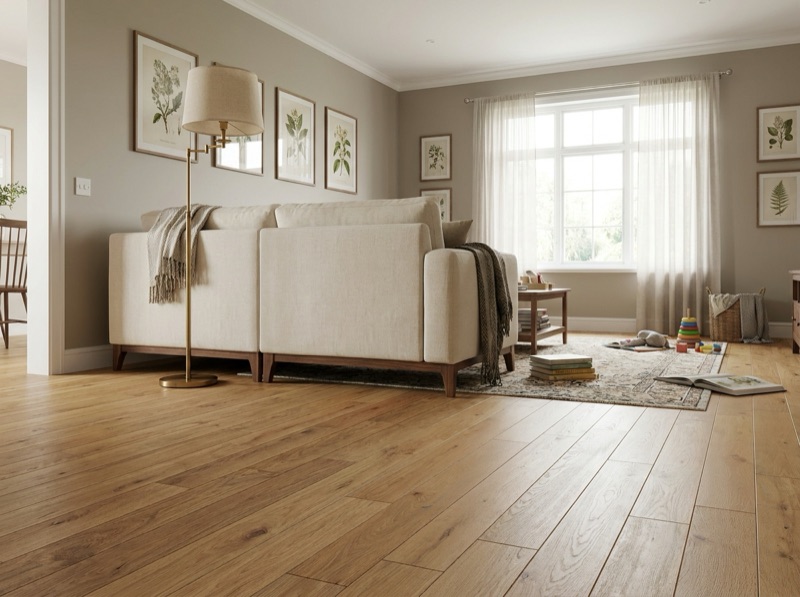
Does engineered hardwood scratch easily?
It can, in the same way any hardwood floor can, because the surface at the very top is a factory-cured finish, not armor. Fine grit ground underfoot dulls that finish first as a light haze, well before anything reaches the wood underneath it. What actually decides how much shows is what stands between your floor and that grit, not the species.
It starts at the door, before anyone touches the floor
The thing that actually scratches a hardwood floor is not a shoe or a paw. It is whatever grit that shoe or paw is carrying, sand, small stone, road salt residue tracked in from the driveway. Underfoot, that grit behaves like sandpaper riding on the bottom of a boot, and it works exactly the same way whether the boards below it are engineered or solid, because the abrasive is never the wood itself.
Where it lands first: the finish, not the wood
Most engineered hardwood arrives with a factory-applied finish, commonly an aluminum oxide coating cured under UV light, which our engineered hardwood page covers as harder and more even than anything applied on site. Hard is not the same as unscratchable. That topcoat takes the first hit from everyday grit, and what shows up in a traffic lane after a season or two is usually fine surface scratching in the finish itself, visible as a light haze rather than a gouge. That is a maintenance layer wearing, not a construction failure, and it is the reason a dulling floor is not the same problem as a damaged one.
The step that actually breaks through: one event, not gradual wear
A finish coat wearing thin from years of foot traffic is one story. A single hard event is a different one entirely. A chair dragged instead of lifted, a claw catching wrong on a turn, a dropped pan corner, a stiletto heel landing at the wrong angle. Any of those can go straight through the finish in one motion, and that is the moment an actual scratch can reach the wear layer underneath rather than just the coating on top of it. It is a narrower risk than people assume, and it is also the one moment on this whole list that actually decides whether a repair conversation happens at all.
The step that decides the outcome: what stands in the way before any of this happens
Everything above this point can be interrupted before it starts, and that interruption matters more than any product decision made at the counter. Mats at every exterior door catch grit before it ever reaches the finish. Felt pads under every leg of every piece of furniture that moves turn a drag into a glide. Trimmed nails or booties handle the claw risk directly. And sweeping or vacuuming with the beater bar switched off, a habit our care guidance already covers, keeps grit from grinding into the finish during routine cleaning instead of getting lifted off it. None of those habits requires a different product from the one you already picked. They work on whatever is already down.
The species and the wear layer still matter for how a floor holds up over the long run, and how thick that layer needs to be for your household is its own question with its own page. But day to day, the sequence above is the one actually running in every room, every time someone walks across it.
Sheen changes how much shows, not how much actually happens
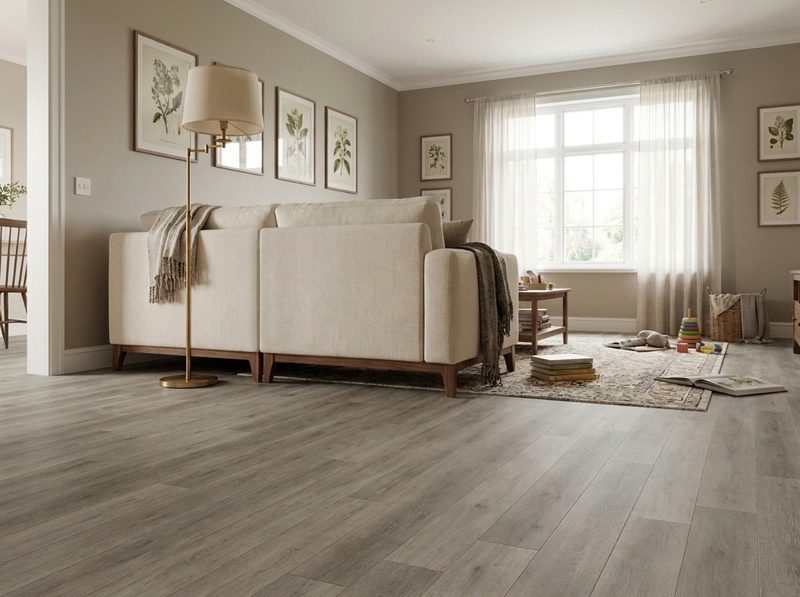
One more thing worth knowing before you narrow down a finish: the same fine scratching reads differently depending on how much sheen the finish carries. A high-gloss, smooth surface reflects light in one direction, so any interruption in that surface, even a light one, catches the eye immediately. A matte, textured or hand-scraped finish scatters light in more directions to begin with, which makes the identical scratch far less visible against everything else already going on across the surface. That is a property of how light bounces off a finish, not a difference in how tough one construction is compared to another, and it is exactly the kind of thing worth comparing under your own light before you settle on a sheen for a busy room.
More on scratching and everyday wear
Solid versus engineered, whether a scratch reaches the wood, and what actually causes that haze in a traffic lane.
636-332-0654Not meaningfully. The visible surface on both is the same species with the same range of finish options, and finish is what takes the first scratch on either construction. The number worth asking about is the wear layer thickness on the engineered side, since that governs how much real wood is standing behind the finish if a scratch ever does go deeper.
Usually not. Most everyday scratching stays inside the finish coat as surface haze. A genuine gouge from a hard, single event can go deeper into the wear layer itself, and whether that is repairable comes down to how much wear layer is actually there, which is why that number is worth asking for by name before you buy rather than hunting for it afterward.
It can, because a spinning beater bar grinds whatever grit is already on the floor into the finish rather than lifting it off. That is exactly why switching the beater bar off for hard flooring, and sweeping or vacuuming with a soft setting instead, is standard care advice for any hardwood surface, engineered included.
Not automatically, and it depends on the wear layer and how the finish was applied. Sanding a single board flush with its neighbors is not usually practical, so when a refinish is the right fix it tends to be a whole-room project rather than a single-board touch-up. A light surface scratch in the finish is a different, smaller repair.
Match the wear layer and finish to your household
Tell us about dogs, kids, high heels, whatever the room actually sees. We'll steer you toward a wear layer and a finish built for that traffic, and show you the samples side by side.
Free estimate
636-332-0654