 Flooring Correct
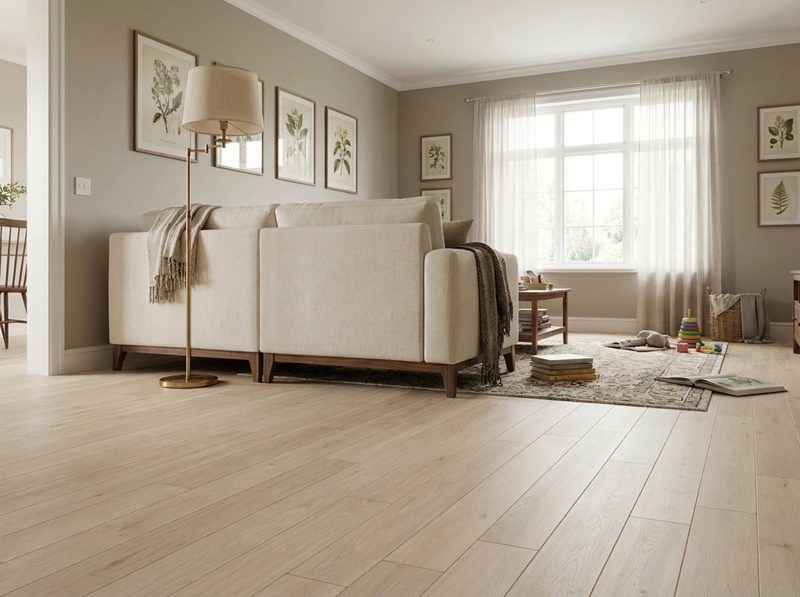
Does laminate need to acclimate?
Yes. Unopened boxes sit in the room where the floor is going down, at the temperature and humidity that room lives at, before installation starts. What you can watch for is planks lying flat rather than curling at the edges once a box is opened. That test tells you the material has settled to the room's climate. It tells you nothing about the subfloor underneath, which is a separate check.
The test you can actually run yourself
Leave the unopened boxes stacked in the room where they are going down, for the stretch of time the product instructions call for before installation. Exact windows vary by line and are printed on the carton itself, so read that before breaking the shrink wrap rather than going by memory or a general rule. Every one of those windows rests on the same rule, which is that material ends up matched to whatever air is around it, wherever that air happens to be. The hardwood acclimation page works through that rule and the garage version of the mistake, and it applies just as squarely to a stack of laminate boxes.
What is different here is the thing doing the adjusting. It is not a solid board taking on and giving up moisture across an open face, it is a pressed fiberboard core sealed under melamine on top and a backer underneath, so the exchange happens at the cut edges and the ends of each plank. That is also why the printed window belongs to the specific line rather than to the category, since core density and packaging are not the same from one product to the next.
What the result tells you
Once a box is opened, lay a few planks loose on the floor and look at them edge to edge. Flat, tight-fitting boards that click together cleanly are the sign the material has settled into the room's climate and is ready to be installed as one stable piece. Cupping, a slight curl at the long edge, or planks that resist snapping together cleanly are signs the wood fiber core is still adjusting, and that is worth waiting out rather than pushing through. Laminate floats and locks to itself rather than to the house, which is exactly why the whole floor needs to start from the same climate before it goes down as one connected piece.
What the result does not tell you
A good acclimation test says nothing about the floor underneath it. The room's air can be perfectly settled while the slab or subfloor beneath it is still doing something entirely different, whether that is a concrete slab moving vapor upward or a plywood subfloor with a dip nobody has checked yet. Acclimation and subfloor prep are two separate steps that both have to be right, and passing one is not evidence about the other.
It also does not test the room's heating and cooling over time, only its condition during the window you tested it in. A house that sits unheated and unconditioned for stretches, or a new build where the concrete is still curing and giving off moisture into the air, can throw the test off even after the recommended wait. That is the kind of detail worth mentioning at the measure rather than assuming away.
Why this step gets skipped, and what it costs
It gets skipped because it looks like dead time on a schedule, boxes sitting in a room doing apparently nothing while everyone waits to start. What it is actually doing is letting a wood-fiber core reach equilibrium before it is locked into a rigid, connected floor. Skip it and install straight off the truck, and a floor that measured perfectly flat on day one can gap or buckle weeks later as the material finishes adjusting after installation instead of before it, when there is no longer an easy fix. A floor lifting at the seams months in traces back to this step more often than people expect.
A delivery scheduled the same week as installation is the most common way this gets compressed without anyone deciding to skip it on purpose. If the boxes are arriving right before the crew, that timeline is worth flagging early rather than discovering at the door that the material has not had its window in the room yet.
Why a sample in your own room beats a photo on a screen
A photo online cannot show you how a plank behaves once it has settled, because settling only happens to material that has spent time in real air. What you can do is take two or three samples home and let them sit for a few days in the room they would actually go into, which is this same test in miniature and costs you nothing but the wait. Grain and undertone shift under evening light as well, so the room ends up deciding that question too.
That is also where questions about a specific line's acclimation window get answered directly, rather than guessed at from a box you have not opened yet.
What else people ask about acclimating laminate
How long it takes, where to stage the boxes, and what it does not fix.
636-332-0654Not quite, and the difference is worth knowing before you borrow a schedule from one for the other. A solid board exchanges moisture across its whole face and reacts strongly to it. A laminate plank is a fiberboard core sealed top and bottom, so the exchange runs through the cut edges instead, which is why the window belongs to the printed instructions for that line rather than to a general wood rule.
Not really, because the point of the window is settling the material to the climate the room will actually live at. An unconditioned house in the middle of a Missouri summer or winter, or a new build where the slab is still giving off moisture into the air, is a different climate from the one the floor will spend its life in. Say so before the delivery date gets set.
No. Acclimation is about the material reaching the room's climate, not about what is underneath it. A subfloor that is out of flat needs its own fix, typically leveling compound or underlayment addressing the specific dip, and that gets identified separately during the free in-home measure regardless of how well the boxes acclimated.
Run the test in your own room first
Come see the samples in person and take a favorite home with you. Let it sit for a few days in the room it would actually go into before you commit, the same test in miniature. Bring the line you are weighing and the acclimation window printed for it gets answered directly rather than guessed at.
Free estimate
636-332-0654