 Flooring Correct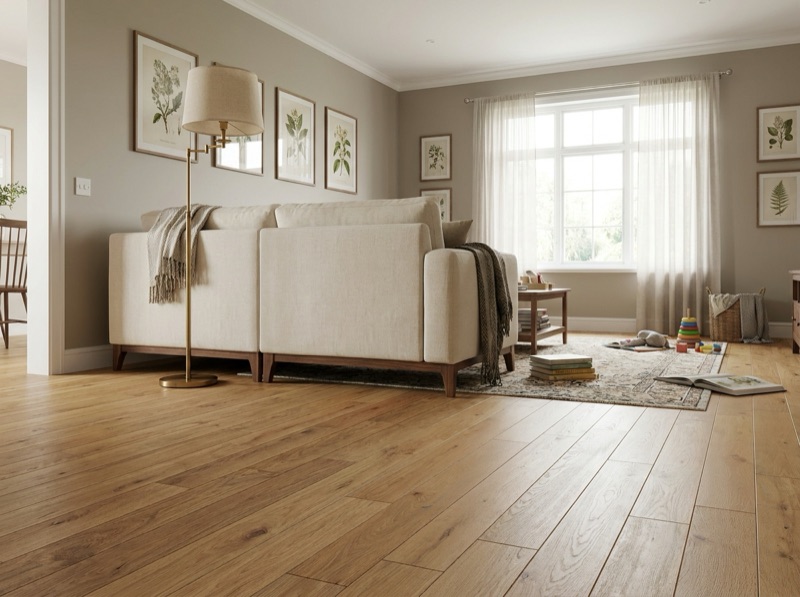
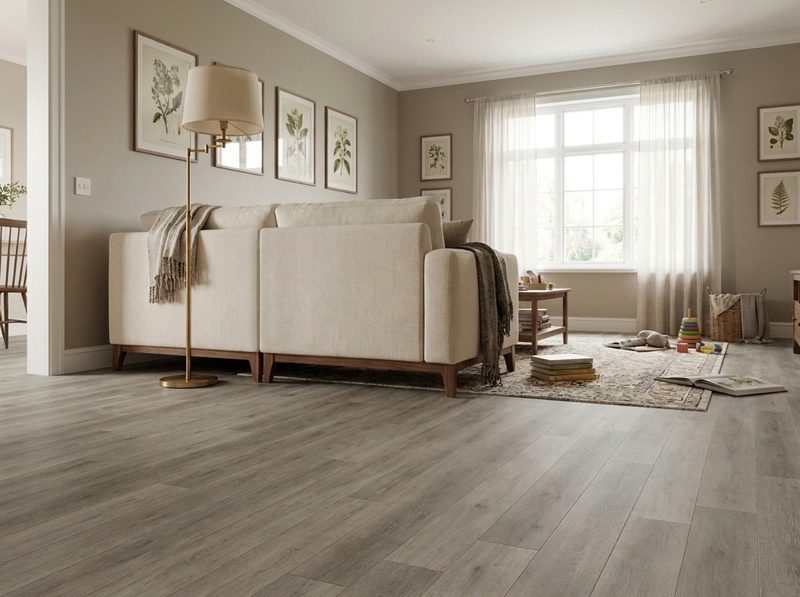
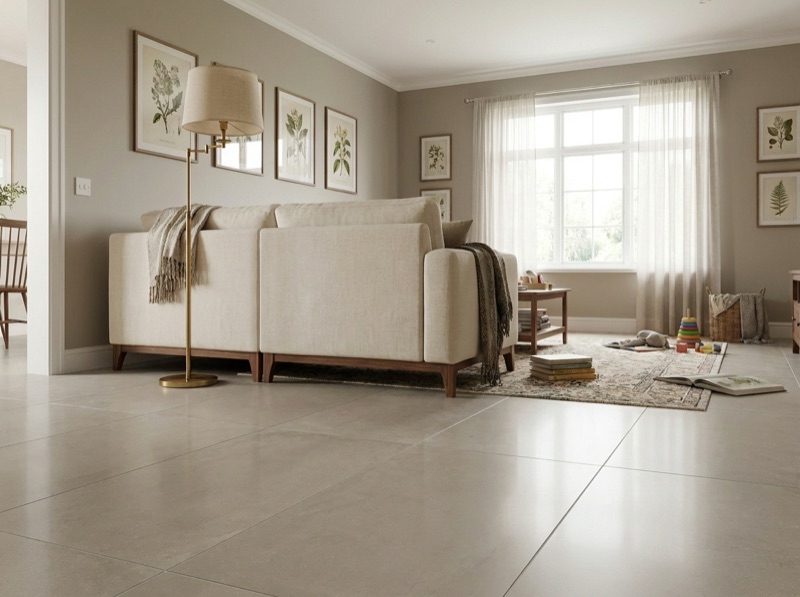
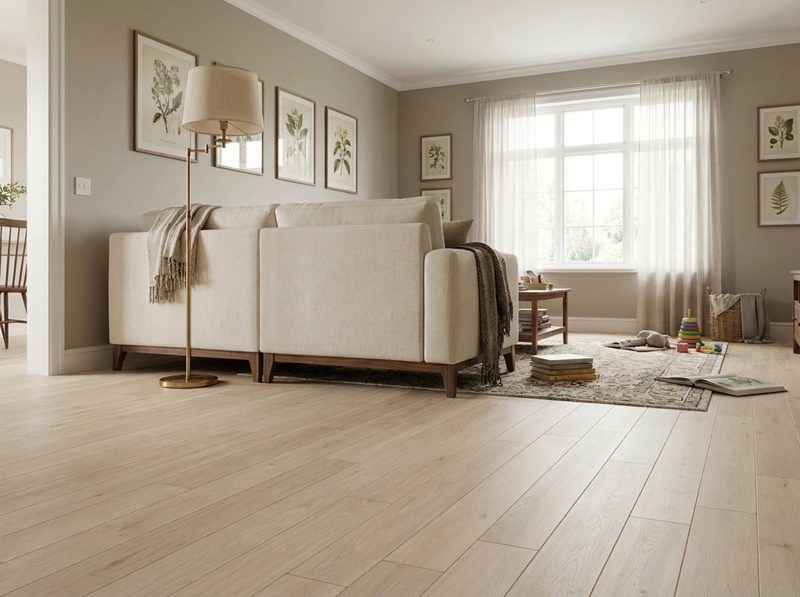
Porcelain that looks like oak,
or vinyl that does the same.
You already decided the room cannot have real wood. This is the fork that comes next, and it turns on things a photograph will never show you: whether a printed grain survives being cut by a joint, what the floor does over a heat loop, and whether you can ever take it back out.
Long plank porcelain and rigid core vinyl are the two honest ways to put a wood look into a room that cannot take wood: a mudroom, a working kitchen, a basement, a bath, a four season porch. Tile covers porcelain, sizing and grout, and luxury vinyl plank covers wear layers and rigid cores. Which of the two wins in which room is settled on luxury vinyl plank against tile. What follows is the narrower fork: you want a wood floor, and you are choosing between the two surfaces that print one.
You have already ruled out wood. Here is what is left to settle
Both of these are printed surfaces imitating oak, and at a glance in a finished room both do it well. The difference is not the picture, it is everything underneath it. Porcelain is a hard, brittle, permanently set surface bonded to your subfloor with grout joints between the pieces. Vinyl is a resilient plank that floats loose over the subfloor and clicks to itself.
That one structural difference produces the consequences below: whether a printed grain survives being interrupted by a joint, whether the floor can be heated, what a rough subfloor does to it, and whether this is a decision you can reverse. Comfort underfoot, water and the room by room verdicts belong to the general matchup.
Whether the illusion survives the joint
Wood look tile comes with grout and vinyl plank does not, and for some households that sentence is the whole comparison. Where it matters most is the illusion. A board has no line across its width, so a grout color matched tight to the tile lets the eye skip the joint and the plank reads as a plank. Any contrast outlines every piece and the floor stops pretending, which is a fine look as long as it was chosen on purpose. If the tile wins, the grout decision belongs to the tile page.
What to check on a sample so the print still works across a room
Both surfaces are a printed image under a hard clear layer, and both can be convincing in your hand and disappointing across twenty feet of floor. The vinyl side has a named specification for the part that decides it: texture pressed in alignment with the print, so a groove lands on a printed grain line rather than wherever the press happened to fall. The embossed in register entry covers how to test a board by hand. Depth and alignment are separate properties, and depth is the one that catches the eye on a rack.
The other half of that question is repeat, and it applies to both sides equally. A line carries a limited number of different printed faces before it starts using one again, and a short repeat shows up as the same knot turning up twice in one sight line. So a wood look gets judged from several pieces at once, lying on the floor.
The floor you can heat, and the floor with a temperature limit
Tile pairs with in floor radiant heat better than any other material we sell, and that changes what a porcelain floor is. Heated, the coldest surface in the house becomes the warmest, and a January morning in a tile mudroom stops being an argument. It is also the one advantage here that has nothing to do with the print, which is why it settles the fork so often.
Vinyl plank over radiant is possible and it is conditional. Every product publishes a maximum surface temperature and an approved installation method, printed on its own specification sheet. If radiant is already in the plan or already in the slab, that leans hard toward tile. If it is not, temperature underfoot goes back to the general matchup.
The wood look is what makes the tile demanding
This requirement surprises people, and it comes from the shape rather than the material. A wood look only reads as wood in a long narrow piece, and a long narrow porcelain piece is large format, the category that asks for a genuinely flat substrate. A plank tile bridging a hump shows lippage at the ends or cracks later, so it needs a far flatter floor than a floating plank does, and the tolerance is set out on the tile page. The wood look is what put you in the demanding format.
Vinyl is more forgiving but not indifferent. A stone plastic composite core is thin and firm and will report every ridge in the subfloor underfoot. A wood plastic composite core is thicker and rides over minor variation more comfortably. Either way the subfloor gets flattened and a slab gets a moisture check first, because a floating floor moves with the seasons and needs a level surface to move on.
Sunrooms, porches and the room that swings hardest
A four season porch or a sunroom is the room where this comparison gets specific. Temperature swings there are wider than anywhere else in the house, and a floating floor expands and contracts with them. That is the case for a stone plastic composite core, the hardest and most dimensionally stable of the vinyl cores, laid with the expansion gap the manufacturer actually specifies rather than the one that fits the trim.
Tile does not have that problem, because it is bonded down and does not move with temperature the way a plank does. What it needs instead is movement joints: a soft joint where the field meets the walls and at intervals across a long run, so the floor has somewhere to go when the house moves with the season.
Which one you can undo
A floating vinyl floor comes back up. Pull the base trim, unclick the planks, and the room is empty in an afternoon, which matters if you suspect you will want something else in a decade or if you are floating over a floor you would rather not disturb. A ruined plank swaps out on its own if you still have leftovers from the original order.
Tile does not come back up. Removing a bonded porcelain floor is a demolition job with a dumpster attached, and that is worth knowing before you sign, not after. The flip side is that tile does not need to come up. A well set porcelain floor can outlast the kitchen it was installed in, and a single cracked piece is replaced without touching its neighbors.
When the honest answer is neither of these
If the room turns out to be above grade over a wood subfloor with no water history, go back and look at real wood, because the reason you ruled it out may not survive an in home measure. A genuine wood surface is repairable in a way neither of these is.
That last point is the one thing both sides of this page have in common. A real wood floor carries its grain all the way down, so a scratch sands out. On both of these the grain is a printed image under a hard surface, and damage does not sand out of a print. It gets cut out and replaced, which is why keeping material back from the original order matters more here.
And a shower floor is tile, full stop, though not because of the wood look. A laundry room where a supply hose can let go is the one place a seamless sheet floor beats any plank format, tile included. The rest of the matchups take those cases apart.
What we lay side by side before you decide
Bring both into the showroom light at once and stand on them, in shoes and then without. Look at the plank tile with a grout color beside it rather than imagining one, and run a fingertip across the vinyl to find out whether its texture has anything to do with its print. Check the sheen on both, because a low sheen with grain variation hides daily life and a flat dark color shows every crumb.
Then let us put a straightedge on the actual floor. The in home measure is where a plank tile either becomes practical or becomes a flattening job first, where a slab gets tested rather than assumed, and where the height at the dishwasher and the door casings gets written down before anything is ordered.
“We are so pleased with our new floors! ... During installation, everyone was so professional, kind, and respectful. We will continue to use them for future flooring needs!”
What gets asked when both samples look convincing
By this stage nobody is arguing about the picture on the surface. Call 636-332-0654 and we will answer the practical half.
636-332-0654At standing height in a long plank format, it comes close, and the grout decision is what makes or breaks it. Matched grout in a tight joint keeps the illusion. A contrasting grout line around every piece ends it immediately. Up close it never fools anybody, and neither does vinyl, so pick on how the room performs rather than on who might be deceived.
You can, on either material, and it is a property of the line rather than of tile or vinyl. Each one carries a limited number of different printed faces before it starts using one again, and a short repeat shows up as the same knot appearing twice in one sight line. Lay several pieces out together before you decide, because one sample cannot show you this.
Often yes, on the manufacturer's terms. Every line publishes a maximum surface temperature and an approved installation method for radiant, and that limit is printed on the specification sheet for whichever product you are holding. Tile has fewer conditions attached and conducts heat better, so if the loop is already there we usually lean toward the porcelain.
Sometimes. Flattening a floor to the tolerance a long plank tile wants is real work, and if that is not something you want to take on in time or disruption, the plank floats over more variation and that alone settles it. The tile page carries the tolerance itself. Either way a slab gets tested for moisture before anything goes down.
A cracked tile is cut out and replaced individually. A damaged vinyl plank can be unclicked out of a floating floor, though away from a wall the method used more often is to cut the plank out and glue a trimmed replacement in. Either repair depends on you having kept material from the original order, because neither is invisible if the replacement came from a different batch.
Neither has a built in advantage, because both are printed and the quality varies more inside each category than between them. What decides it is the format and the joint. A long narrow piece reads as a board and a short wide one does not, and on the tile side a matched grout in a tight joint keeps the eye moving along the plank instead of stopping at every edge.
Put a straightedge on the floor before you order a long plank tile
Flatness decides this one and it cannot be judged by eye. We check the substrate against the tolerance a large format tile requires, test the slab for moisture rather than assuming it is dry, and measure the height a new floor adds at the appliances and the door casings. Call 636-332-0654.
Free estimate
636-332-0654