 Flooring Correct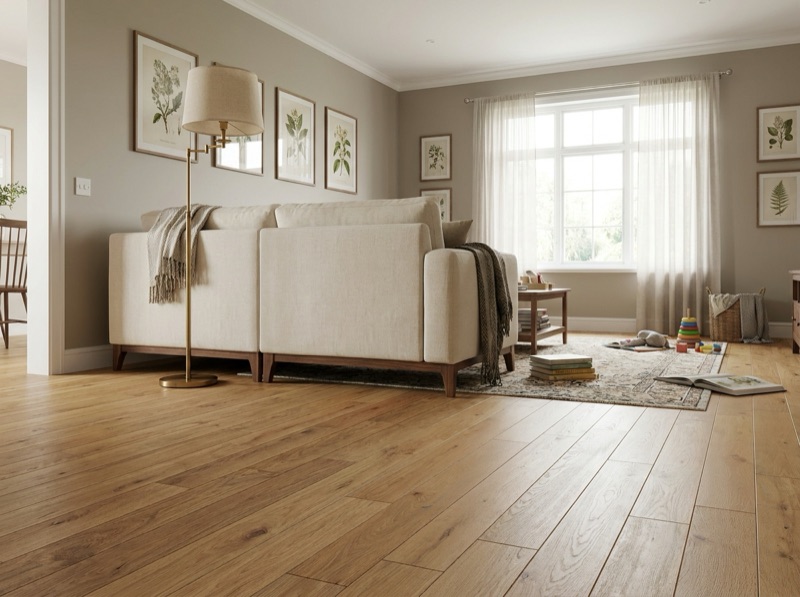
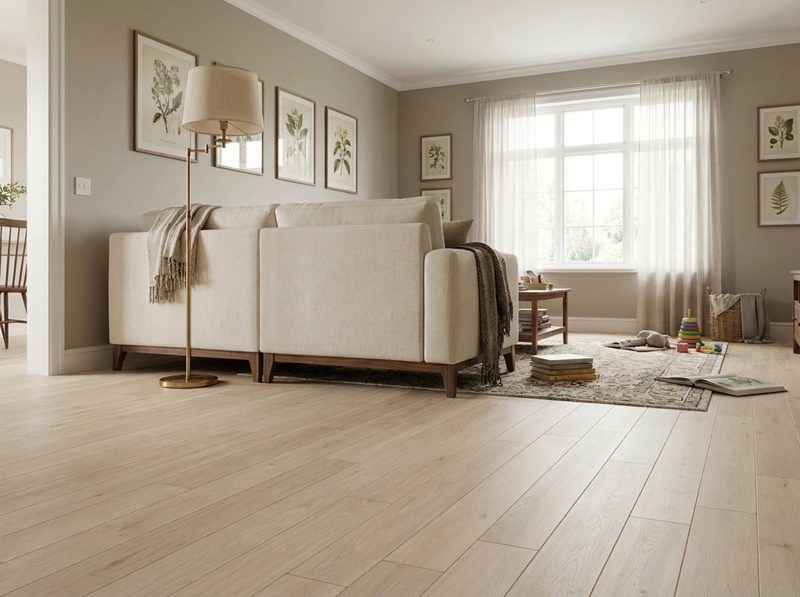
Embossed in register
What does embossed in register mean?
Embossed in register describes texture pressed in alignment with the printed image below it, so a groove lands on a printed grain line and a hollow lands on a printed knot. It is an alignment specification, not a depth or a quality grade. A deeply textured plank can be entirely out of register.
The belief is easy to hold and it is wrong in one specific way. People look at a plank with deep, obvious grain texture and conclude it must be embossed in register. Depth and alignment are separate specifications, and depth is the one the eye reaches first.
Why the belief exists
Three things encourage it. The first is the word. Sample tags say embossed, and embossed is true of almost every plank made today, so the term gets read as a mark of quality rather than as a description of a manufacturing step that may or may not have been aligned to anything.
The second is the display rack. A sample hanging vertically under overhead light shows its texture as shadow, and shadow scales with how deep the press went, not with whether the press was lined up. The deepest board on the wall is the one that looks most convincing from the aisle, and that tells you nothing about register.
The third is sample size. Out of register texture is genuinely persuasive on a small board, because a repeating pattern needs a run of floor before it starts visibly repeating. By the time it announces itself you are standing in a finished room.
What is actually happening at the factory
Printing and texturing are separate operations. The image is a printed film. The texture is pressed into the clear layer above it. If the press carries a generic plate, it puts the same pattern into every board that goes under it and that pattern lands wherever it happens to land relative to the picture. If the press is aligned to the print, a groove sits on a printed grain line and a hollow sits on a printed knot. Both approaches sit side by side within the luxury vinyl plank category.
Alignment is a tooling and setup expense rather than a materials one. That is why it does not track the way people assume it should, why it turns up on some lines and is absent from others in the same part of a showroom, and why the only reliable way to know is to check the board in front of you. A shallow texture in register will beat a deep texture out of register in the only test that matters, which is whether the floor still reads as wood when you stand over it.
The second thing people get wrong about it
The other belief worth correcting is that register predicts durability. It predicts nothing about durability. Register is a visual alignment and stops there. What survives a dog, a dining chair and the grit that walks in off a driveway is the clear layer over the print, covered on the wear layer page. How the floor sits, sounds and feels comes from the core, which is the SPC page and the WPC page.
A related mix-up is print repeat. Register is whether the texture matches the picture. Repeat is how many different board images a line carries before it starts using one again. A short repeat shows as the same knot appearing twice inside one sight line, and no amount of registration fixes it. The two get confused because they are noticed at the same moment, standing over a finished floor, feeling that something is off without being able to name it.
The accurate version, and what follows from it
Register is a yes or no property of a specific line, and it is checkable by hand rather than by claim. Put a fingertip on a feature you can see, then find out whether you can feel it. That is the whole test and it takes seconds. If the texture under your finger has nothing to do with the picture under your eye, the board is embossed and not embossed in register, which is a description rather than an accusation.
What follows is a decision about where to spend attention. Register earns the most in rooms where light travels along the floor and where people stand over it: a kitchen with a window at one end, a great room with afternoon sun crossing the boards, an entry with a low winter sun coming through the door. It earns the least where the floor is mostly covered by furniture and rugs or lit flatly from above.
Sheen changes the stakes more than most people expect. A gloss finish throws a hard highlight off every ridge, so texture that disagrees with its own print is loudest on a shiny plank and quietest on a matte one. If you are drawn to higher sheen, register matters more rather than less. The reverse holds too, and a matte board with modest texture in register is one of the calmer floors you can put in a house.
Settling it in your own light
Which way the boards run relative to your windows changes how much of this you will ever notice, and that is not a showroom decision. It gets settled standing in the room at the free in-home measure, where plank direction, where the seams fall and how much waste the layout carries are already on the list. Say which windows matter to you while somebody is standing in the room with a tape measure.
Until then, take samples home and look at them lying on the floor rather than held in your hand, at night under your own fixtures as well as at noon. Everything else about the category is on the luxury vinyl plank page. If you would rather have somebody rake a light across a few boards with you, call 636-332-0654 or come by the showroom in Wentzville.
More on register, depth and sheen
What a spec sheet will and will not tell you, whether texture wears away, and why deeper is not automatically better.
636-332-0654Sometimes, and not reliably. Lines that have paid for the alignment usually say so, often abbreviated to EIR. Lines that have not simply describe the texture without mentioning register at all, and absence on a sheet is not proof of absence on the board. A fingertip on a knot settles it in seconds and no document needs to be trusted.
The texture is pressed into the clear layer rather than applied on top of it, so it does not rub away the way a coating would. What does change is sheen. A traffic lane polishes the high points before it touches the low ones, which can make a busy path look shinier than the rest of the room long before any texture is actually gone.
No, and past a point it works against itself. Real sawn wood has shallow variation across most of its face with deeper character only at knots and checks. A board pressed hard and evenly everywhere reads as a texture rather than as timber, and it holds more of what gets tracked in. Depth helps only where the print gives it a reason.
The window decides more than the sample rack does
At the measure we stand in the room and settle which way the planks run against your light. Say which windows matter and we will look at register in that light instead of under store fixtures.
Free estimate
636-332-0654