 Flooring Correct
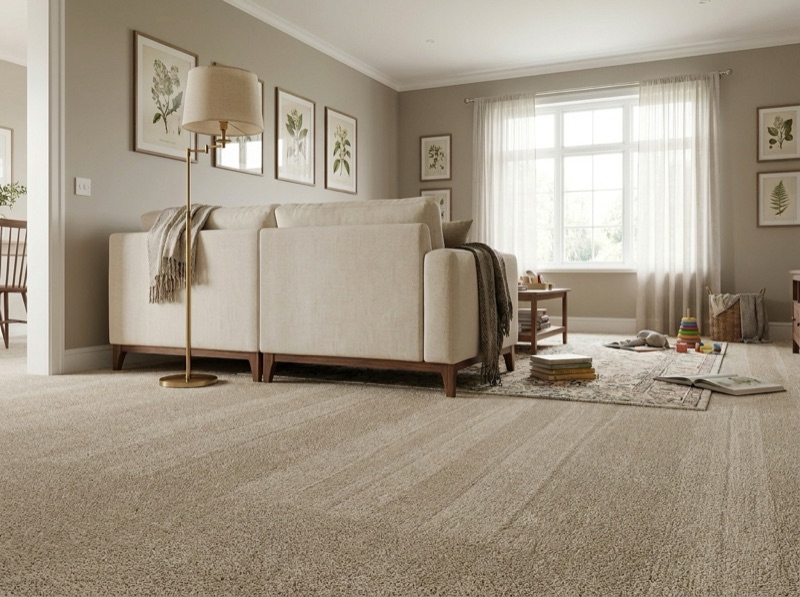
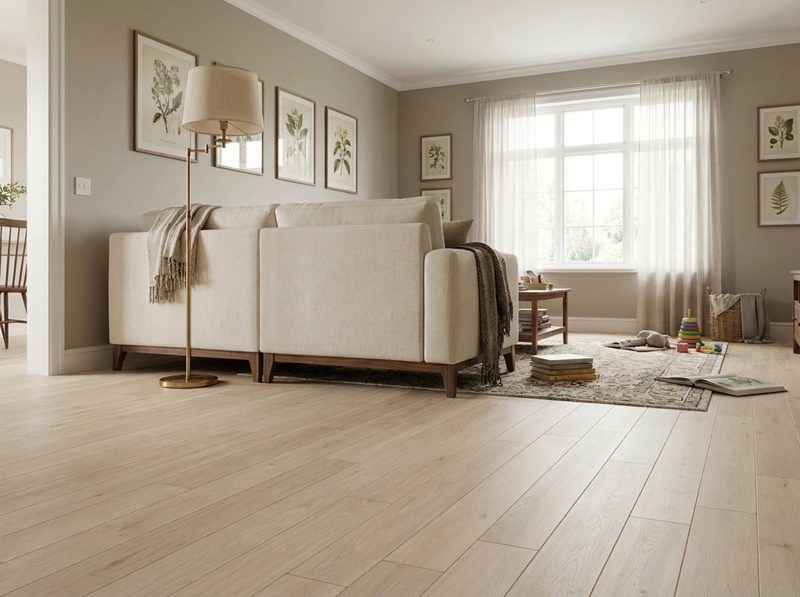
Hand-scraped and wire-brushed textures
What is the difference between hand-scraped and wire-brushed wood?
Both are textures cut into the face of a wood plank before it is finished. Wire brushing drags stiff bristles along the grain, scouring out the soft early growth and leaving the hard grain standing. Hand scraping removes wood in longer, irregular strokes across the board to imitate a floor leveled with a hand plane.
Texture goes onto a wood floor in a specific order, and the order is the whole story. Two boards can carry the same species, the same color and the same scraped profile, and one will read as a floor somebody has lived on for thirty years while the other reads as a new floor that got dragged across a driveway.
It starts with a flat board
A prefinished plank begins life sanded smooth and dead flat, whether it is solid or engineered. Every texture you can buy is removed material. Nothing is added to the surface to make wood look old. Wood is taken away, and whatever is left standing is the texture.
Then the surface gets opened up
Wire brushing usually comes first in a plant because it is the least invasive. Rotating heads of stiff wire or abrasive nylon bristles run along the length of the board, scouring out the soft early growth wood while barely touching the dense late growth beside it. The result is a shallow ribbing you can feel with a fingertip, and it follows the actual grain of that actual board, because the brush is not carving a pattern into wood, it is eroding what is already there.
Hand scraping takes wood off across a much longer stroke. On the lines that genuinely do it by hand, a person pulls a scraper down each board and the strokes vary because people vary. On production lines, machine heads follow a randomized program to imitate that. Scraped wood reads as a broad undulation along the board rather than fine ribbing across the grain, and it usually arrives with companion distressing: sculpted plank edges, chatter marks, the occasional worm hole or nail mark.
The tell for a machine repeating itself is the same tell as on any pressed surface. Lay out four or five boards from the rack and hunt for the same scrape signature or the same knot showing up twice. On one small display panel it hides easily. On a great room floor it is the first thing a guest notices.
Depth is a dial rather than a setting on both of them. A light brushing barely breaks the sheen and reads as a floor that simply looks less plastic. A heavy brushing leaves ribbing you can feel through a sock. A gently scraped board has a soft roll to it, and a heavily sculpted one has edges that dip visibly. Two products can both be sold as wire brushed and be nowhere near each other, so the word on the tag is a category rather than a description.
The step that decides the outcome
Color goes on after the texture is cut, and that single piece of sequencing is what separates a floor with depth from a floor that looks damaged.
Cut the texture first and every valley, every scraped hollow and every opened pore is raw when the stain arrives. Pigment pools down there. The standing grain takes less of it. You end up with contrast built into the surface itself, where the low areas read darker and the board changes as you walk around it and the light moves.
Reverse the order and you get the opposite result. A board stained flat and then brushed or scraped has pale, raw wood sitting at the bottom of every cut. In a photograph it can pass. On a real floor in daylight it reads as wood that has been scratched rather than wood that has been textured, and no amount of finish over the top corrects it.
You cannot read this off a label. You read it off the sample. Get the board to a window, tip it so the light rakes across the face, and look down into the valleys. If the low areas are darker than the standing grain, the color went on after the cut. If the low areas flash lighter, it did not.
Finish goes on last and settles into the low spots
Whatever finish the line uses is applied over the texture, so it flows into the valleys and thins on the peaks. That is one more reason a textured floor holds up: the peaks taking the traffic are backed by hard late growth wood, and the finish that survives longest is sitting down in the protected hollows. It is also why matte suits texture and high gloss fights it, since gloss lays a reflective sheet over a surface whose entire job is breaking reflection up. A penetrating oil finish takes that idea furthest, because there is no film bridging the texture at all.
Choosing the species and the texture in one breath
Here is where the decision actually narrows. Wire brushing works by taking out soft grain and leaving hard grain standing, so a species with a big difference between its early and late growth brushes dramatically, and a species with tight, even grain barely responds to the brush at all.
- White oak and red oak have open, obvious grain and take a brush hard. Most of the brushed floors people bring us photos of are one of the two.
- Hickory brushes well and already carries heavy board to board color variation, so it reads busy on purpose.
- Maple has a tight, subtle grain, so a wire brush barely registers on it. Maple that needs character usually gets it from scraping rather than brushing.
- Walnut is softer and already dark straight from the tree, and a light brushing on it reads as depth more than as texture.
Grade interacts with all of it, because a character grade board full of knots and mineral streak carries its own visual noise before a single pass of texture is cut into it. Grade is its own specification and deserves deciding on its own terms.
The honest downside, which the hardwood page puts in a line: texture camouflages real life, and that is the main reason people buy it. What it costs you is a slightly less easy sweep, a surface that feels different under bare feet, and a repair that is harder to blend years later, because a replacement board has to match a texture as well as a color. If you are weighing it against a smooth floor, the fastest way through is a stack of samples on your own floor, and the engineered hardwood page lists the lines those samples come from. Call 636-332-0654 or come pull them off the rack with us.
What else people ask about textured wood
Cleaning, whether texture can be added later, and how long it goes on hiding wear.
636-332-0654A little. Any cut surface holds dust a broom would have carried off a flat plane. The practical answer is that it also hides what it holds, so a textured floor looks clean longer between sweeps than a smooth dark floor does. Vacuum on the hard floor setting and keep standing water out of the valleys.
A floor being finished in the house can be textured by a finisher who does that work, before any coating goes on. A prefinished floor cannot, because the texture was cut before the color and the finish, and reproducing that sequence in a living room is not something anybody does. Texture gets chosen with the product.
It keeps hiding them, because it works by breaking up reflection rather than by covering damage. A scratch is visible mostly as a line of different reflectivity, and on a surface already scattering light in every direction there is no clean line left to see. That same scratch on a smooth semi gloss floor stands out for the life of the finish.
Texture and species get chosen together
Tell us how much movement you want in the floor and we will pull the species that take a brush the way you are picturing. Oak and hickory show it, maple barely does, and that turns a wall of samples into a short stack you can carry home.
Free estimate
636-332-0654