 Flooring Correct
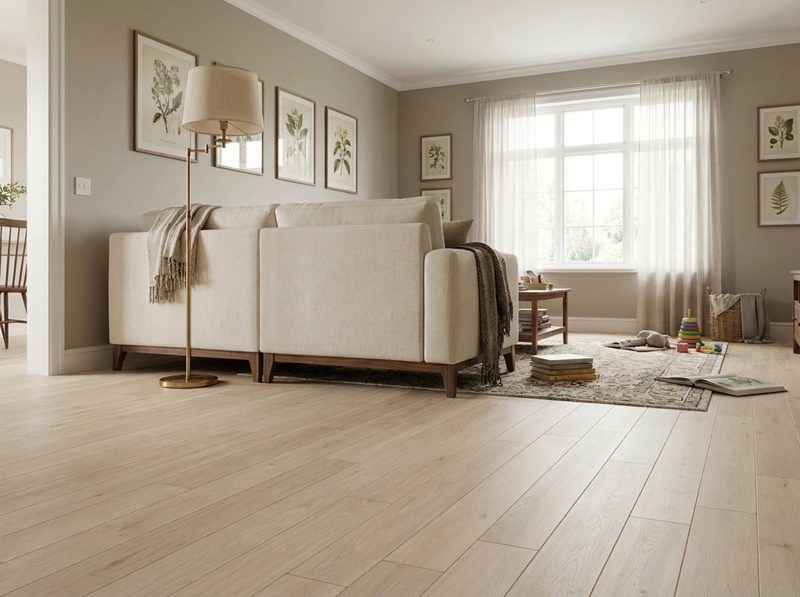
Laminate for the stairs and halls
of a city with no standard house
Laminate tends to end up in the parts of a house that take the most traffic, which in Lake Saint Louis means the hall and the stair. What those look like depends entirely on when your house was finished, because this city has been building without a break for about fifty years. We come out, look at the run, and quote from what is really there.
Cores, wear layers and how a laminate plank is put together are covered on the laminate pillar. This page is about something narrower: what happens when laminate goes into the circulation space of a Lake Saint Louis house. That space is the reason the material comes up in the first place, and it is also the part of the house that varies most across this city. Fifty years of continuous building has produced two very different kinds of hall and two very different kinds of stair, and the job is not the same in each.
Two shapes of circulation space, one city
In the houses that have been here since the 1970s and 1980s, the hall is a real hall. It is a defined corridor with doorways opening off it, often narrow, and the floor in it is largely invisible from the rooms around it. That makes the corridor a self contained problem. It is set out for its own length and its own doorways, and what happens on the far side of each casing is a separate decision taken on its own merits.
In the newer part of the city, circulation is not a separate room at all. The stair is frequently open to the main level, the landing is on show, and the upper hall may look down over the space below. There the floor is being judged from a distance and from below, and the material has to hold up under that scrutiny as well as under feet. Same product, two different problems, and the only way to know which one you have is to stand in it.
A laminate stair is decided by the tread it has to wrap
Stairs are where laminate goes from a simple job to a careful one. The tread depth you actually have, whether the treads are boxed in or open on one side, whether the run turns at a landing or winds, and what nosing detail the stair needs are all fixed by the house rather than by the product. We take those tread by tread rather than as a running measurement, because a stair that measures fine on average can be a nuisance on step nine.
That check is worth doing before anything is ordered, not on the day the installer arrives. It is also the point where we occasionally say the stair would be better left soft, and we would rather say it while you can still change your mind. The stairs and hallways page works through the same trade off from the room side.
The hall is the strip that gets used hardest in any house here
Whatever decade your house comes from, everybody walks the same line through it, every day, in whatever they had on their feet outside. A hall floor takes more traffic in a year than a bedroom takes in several, and it is on show every time somebody comes to the door. That is what sends people toward laminate for that particular strip, and it is a sound instinct.
What we look at is how that strip meets everything around it. In an older plan there are casings to hide a change in. In a newer one there may be nothing between the hall floor and the main level floor at all, which means either the two agree or the joint is deliberate. We work that out with the doors open and the lights on.
Long runs, and the doorways that give them somewhere to break
A long straight hall is a gift and a constraint at once. It shows a plank pattern off, and it also asks more of the layout, since the run has to be set out so it starts and finishes on a sensible board width at both ends and so any break lands where it is least visible. Older plans here tend to give you doorways at useful intervals, which is where a run can be broken cleanly if it needs to be. Newer plans give you fewer places to do that, so more of the decision gets made before the first plank goes down.
Borrowed light is the light a hall is actually seen in
Almost no hallway has a window of its own. It runs on light borrowed from the rooms either side of it and from one fixture in the ceiling, and that is nothing like the light over a sample rack. Two things move under it. Emboss, the texture pressed into the surface of the board, reads strongly under a spotlight and can flatten to nothing when the light arrives from one end of a corridor instead of from above. Sheen does the opposite and picks up the whole length of the run at once. Neither is a fault in the plank. A hall is a lighting condition as much as it is a room, which is why a board has to be stood in the actual hall, in the evening as well as the middle of the day, before anybody commits to it.
The showroom is 6.1 road miles away, and what that distance means for the way a project here gets arranged is set out on the town page. What it means for this material is narrower and more useful: nothing about a laminate board has to be settled from memory, because it can be carried to the hall it is going into and judged there with the ceiling light on.
Getting an old covering off a stair is its own piece of work
Taking up a hall floor and taking up a stair are not the same task. A hall gives you room to work and one surface to clear. A flight gives you a tread, a riser and a nosing on every single step, all of it fastened down by somebody who did not expect the covering ever to come off again. Where a hard surface was fitted over the treads at some point there is adhesive to deal with and a finished height to bring back to where a new nosing needs it. Because this city has been building continuously for about fifty years, what is on a stair here is genuinely unpredictable from the outside, so a corner gets lifted at the in home measure. That is what turns the stair from a guess into a number of hours.
The laminate lines you will see on our rack
Aquaproof, DreamWeaver, NextGen, Mohawk RevWood, Nextfloor, National Flooring Products and In Haus are the laminate lines we carry. They are genuinely different from one another in texture and in how the edges read along a run, which is exactly the sort of difference a screen flattens out. Bring the shortlist to the house or come and stand over full planks in the store, and the choice usually makes itself.
If the stair in your Lake Saint Louis house should stay soft
Plenty of them should, and a hard stair is not automatically an upgrade. If the run is steep, or if the household includes somebody who would rather not take a stair in socks on a hard surface, the soft answer is carpet in Lake Saint Louis, and we will happily talk you into it. If the argument is really about wanting wood, the two versions of that sit on luxury vinyl plank in Lake Saint Louis and engineered hardwood in Lake Saint Louis. The in home measure is free either way, and the town page covers the drive.
“Amazing, quick, easy experience. My floors look great!! Jonah steered my in the right direction with his expertise ...”
Questions from the hallway
Straight answers about laminate in the halls and stairs of a city that has been building without a pause for fifty years. Call 636-332-0654.
636-332-0654Often yes, but the stair decides it rather than the product. We take tread depth and tread count one step at a time, look at whether the treads are boxed or open on a side, and check what nosing detail the run needs. Occasionally the answer is that the stair is better left soft, and we say so.
It changes the layout more than the material. A long straight run has to be set out so it starts and finishes on a sensible board width and so any break lands at a doorway rather than in the middle of the corridor. Older plans in this city usually offer doorways at useful intervals where a run can be broken if it needs to be.
It is more visible, which raises the standard rather than the difficulty. In the newer houses here the stair and landing are seen from below and from across the room, so the joint where the floor changes has to look intended. We plan that at the measure instead of on install day.
More than most people expect. A hall runs on light borrowed from the rooms beside it, so emboss can flatten out and sheen can pick up the whole length of the run in a way neither of them does under a sample rack. A board has to be stood in the hall itself, with the ceiling light on and again in daylight, before it is ordered.
That depends on the age of the house, and in this city that varies street by street. A newer hall usually has one covering over a builder set subfloor. An older one may have had two, so we look at a corner rather than assume, since it changes both the tear out and the finished height.
The estimate and the in home measure are both free, and at 6.1 road miles we are not making a trip of it. We measure the run, count the treads, check the door swings and quote from that. Call 636-332-0654.
Measure a Lake Saint Louis hall 6.1 road miles from the sample rack
We count the treads one at a time, take the depth of each, look at how the hall meets the main level and check every door along the run. The measure is free and it happens in your own house. Call 636-332-0654.
Free estimate
636-332-0654