 Flooring Correct
Cut and loop carpet
What is cut and loop carpet?
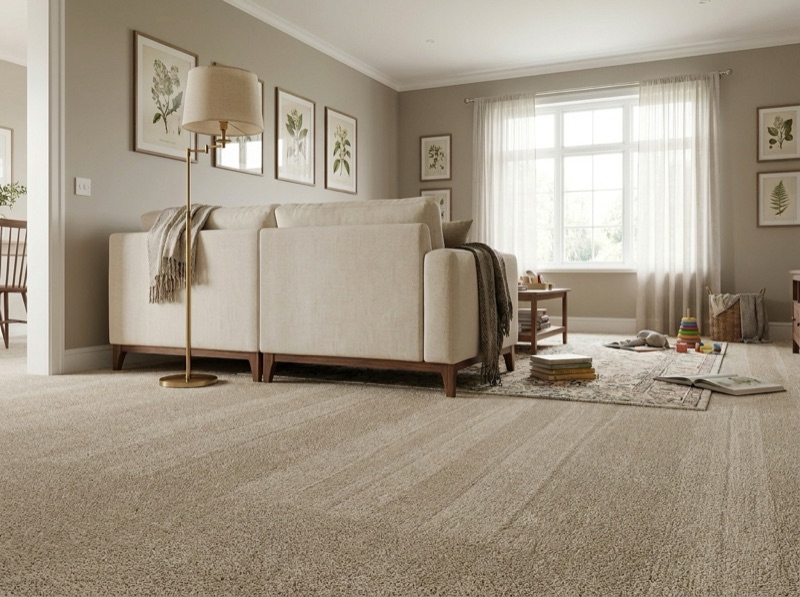
Cut and loop carpet is tufted so that some yarn is sheared open into upright tips and some is left as a closed loop, in a deliberate arrangement. The two heights sit at different levels and return light differently, so the design is built from texture and shadow rather than from a second color or a printed pattern.
A cut and loop carpet is one carpet, not two joined together. The same yarn runs through the whole width, and the only difference between one part of the design and the next is whether a blade reached that row during tufting. That single mechanical fact is where the pattern, the feel underfoot and the honest limits all come from.
Two pile heights out of one tufting pass
Every tufted carpet starts as loops pushed through a backing by a row of needles. On a plain cut pile, a blade opens all of them. On a plain loop, none of them. A cut and loop machine does neither: knives are engaged over some needles and not others, row by row, and the design is programmed into which loops get opened and which are left closed. The sheared rows usually stand a little taller than the looped rows, because a cut tuft springs open the moment it is released and gains height doing it.
That is why the design goes all the way through the carpet instead of sitting on top of it. Nothing is printed and nothing is stenciled. Take a piece, look at the cut edge from the side, and you can see the two heights as a profile. It is the most direct way to prove to yourself that a sculpted carpet is actually sculpted rather than shaded.
The design is made of shadow, not dye
A sheared tip presents a cut end of yarn to the light and scatters it. A closed loop presents a smooth curve and returns it more evenly. Set the two beside each other at slightly different heights and you get a shadow line along every edge of the design, plus a difference in sheen across the faces themselves. Both effects come from geometry, which is why a cut and loop carpet can carry a clearly visible pattern in a single solid color of yarn.
The practical consequence is that the pattern moves. Walk the length of the room, or come back at a different hour, and the light meets those faces at a new angle, so the design can read strongly from one direction and nearly disappear from another. That is normal behavior for the construction rather than a fault in a particular carpet, and it is the first thing worth checking on a sample.
Level cut loop, sculpted, carved: the names on the tag
The trade uses several names for the same family, and they describe degree rather than quality. Level cut loop means the cut tufts and the loops sit at close to the same height, so the design reads mostly as a shift in sheen and only slightly as relief. Sculpted or carved means a bigger height difference, where the loops sit visibly lower and the pattern has depth you can feel with a flat hand. Neither word is a grade, and neither tells you anything about the fiber, the density or the twist underneath the design.
What the mixed surface does underfoot and over time
The cut tufts stand taller, so they meet the traffic first. That is worth saying plainly: in a walked lane, the sheared part of the design can lose some of its height advantage before the looped part shows anything at all, and when it does the pattern reads with less contrast than it did on the sample card. Density and twist decide how long that takes, exactly as they do on any other pile.
The loop half also brings the loop half's risk with it. A closed loop shares backing tension with its neighbors, so a snag can run rather than staying one pulled tuft, and our Berber page walks that mechanism and the fingernail check that reads it on a sample. Underfoot the surface feels like what it is, softer where the tips are open and firmer where the loops are closed, which is part of the appeal and worth standing on rather than imagining.
Whether to buy a pattern at all is a different question
Everything above is about how this construction is built. Whether a patterned floor is right for your room is a separate decision that turns on how much of the floor stays visible once the furniture is in, how far you see it from, and what else in the room already carries a design. Our patterned carpet page works through all three, and that is the better place to settle it than a construction name.
How to read one at the rack
- Turn the sample a quarter turn under the light and watch the design. If it vanishes completely from one direction, expect the same thing in the room.
- Look at the cut edge from the side to see the real height difference. A carpet sold as sculpted with almost no profile is really a level cut loop, which is a different look on a floor.
- Run a fingernail along a looped row the way a claw would move. The loop half carries the snag risk and the cut half does not, so that is where to check.
- Ask which fiber is under the design. The taller cut tufts take the traffic first, and fiber is most of what decides how well they recover after being walked on.
What else people ask about cut and loop carpet
Whether it counts as a patterned carpet, why the design shifts with the light, and what a staircase does to a repeat.
636-332-0654Not quite. Cut and loop is one way to make a pattern, using two pile heights and the shadow between them. A pattern can also come from color, from a dyed or printed design, or from a multi-level loop with no cut tufts in it at all, and those read differently across a room than a sculpted surface does.
Because the design is made of height and shadow rather than pigment. Standing over it you read the texture directly. From across the room you are reading light coming off two surfaces at an angle, so the same carpet can look strongly patterned from one end of a room and close to solid from the other.
It can, with one caution the stair answer is blunt about: a repeating design has to stay in register from tread to tread, and a staircase whose steps are not identical will announce it. The broken texture does help hide wear on a busy flight, so it stays a real option. Read what carpet works best on stairs before you commit a repeat to a staircase.
See the design move before you choose it
Tell us the room and the light it gets and we will pull cut and loop samples worth turning under it. The free in-home measure settles the rest in the room itself.
Free estimate
636-332-0654