 Flooring Correct

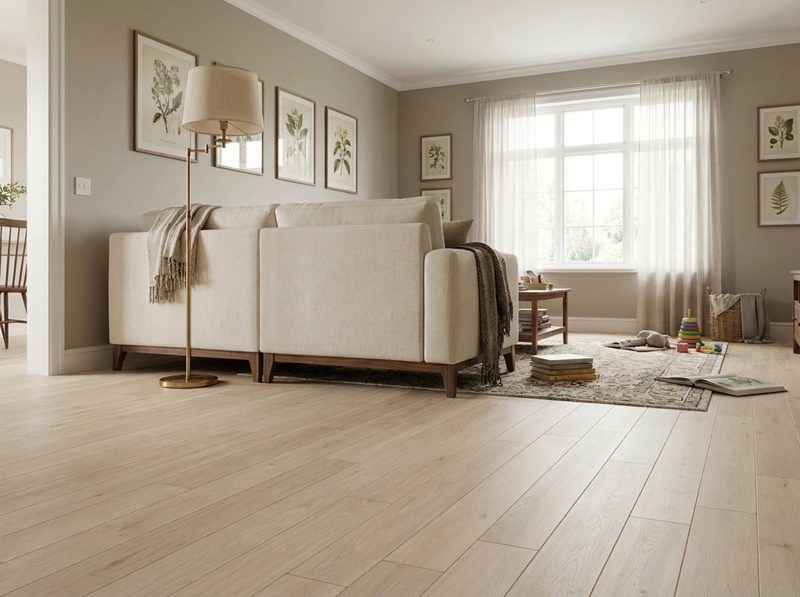
Engineered wood construction
How is engineered wood flooring built?
Engineered wood flooring is a genuine hardwood face bonded to a stabilizing core, with a thin backing layer balancing the sandwich. It is real wood on top, not a printed picture of it. Two decisions separate one plank from another: whether the face was peeled, sliced or sawn off the log, and which core the tongue or click profile was milled into.
Two planks can carry the same species name, the same stain and the same rack position, and not be the same floor at all. The difference is never on the front of the display. It sits in how the face came off the log and in what the joint was cut into, and both of those are settled at the mill long before anybody prints a label.
The layer stack, in one paragraph
An engineered plank is a genuine sawn hardwood face over a core of cross laminated plies or dense fiberboard, with a thin balancing layer underneath so the sandwich pulls against itself evenly and the board lies flat. That parts list, top to bottom, is laid out in full on what engineered hardwood is made of, and the question of whether the surface is genuine wood rather than a printed image is settled on is engineered hardwood real wood. The category page covers what the construction lets a floor do and which lines sit on our showroom floor. What follows is the part none of those settle: the two build decisions that separate one engineered plank from the one lying beside it.
The face, and how it came off the log
This is the decision that determines whether a plank reads as real wood once it is down in your room, and it is almost never printed on the display.
- Rotary peeled. The log is spun against a fixed blade and a continuous sheet comes off it, the way a paper towel unrolls. It is the most efficient way to get face material, and it produces a wide, swirling figure that does not look like a sawn board, because it is not one.
- Sliced. A block of wood is sliced flat, one leaf at a time. The grain lands much closer to what a saw would have given you, with far less of the peeled swirl.
- Sawn face. Cut with a saw, exactly the way a solid board is cut. You get genuine plainsawn, riftsawn or quartersawn figure, including the ray fleck people buy white oak for. It wastes the most wood, and it is the build that behaves like a solid floor at the surface.
The tell is repetition. A peeled face is unrolled from the log as one continuous ribbon, so the same knot, the same swirl and the same color break come back around a few courses later, and the effect only appears once several boards are together. Ask for more than one sample and lay them end to end before you decide anything about a floor you have only seen as a single board.
Why the cut still matters years later
Peeling a log means flattening a curved sheet of wood, and flattening it opens fine cracks on the face that was against the knife. Those lathe checks are invisible on a new board under a fresh finish. As the floor takes moisture in and gives it back over years, they can telegraph through as faint hairlines running with the grain, which is why a peeled face and a sawn face of the same species can age very differently in the same room.
The cut also sets what a future refinish has to work with. A sawn face sands like the solid board it was cut from. A peeled face is thinner in most builds and its checks sit nearer the surface, so an aggressive sanding finds them. Whether a sanding is available to you at all is a separate piece of arithmetic, and it is worked through on the veneer thickness page.
The core and the joint are one decision
Plywood and dense fiberboard cores both stabilize a plank, both are legitimate, and the parts list page sets them against each other. What that comparison leaves out is that the core is also the material the joint is cut into, so the profile and the core get engineered together rather than picked separately.
A tongue and groove milled into stacked wood plies is being cut across layers of real grain, so the tongue has a grain direction and the profile has to respect it. A click profile milled into a dense, uniform sheet can carry a much finer geometry, because there is nothing in the material to split along. That is why a locking system is designed around one particular core rather than bolted onto any plank, and why a manufacturer specifies one installation method and rules the others out. Core density is the specification sitting behind how well that profile holds its shape.
It also explains a failure that usually gets blamed on the installer. Force a click profile together on a core that is too soft for it, or over a subfloor that is not flat, and the shoulder of the joint crushes instead of latching. The floor looks right on the day it goes down and opens at a seam a season later.
What the construction fixes and what it leaves alone
It fixes dimensional movement. That is the reason genuine wood can go over a slab, over radiant heat and on a level below grade, and it is why engineered hardwood can be milled far wider than a solid board without the seasonal drama a wide solid plank brings.
It does not make wood waterproof, it does not flatten a subfloor, and it does not excuse acclimation. Moisture arriving from below still reaches a board unevenly, which is what a vapor retarder or a moisture control adhesive exists to stop, and the slab itself gets tested rather than assumed to be dry.
It also does not make every engineered plank equivalent. A sawn face over a thick plywood core and a thin peeled face over a light core are both correctly called engineered hardwood, and they are not the same floor. Which one belongs in your house starts with what is under the room right now. Bring a photo and tell us whether it sits on joists or on concrete, and if it is concrete, whether anything has ever come up through it. Call 636-332-0654 and we will start there rather than at the color.
What else people ask about the build
What a cut end reveals, why some floors repeat, and what the face cut does to a future refinish.
636-332-0654Partly. Look at the end of a sample and you can usually see whether the core is stacked plies or one dense sheet, and roughly how thick the wood on top is. What the end grain will not tell you is whether the face was peeled, sliced or sawn, which is why looking across several boards for a repeating figure is worth the minute it takes.
Because the face came off the log as one continuous ribbon rather than as separate boards. A rotary peeled sheet is unrolled from the log in a single pass, so the same knot, the same swirl and the same color break turn up again a few courses later. Sliced and sawn faces come off as discrete pieces, which is why they read closer to a solid floor across a long run.
It can. A sawn face sands like the solid board it was cut from, because it is one. A peeled face carries fine checks opened when the sheet was flattened off the log, and a hard sanding can bring those nearer the surface than anyone wants. How many sandings a plank has in it at all is a thickness question rather than a cut question, and it has its own page.
The subfloor decides the construction
Whether a plywood core, a dense fiberboard core or a sawn face plank suits your house is a question about what is underneath it. The subfloor or the slab gets checked at the free in-home measure, and the build gets chosen from what the meter reads.
Free in-home measure
636-332-0654